TEHRAN, — The war involving Iran, the United States and Israel, which began with U.S.-Israeli strikes on Iran on February 28, 2026, has placed additional pressure on an Iranian economy that was already struggling with high inflation, currency depreciation, sanctions, weak job creation and shortages of water and energy.
The conflict has disrupted trade, damaged infrastructure, complicated imports and exports, and weakened household purchasing power. The effects are increasingly visible in the prices of food, medicines, household goods and other daily necessities, while businesses and workers are also facing declining demand and fewer employment opportunities. The World Bank says economic activity has been severely disrupted by the conflict, sanctions and social unrest, with import disruptions adding inflationary pressure and increasing food-security risks.
Importantly, the war did not create all of Iran's economic problems. Many of the pressures were already present before February 28 because of long-running sanctions, inflation, currency weakness, structural economic problems and energy shortages. The conflict has amplified those existing problems.
Food prices have risen sharply
Food has become one of the most visible areas of pressure on Iranian households.
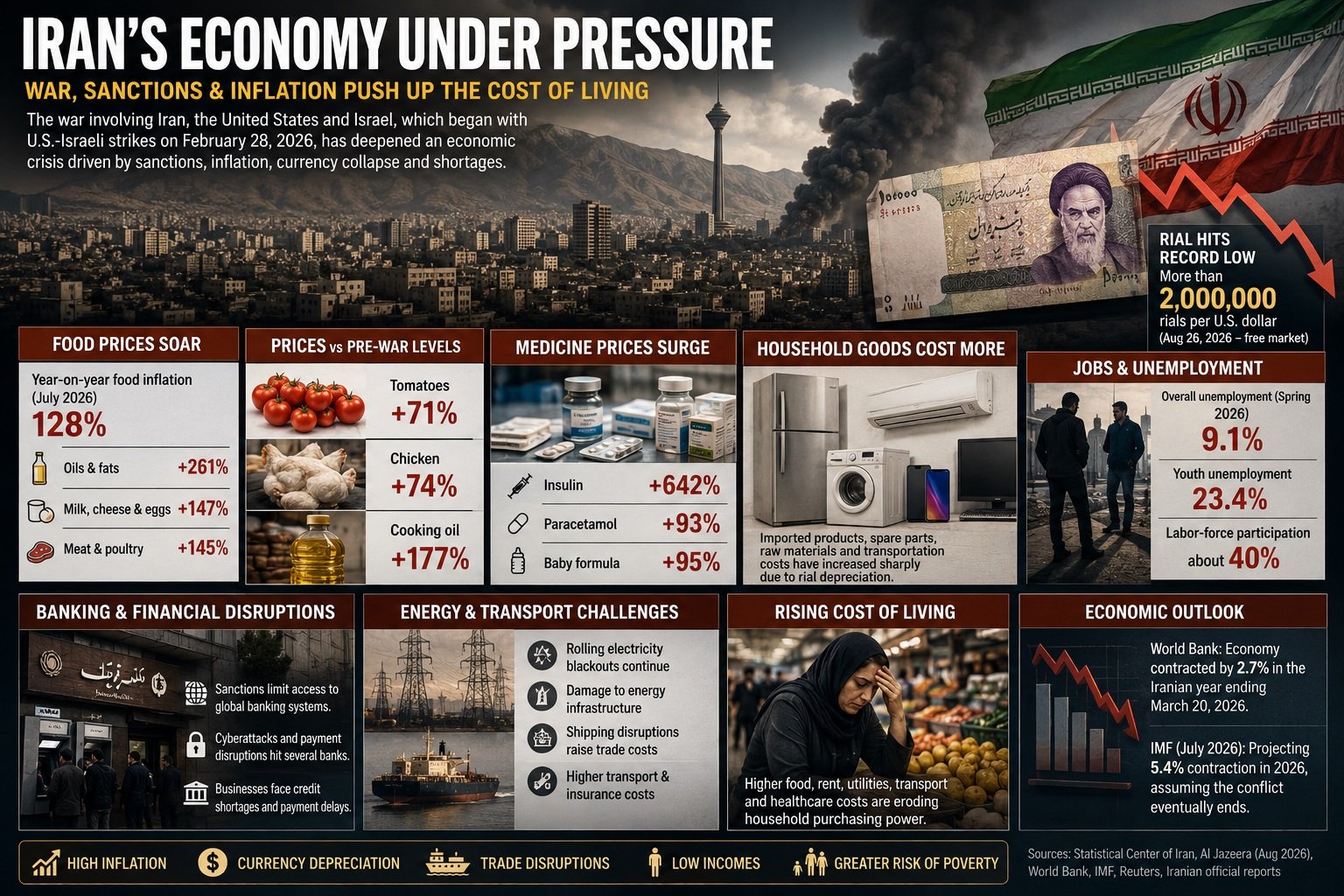
According to Iran's Statistical Center, year-on-year food inflation reached about 128% in July 2026. Within major food categories, prices of oils and fats were about 261% higher, milk, cheese and eggs about 147% higher, and meat and poultry about 145% higher than a year earlier.
A comparison of prices immediately before the war with prices in August shows how much purchasing power has been lost. An Al Jazeera comparison found that tomato prices had risen 71%, chicken 74% and cooking oil 177% compared with the period before the war.
The result is not simply higher grocery bills. Families are changing what they buy. Some households have reduced or eliminated meat, chicken and other higher-cost foods as their incomes fail to keep pace with prices.
Bread and other staples
Bread remains subject to government controls and subsidies, but prices have also increased. In Tehran, regulated bread prices were nearly doubled in an official adjustment earlier this year.
The cost of staple foods had already been rising before the war. The Center for Strategic and International Studies reported that wheat-flour prices had increased substantially even before the conflict, while subsidized bread shortages and long queues were already appearing in some areas.
Household goods and everyday products
The fall of the rial has made imported products and goods dependent on imported components significantly more expensive.
The Iranian rial reached a record low of more than 2 million rials per U.S. dollar on the free market on August 26, increasing the local-currency cost of imported products and materials.
This affects a wide range of everyday products, including:
- Smartphones and computers
- Refrigerators and washing machines
- Air conditioners and electrical appliances
- Spare parts and repair services
- Personal-care products
- Cleaning products
- Clothing and footwear
- Imported components used by Iranian manufacturers
The problem extends beyond the original price of imported goods. Businesses also face higher costs for raw materials, transportation, replacement parts and financing. Those costs eventually reach consumers.
For retailers, however, simply raising prices is not always possible because customers themselves have less purchasing power. Iranian businesses have therefore faced the difficult combination of higher operating costs and weaker consumer demand. A Tehran retailer interviewed by Al Jazeera reported that his sales had fallen by about 40% compared with the previous year.
Jobs and unemployment
The economic impact is also appearing in the labor market.
Iran's overall unemployment rate was 9.1% in spring 2026, according to the Statistical Center of Iran, while youth unemployment reached 23.4%, 3.7 percentage points higher than a year earlier. Labor-force participation was only about 40%, meaning a large proportion of working-age people were outside the official labor force.
The conflict has affected employment through several channels.
Businesses dependent on imports face difficulties obtaining supplies. Manufacturers face energy and transportation disruptions. Retailers are dealing with lower sales. Tourism and other service businesses have also been affected by the wider security and economic environment.
Some workers are responding by accepting longer working hours or jobs outside their professional qualifications. Reports from Tehran describe employers offering low salaries, long working hours and, in some cases, jobs without insurance.
The result is a growing gap between income and the cost of basic living.
Iran's minimum wage for the current Iranian year was raised by 60%, but inflation has rapidly eroded the value of that increase. The government-approved minimum wage is about 166 million rials per month, with benefits taking the total for eligible workers to less than 220 million rials.
Banking and financial disruptions
Iran's banking system is facing pressure from both longstanding international financial restrictions and new wartime disruptions.
U.S. sanctions have restricted Iran's access to international banking and payment systems for years. Even products such as medicines, which can be exempt from sanctions under humanitarian rules, can become difficult to purchase because banks and international suppliers may be unwilling or unable to process transactions.
The conflict has added another layer of disruption.
Reports in 2026 have described banking disruptions following major cyberattacks, including attacks that disrupted services at several Iranian banks. Businesses have also faced difficulties obtaining credit and dealing with payment delays. The disruption makes it harder for companies to import raw materials, pay suppliers and maintain normal operations.
The weakness of the rial creates another problem. When the currency loses value rapidly, businesses must pay more rials for imported goods and components, while households see their savings and salaries lose purchasing power.
Medical care and medicine
Healthcare is another area where the economic crisis is directly affecting ordinary people.
Iran's pharmaceutical system already faced problems before the war because of sanctions, currency instability, banking restrictions and difficulties obtaining imported raw materials and medical equipment. The conflict has added transportation and supply-chain problems and has damaged parts of the health infrastructure.
The price increases reported in August illustrate the scale of the problem. Compared with the period immediately before the war, Al Jazeera found that the price of insulin had increased by about 642%, paracetamol by about 93%, and baby formula by about 95%.
Higher prices are only part of the problem. Hospitals and pharmacies also need reliable supplies of medicines, medical equipment and imported production materials. Restrictions on international payments can delay procurement even when the products themselves are not formally prohibited.
A recent analysis published in the International Journal for Equity in Health found that sanctions and financial restrictions have affected procurement, healthcare financing, medical technology, workforce capacity and continuity of care.
The 2026 conflict has increased those vulnerabilities. Humanitarian assessments reported damage to healthcare facilities and additional pressure on medical services during the fighting.
Energy and transportation
Iran is also dealing with electricity and energy shortages.
Power disruptions existed before the current conflict, but damage to energy infrastructure and industrial facilities has made the situation more difficult. The House of Commons Library reports continuing rolling electricity blackouts and difficulties meeting domestic petrol demand.
Energy shortages affect much more than household electricity bills. Factories need electricity to operate, businesses need reliable power to provide services, and interruptions can reduce production and employment.
Transportation has also become more difficult because of disruptions around the Strait of Hormuz, a major route for Iranian trade. Higher shipping, insurance and transportation costs increase the cost of imported goods and can also make exports more difficult.
Housing and household budgets
Housing costs have also added to the pressure.
Reports from Iran indicate significant increases in rents, with some households negotiating with landlords simply to limit the size of annual increases. At the same time, utilities, transportation, food and healthcare are consuming a larger share of household income.
This creates a wider cost-of-living problem: even when a household continues to have employment, its real purchasing power can fall rapidly.
A worker may receive a nominal salary increase, but if food, rent, medicine and transportation rise faster, the worker can still afford less than before.
What has changed for ordinary Iranians?
The economic impact can be summarized across several areas:
| Area | Effect on ordinary people |
|---|---|
| Food | Very large increases in food prices; families reducing meat and other expensive foods |
| Household goods | Imported products and equipment becoming substantially more expensive |
| Medicine | Sharp increases in prices of some medicines and greater supply difficulties |
| Employment | Higher unemployment, particularly among young people |
| Wages | Nominal wage increases losing value rapidly because of inflation |
| Banking | Payment, credit and international transaction difficulties |
| Healthcare | Higher costs, procurement problems and pressure on medical facilities |
| Electricity | Continuing power shortages and disruptions |
| Transport | Higher costs and disruption to trade routes |
| Businesses | Higher raw-material costs combined with weaker consumer demand |
| Currency | Rial depreciation dramatically reducing purchasing power |
| Poverty | Greater risk as food inflation and import shortages reduce real incomes |
The conflict is worsening an existing economic crisis
Iran's current economic situation therefore cannot be attributed entirely to the war.
Before February 28, Iran was already dealing with international sanctions, a weak rial, high inflation, low job creation, energy shortages and structural economic problems. The conflict has added damage to infrastructure, trade disruptions, restrictions on shipping and additional pressure on imports and exports.
The World Bank expects high inflation and falling real incomes to suppress domestic demand, while disruptions to imports create additional food-security risks. It also estimates that Iran's economy contracted by 2.7% in the Iranian year ending March 20, 2026, with the conflict and trade disruptions contributing to the deterioration.
The IMF's July 2026 projection was for Iran's economy to contract 5.4% in 2026, assuming the conflict eventually ends, according to the House of Commons Library.
For ordinary Iranians, the most immediate consequence is therefore not simply a change in one commodity's price. It is the combined deterioration in purchasing power, employment, access to healthcare, business activity and the ability to afford basic household necessities.
The Iranian economy has not completely collapsed, and shops in major cities can still have supplies. But the combination of very high inflation, currency depreciation, disrupted trade and declining real incomes means that having goods available does not necessarily mean that ordinary households can afford them.
——— End of Article ———