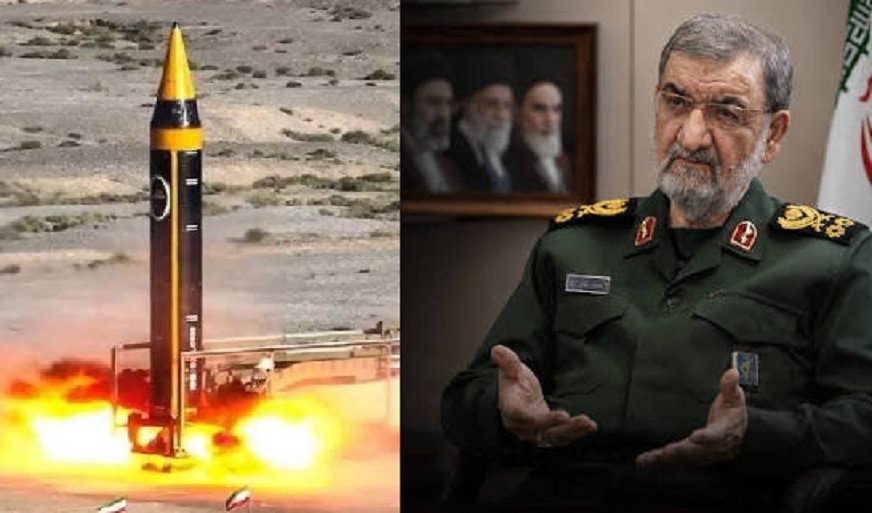
TEHRAN, Iran — Iran prepared retaliatory missile strikes against three locations in Ukraine following the July 25 attack on a vessel in the Caspian Sea, but suspended the planned operation after diplomatic communications with Kyiv, according to a senior Iranian official.
General Mohsen Rezaei, an adviser to Iran's Supreme Leader, said during an appearance on Iranian state television that Iran's armed forces had completed preparations for the strikes. He stated that the operation was halted after Ukrainian officials reportedly said the attack on the Iranian vessel had been unintentional.
"We were prepared to strike three locations in Ukraine, but after they said the attack had been a mistake, we put our response on hold to assess their claim," Rezaei said.
He added that the retaliatory operation was ultimately called off. Rezaei did not identify the three intended targets or provide evidence supporting his claims. His statements have not been independently verified.
Caspian Sea Incident
The planned response followed a military operation in the Caspian Sea on July 25, which has become the center of a dispute between Iran and Ukraine.
Iran said Ukraine attacked an Iranian commercial vessel carrying civilian cargo, causing an explosion that killed one sailor and injured another. Tehran condemned the incident as a violation of international law and said attacks on Iranian citizens and interests were unacceptable.
Ukraine presented a different account of the operation.
President Volodymyr Zelensky and Ukraine's Security Service (SBU) confirmed that Ukrainian Defense Forces conducted long-range strikes in the Caspian Sea. According to the SBU, the operation targeted the Russian missile boat Molnyia along with two cargo ships, Port Olya 2 and Begey, which Ukraine said were operating under international sanctions.
Ukraine stated that the vessels were transporting Iranian-made missile and drone components intended for Russian forces. Separate reports identified one of the ships involved as the Iranian-owned cargo vessel Ana.
Kyiv maintained that its military operation targeted vessels involved in transporting military cargo rather than civilian shipping.
Diplomatic Contacts Followed the Incident
Diplomatic efforts began soon after the July 25 operation.
On July 28, Ukrainian Foreign Minister Andrii Sybiha spoke by telephone with Iranian Foreign Minister Abbas Araghchi.
According to Iranian officials, Araghchi formally protested the strike and told Ukraine that Iran expected compensation for the damage and casualties. Iranian officials also said Ukraine described the incident as unintentional during the diplomatic exchanges, which prompted Tehran to suspend its planned military response.
Sybiha later described the call as a "frank conversation" and said Ukraine's military operations are conducted solely in defense against Russian aggression and are not intended to target civilian vessels or civilians.
Ukraine has not publicly confirmed or denied the specific Iranian claim that it apologized or formally acknowledged the incident as a mistake beyond the statements made following the foreign ministers' discussion.
Both sides indicated during the diplomatic contacts that they did not seek further escalation.
Missile Capability
If Iran had decided to carry out the planned operation, several of its ballistic missile systems have the theoretical range to reach Ukrainian territory.
According to the CSIS Missile Defense Project infographic published in March 2026, Iranian missile systems including the Sejjil, Emad, Ghadr-110, Shahab-3, and Khorramshahr-2 have the range to reach Ukraine. Such missiles would present a significant challenge for Ukraine's existing air defense network if employed.
However, there is no independent confirmation that any missile operation was actually prepared beyond the statements made by General Rezaei.
Previous False Strike Claims
This is not the first time reports of Iranian strikes on Ukraine have appeared publicly.
In April 2026, Iranian propaganda outlets circulated videos claiming that Iran had launched missile strikes against Kyiv, Kharkiv, and Dnipro. The footage was later identified as AI-generated, and no such strikes occurred.
Wider Context
The Caspian Sea has become an important transport route linking Iran and Russia.
Analysts from the Armed Conflict Location & Event Data Project (ACLED) have noted that Ukraine has increasingly targeted Russian-linked maritime and oil infrastructure since May as part of efforts to disrupt Moscow's wartime logistics. The Caspian Sea shipping route has been identified as one of the supply corridors connecting Iran and Russia.
Iran and Russia have also expanded military cooperation in recent years. Tehran has supplied technology and components used in the production of Shahed attack drones, which Russian forces continue to use in strikes against Ukraine.
For now, Iran's reported plans to strike Ukraine remain based solely on statements made by General Mohsen Rezaei on Iranian state television. No independent evidence has been presented to confirm that preparations for such an operation were completed, and Ukrainian authorities have not publicly confirmed the specific Iranian account of the diplomatic exchanges.
——— End of Article ———