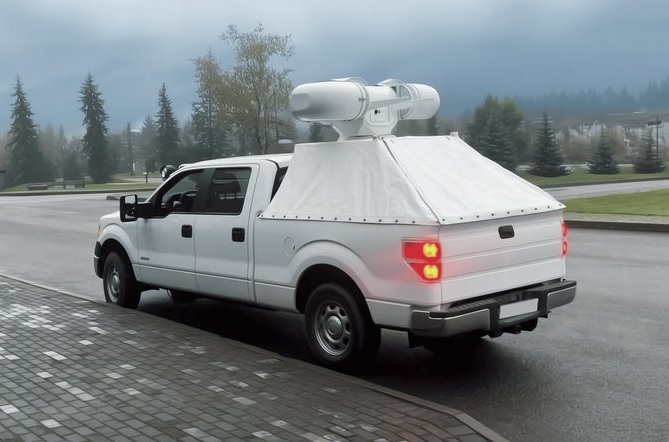
MOSCOW / NIZHNY NOVGOROD, Russia — May 23, 2026 : Russian technology firm Inferit Security, operating within the Softline Group ecosystem, has unveiled a laser-based anti-unmanned aerial vehicle (UAV) system designed specifically for the civilian sector. The system was presented on May 19, 2026, during the CIPR (Digital Industry of Industrial Russia) conference, with the company describing it as the first fully domestically developed and manufactured laser complex of its kind in Russia.
The newly introduced system is intended to protect industrial facilities, transport infrastructure, energy installations, and other critical civilian assets against drone threats. According to Inferit Security, the laser complex is designed for deployment at fuel and energy sector facilities, nuclear and hydroelectric power plants, logistics hubs, manufacturing sites, and densely populated infrastructure zones where minimizing collateral damage is essential. The system can operate autonomously or function as part of a layered air-defense and security network integrated alongside traditional air-defense and electronic warfare systems.
Technical Design and System Capabilities
Inferit Security stated that the laser complex operates through an integrated combination of radar, optical-electronic sensors, thermal imaging systems, LiDAR technology, and artificial intelligence-assisted software to detect, track, and neutralize UAV threats.
The system’s standard configuration includes a 3-kilowatt (kW) laser module, while the company plans to expand output capability to 12 kW without altering the external dimensions or structural form factor of the platform. The transmitting unit incorporates a dedicated refocusing mechanism and precision beam-positioning technology, reportedly maintaining an error margin of approximately 2 centimeters at a range of 1,000 meters.
According to the developer, the system achieves a destruction accuracy exceeding 90 percent against copter-type UAVs. The platform is also designed to counter drones operating in autonomous flight mode, radio-controlled UAVs employing frequency-hopping technology, and systems controlled through fiber-optic communication links.
The laser complex can reportedly operate continuously for up to 100 seconds, while average engagement time against small UAVs ranges between three and five seconds, depending on target type and operational conditions.
Three-Stage Operational Process
Inferit Security stated that the laser complex neutralizes aerial threats through a sequential three-stage operational process involving detection, tracking, and engagement.
During the detection phase, an integrated radar system scans surrounding airspace and identifies UAVs at distances of up to 3,000 meters, simultaneously registering target coordinates, speed, altitude, direction, and trajectory data.
In the tracking and identification phase, optical-electronic systems functioning across visible and infrared spectrums assume responsibility for target recognition and monitoring. These systems, supported by thermal imaging equipment, a video surveillance module, LiDAR complex, and laser rangefinder, continuously track objects at distances ranging from approximately 2,000 meters to 200 meters.
The final engagement phase begins once the UAV enters direct line of sight at distances of up to 1,000 meters. The laser module can apply either functional suppression, intended to blind or disable drone optics and onboard systems, or physical suppression, in which thermal energy is used to damage and neutralize the target.
For standard quadcopter-type drones, Inferit Security stated that neutralization may occur in roughly three seconds, depending on operational conditions and target exposure.
Cost Efficiency and Operational Advantages
A key operational characteristic highlighted by Inferit Security is the system’s economic efficiency. Since the platform relies on directed laser energy rather than missiles or kinetic interceptors, it possesses an effectively unlimited ammunition supply, removing the logistical constraints associated with conventional interception systems.
The company stated that the financial cost of a single engagement corresponds primarily to the electricity consumed during laser firing, significantly lowering operational expenses during sustained infrastructure protection missions.
Inferit Security also emphasized that the point-focused nature of laser engagement minimizes risks associated with falling debris, explosive fragmentation, or collateral structural damage. This characteristic is particularly relevant for deployment near sensitive facilities such as industrial plants, nuclear infrastructure, hydroelectric stations, and densely populated urban environments.
Launch of Dedicated UAV Countermeasures Center
Alongside the unveiling of the laser complex, Inferit Security announced the establishment of a dedicated UAV Countermeasures Center, intended to support physical infrastructure protection requirements beyond traditional cyber and information security measures.
According to the company, the center will deploy specialized teams responsible for evaluating industrial sites, conducting risk assessments, developing drone-threat models, and integrating laser counter-UAV technologies into existing security ecosystems.
Ivan Kireev, Managing Director of Inferit Security, stated that the project was developed in response to increasing market demand for practical infrastructure protection solutions suited to civilian-sector operations. He noted that the system was designed to provide operational cost efficiency, reduced collateral damage, compatibility with layered security systems, and technological independence from export restrictions.
Deployment Status
Inferit Security positioned the laser complex as a mobile and scalable solution intended for seamless integration into existing protection systems for civilian and industrial infrastructure. However, the company has not released information regarding serial production schedules, procurement agreements, deployment timelines, or confirmed contracts for operational use.
——— End of Article ———