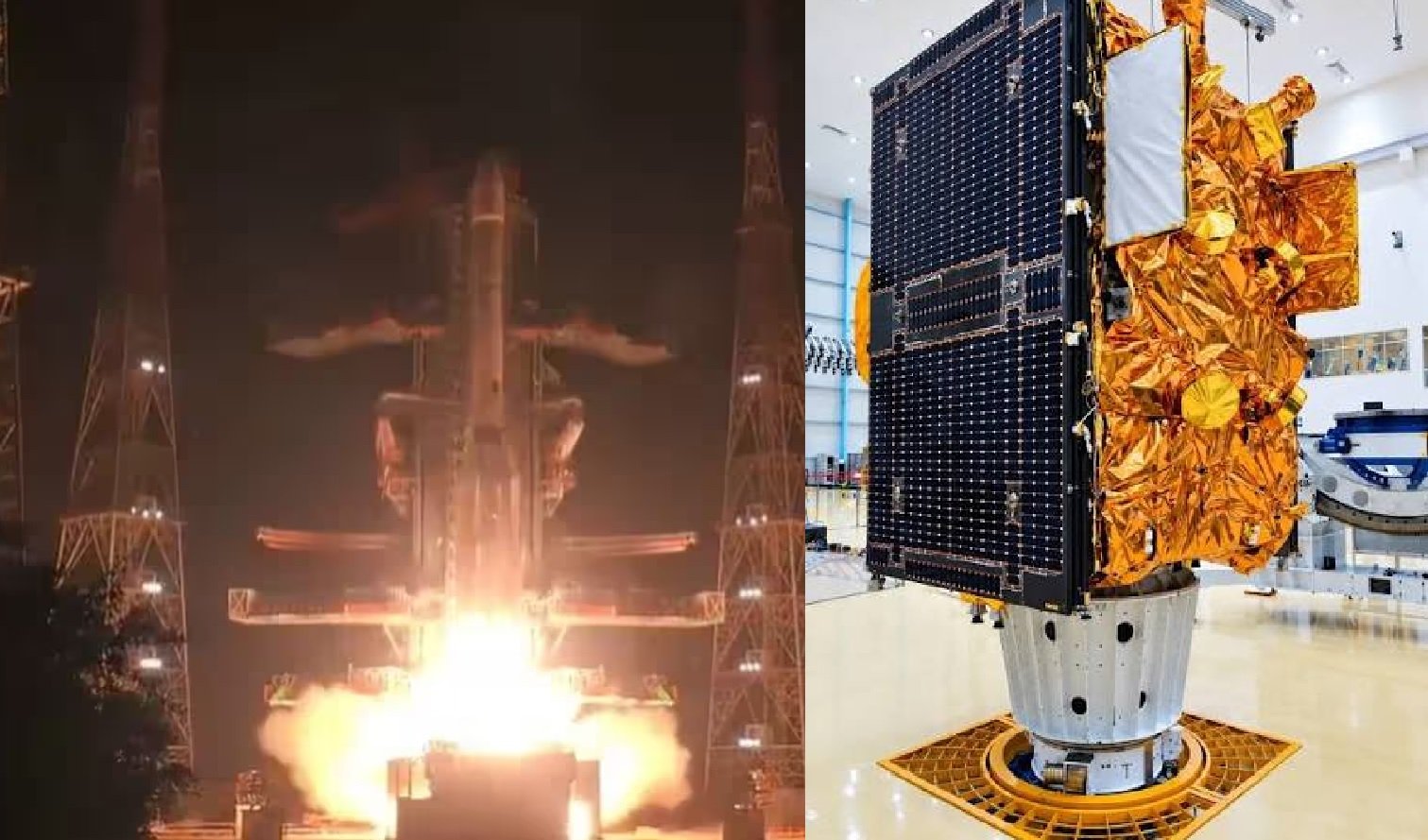
SRIHARIKOTA, — The Indian Space Research Organisation (ISRO) has successfully launched its next-generation navigation satellite NVS-03 aboard the GSLV-F18 rocket, strengthening India's indigenous Navigation with Indian Constellation (NavIC) system.
The rocket lifted off at 11:51 pm IST on October 30 from the Second Launch Pad at the Satish Dhawan Space Centre in Sriharikota. Approximately 18 minutes after launch, the 2,250-kg satellite was placed into its intended Geosynchronous Transfer Orbit (GTO).
ISRO Chairman V. Narayanan confirmed the successful mission, stating that the launch vehicle performed as expected and placed the satellite into orbit with high precision. The achieved orbit was approximately 170.3 km by 38,080 km.
The satellite's solar panels deployed successfully, and the spacecraft was reported healthy. NVS-03 will use its onboard propulsion system to reach its final operational orbit before beginning navigation services. The satellite has a designed mission life of 12 years.
NVS-03 Adds L1 Signal and Indigenous Atomic Clock
NVS-03 is the third satellite in ISRO's second-generation NVS series, developed to strengthen the Navigation with Indian Constellation (NavIC), formerly known as the Indian Regional Navigation Satellite System (IRNSS).
The satellite carries an indigenously developed rubidium atomic clock alongside procured atomic clocks. It also introduces the L1 frequency band in addition to the existing L5 and S-band signals.
The addition of L1 improves compatibility with a wider range of civilian navigation receivers, including smartphones and other low-power devices. NavIC provides coverage over India's landmass and a region extending approximately 1,500 km beyond India's geopolitical boundaries.
The system provides two services: the Standard Positioning Service for civilian users and a Restricted Service for authorised users.
NavIC Satellite Status: First and Second Generation
ISRO has launched 12 navigation satellites for NavIC, comprising nine first-generation IRNSS satellites and three second-generation NVS satellites, including NVS-03.
First-generation IRNSS satellites
The first-generation constellation consisted of IRNSS-1A to IRNSS-1I.
-
IRNSS-1A: Launched in July 2013. Its atomic clocks failed, limiting its navigation capability.
-
IRNSS-1B: Launched in April 2014 and remains operational for Positioning, Navigation and Timing (PNT).
-
IRNSS-1C: Launched in October 2014. Its atomic clocks failed.
-
IRNSS-1D: Launched in March 2015; subsequently decommissioned.
-
IRNSS-1E: Launched in January 2016. Its atomic clocks failed.
-
IRNSS-1F: Launched in March 2016; its atomic clock failed in March 2026 after completing its designed 10-year mission life.
-
IRNSS-1G: Launched in April 2016. Its atomic clocks failed.
-
IRNSS-1H: Launch attempt in August 2017 failed after the payload fairing did not separate.
-
IRNSS-1I: Launched in April 2018 and remains operational for PNT services.
Several first-generation satellites experienced failures of their imported rubidium atomic clocks, supplied by SpectraTime, a company based in Switzerland. These failures reduced the number of satellites available for full navigation services.
Second-generation NVS satellites
-
NVS-01: Launched in May 2023. It is operational for PNT services and was the first NavIC satellite to carry an indigenous atomic clock and the L1 signal.
-
NVS-02: Launched in January 2025. It reached its transfer orbit but could not reach its final operational orbit due to a propulsion system issue involving a pyrotechnic valve.
-
NVS-03: Launched on October 30, 2026. It has successfully reached its transfer orbit and is expected to join the operational constellation after orbit-raising manoeuvres and commissioning.
Following NVS-03's successful launch, IRNSS-1B, IRNSS-1I and NVS-01 are the three previously operational satellites providing full PNT services. NVS-03 is expected to restore NavIC to its minimum operational configuration once commissioned.
Why NavIC Needs Four Satellites for Accurate Positioning
A satellite navigation receiver calculates its position by measuring the time taken for signals to travel from satellites to the receiver.
For standalone three-dimensional positioning, a receiver generally requires signals from at least four operational navigation satellites. These measurements allow it to calculate latitude, longitude, altitude and correct its own clock error.
NavIC's designed full constellation consists of seven satellites, providing continuous regional coverage and improved availability and redundancy.
The system supports applications such as vehicle tracking, railway navigation, maritime operations, disaster management, precision agriculture and strategic services.
ISRO Develops Indigenous Atomic Clock Technology
Atomic clocks are critical to satellite navigation because even a small timing error can produce a significant positioning error.
The first-generation IRNSS satellites relied on imported rubidium atomic clocks supplied by SpectraTime, a company based in Switzerland. Repeated failures of these clocks affected the availability of navigation services and reduced the number of satellites capable of providing full Positioning, Navigation and Timing (PNT) services.
To reduce dependence on foreign suppliers, ISRO's Space Applications Centre (SAC) in Ahmedabad developed an indigenous rubidium atomic frequency standard, known as IRAFS or iRAFS.
NVS-01 was the first NavIC satellite to carry an indigenous atomic clock, while NVS-03 continues the use of this technology alongside procured clocks.
The development of indigenous atomic clocks is an important step toward strengthening India's independent navigation and timing capabilities for civilian and strategic applications.
The successful GSLV-F18 mission supports ISRO's efforts to restore NavIC's operational strength and improve its reliability. NVS-03 will begin providing navigation services after reaching its final operational orbit and completing commissioning.
——— End of Article ———