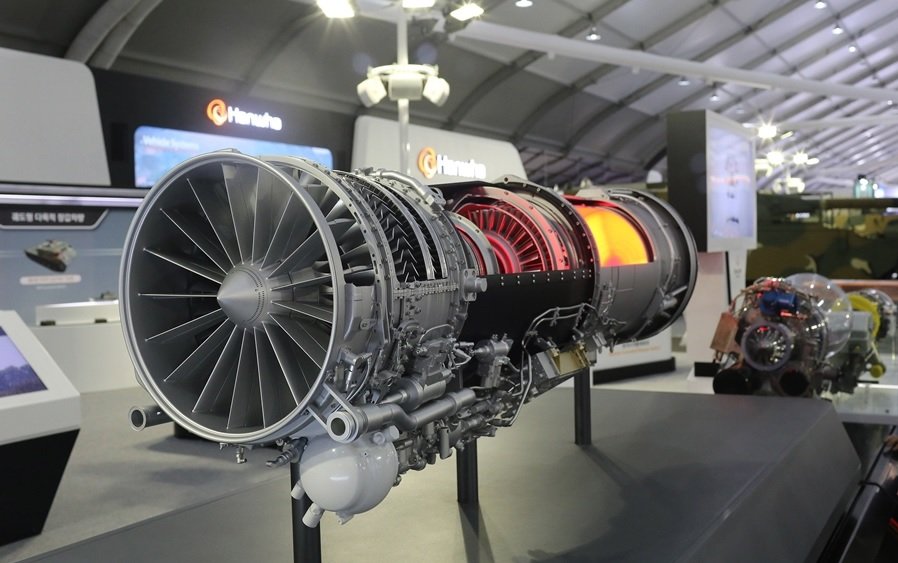
SEOUL, South Korea — Hanwha Aerospace has been selected as the preferred bidder to develop South Korea’s domestically designed 10,000-pound-force (lbf) class high-bypass turbofan engine. The 177.3-billion-won ($133 million) programme is led by the Agency for Defense Development (ADD), with development scheduled until October 2031.
The engine is intended to power a low-observable reconnaissance unmanned aerial vehicle (UAV). It will focus on improved fuel efficiency, high-temperature performance and an operational life spanning thousands of hours.
Hanwha will handle the complete development process, including detailed design, core-component manufacturing, assembly, production of four prototype engines, testing and evaluation.
One of the main targets is to achieve South Korea's highest turbine inlet temperature (TIT) in a domestically developed engine. The programme will also introduce high-bypass-ratio technology to improve propulsion efficiency and reduce fuel consumption. Hanwha has proposed a lightweight design to improve aircraft range, payload capacity and fuel efficiency.
Building on Existing Engine Technology
The programme will build on technologies from the 5,500-lbf-class turbofan currently under development by Hanwha and ADD. Its core includes a high-pressure compressor, combustor and high-pressure turbine.
Hanwha plans to use this foundation to increase thrust beyond 10,000 lbf while improving heat resistance, durability and lightweight construction. The programme could also provide a technological base for developing engines in different thrust categories.
South Korea is also developing a 1,400-horsepower-class turboprop engine alongside its 5,500-lbf turbofan programme for domestic aircraft applications.
Potential Application in Future Fighter Engines
Hanwha aims to apply technologies developed through the programme, including high-temperature materials, improved turbine performance, longer engine life and lightweight engineering, to future propulsion systems.
These advances could potentially support more advanced aircraft programmes, including the KF-21 Block 3. However, the 10,000-lbf engine is being developed for a reconnaissance UAV and has not been confirmed as a future KF-21 engine.
The programme is an important step in South Korea's efforts to strengthen its domestic aircraft engine industry and reduce dependence on foreign propulsion technology.
——— End of Article ———