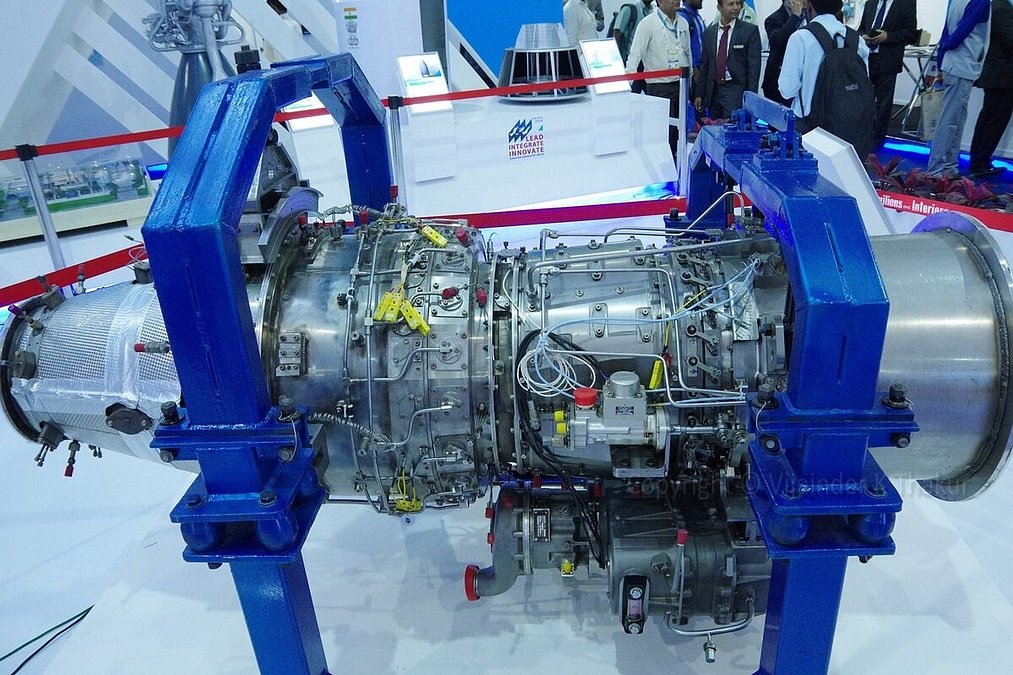
BENGALURU — Hindustan Aeronautics Limited (HAL) has achieved a new development milestone in its indigenous HTFE-25 (Hindustan Turbo Fan Engine) programme, with the engine's core successfully reaching 99.5% of its maximum speed during acceleration trials. The achievement marks further progress in the development of India's 25 kN thrust-class turbofan engine, which is being designed for military and civil aviation applications.
According to HAL's latest Directors' Report, the company has so far built two core engines and one full-engine technology demonstrator under the programme. The core engine has completed light-up, acceleration, and speed trials up to 99.5%, while additional development trials are continuing.
The HTFE-25 is a low-bypass turbofan engine being designed and developed by HAL's Aero Engine Research and Design Centre (AERDC) in Bengaluru. The engine is intended to power basic and advanced military trainer aircraft, small business jets, and large unmanned aerial vehicles (UAVs).
HAL states that the engine can be used in two different aircraft configurations. In a single-engine configuration, it is designed for aircraft in the 5-ton weight class, while a twin-engine configuration is intended for aircraft weighing up to the 9-ton class.
The HTFE-25 has a length of 1,730 mm, a diameter of 590 mm, and a dry weight of approximately 350 kg. It is designed to produce 25 kN of dry thrust and features a bypass ratio of 0.5, an air mass flow of 43 kg/s, and a thrust-to-weight ratio of around 7.27.
As part of its development, HAL has incorporated 3D-printed Ti-6Al-4V components, a titanium alloy commonly used in aerospace applications because of its high strength and low weight.
The engine programme has undergone several stages of testing since the first successful core engine run on December 14, 2015. Development activities have included sea-level performance trials, cold-weather starting tests, and hot-weather high-altitude trials at Leh. HAL has also built and successfully operated a full-engine technology demonstrator.
Earlier acceleration trials had reached about 55% of the engine's rated speed. The latest achievement of 99.5% speed represents a significant advance in the core engine evaluation process. HAL stated that sea-level performance trials on the core engine have also been completed satisfactorily, while further testing remains in progress.
The company has also explored afterburner integration, with basic afterburner tests conducted during earlier stages of development.
HAL estimates the potential market for the HTFE-25 at 200 to 250 engines, based on its technical feasibility assessment. The programme is supported by a dedicated design and testing facility at AERDC, inaugurated in late 2023, which includes specialised test beds for accelerated engine development and evaluation.
The HTFE-25 programme is part of HAL's wider indigenous aero-engine development efforts, alongside projects such as the HTSE-1200 turboshaft engine.
According to HAL, development and certification work on the HTFE-25 is continuing. Based on the company's latest updates, flight-worthiness testing and final certification are currently targeted within the next four to five years.
The successful progress of the HTFE-25 programme is expected to strengthen India's indigenous aero-engine development capability and provide a domestically developed propulsion option in the 25 kN thrust class for future aviation platforms.
——— End of Article ———