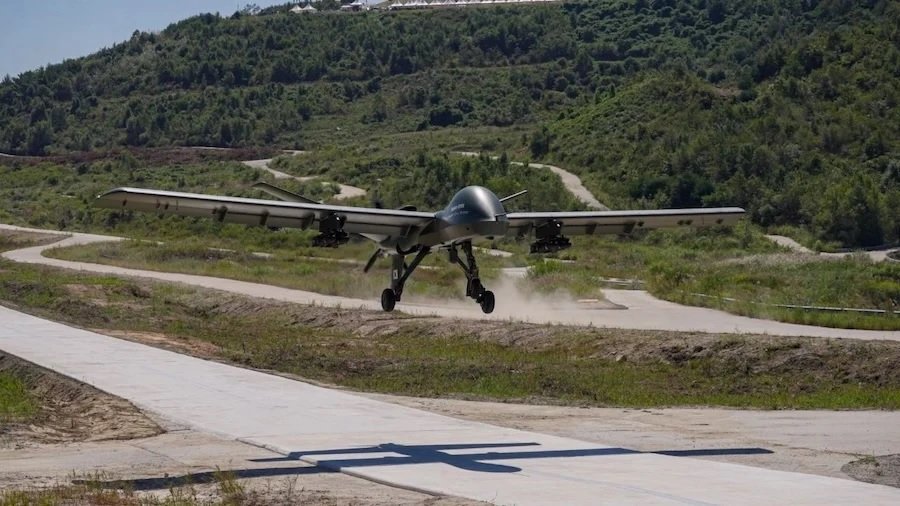
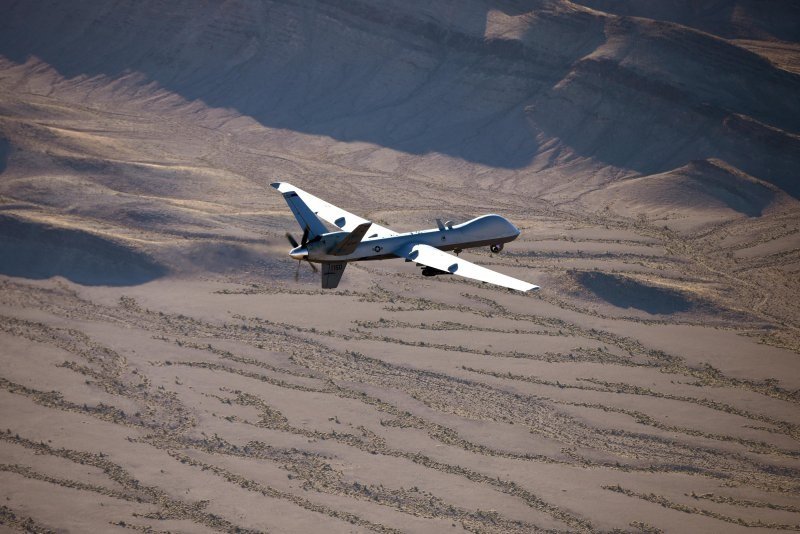
ABU DHABI, — May 21, 2026 : A French Army Leclerc main battle tank assigned to the 5th Cuirassier Regiment successfully destroyed an aerial drone during live-fire trials conducted at Zayed Military City in Abu Dhabi, demonstrating a short-range anti-drone capability using the tank’s standard 120 mm main gun ammunition.
The engagement, confirmed on May 20 by the French Military Governor of Strasbourg and commander of the 2nd Armored Brigade, was carried out using the 120 mm OEFC F1 canister round. The tests were conducted to evaluate whether existing armored vehicles could counter low-cost aerial threats such as FPV drones and loitering munitions without requiring external modifications or additional dedicated systems.
The trials reflect a wider operational shift among Western militaries as armored formations adapt to the growing threat posed by small unmanned aerial systems observed extensively in the Russia-Ukraine war and recent Middle East conflicts.
Live-Fire Trials Conducted in Abu Dhabi
The testing campaign took place at Zayed Military City, where the French Army’s 5th Cuirassier Regiment has maintained a permanent deployment since June 2016. The regiment operates under the authority of the 2nd Armored Brigade and serves as France’s standing armored formation in the Gulf region.
According to French military officials, the engagement conditions were intentionally designed to exceed the parameters commonly encountered during recent combat operations. The drone targets approached from perpendicular angles, creating high angular-speed tracking challenges for the tank crew.
Additional testing conditions included erratic drone flight paths, smaller target dimensions, and engagement altitudes higher than those typically associated with FPV drone attacks.
Military personnel involved in the trials noted that lateral drone trajectories are particularly difficult to engage because they move rapidly across the gunner’s line of sight. The Leclerc’s stabilized gun-laying system, rapid turret traverse, and digital fire-control architecture enabled the crew to track and engage maneuvering aerial targets during the exercise.
OEFC F1 Canister Round Used for Drone Interception
The interception was achieved using the OEFC F1 (Obus Explosif à Effets Canalisés F1) round developed by KNDS France, formerly Nexter and GIAT Industries. The ammunition is fired from the Leclerc’s CN120-26/52 smoothbore cannon and uses the standard NATO 120×570 mm cartridge format.
Originally designed for close-range anti-personnel operations, trench clearing, convoy protection, and urban combat, the OEFC F1 operates through volumetric saturation rather than precision fragmentation.
Immediately after leaving the barrel, the round disperses approximately 1,100 tungsten balls in a widening cone toward the target area. The projectile has a muzzle velocity of approximately 1,410 meters per second and an effective engagement range of around 500 meters.
French Army assessments indicated that this dispersion pattern significantly increases hit probability against small and maneuvering drones by compensating for crew reaction delays and minor aiming inaccuracies.
Military officials noted that FPV drones and quadcopters require only limited structural damage to become inoperable. Damage to rotors, wiring, flight-control systems, or onboard stabilization components is often sufficient to neutralize the aircraft.
Although the Leclerc is equipped with an AANF1 7.62 mm machine gun, French military personnel stated that the 120 mm canister round provides a higher probability of interception against evasive low-altitude aerial targets.
However, officials emphasized that the capability is intended as an opportunistic self-defense measure and not as a replacement for dedicated short-range air defense systems.
Future Combat Command Oversaw the Trials
The tests were conducted under the French Army’s Future Combat Command (CCF), established on August 1, 2023, to accelerate doctrinal adaptation, battlefield experimentation, and integration of operational feedback.
The command is led by Army Corps General Bruno Baratz and reports directly to the French Army Chief of Staff. It combines several institutions, including the Command Doctrine and Leadership Training Center, the French Army Technical Section, the Army Battle Lab, and the Scorpion Combat Expertise Force.
The Abu Dhabi trials were conducted as part of the ATHENA framework, which focuses on rapid unit-level experimentation and tactical adaptation without waiting for lengthy procurement or modernization programs.
5th Cuirassier Regiment Maintains Permanent UAE Deployment
The 5th Cuirassier Regiment maintains a permanent armored presence at Zayed Military City and operates as both a desert warfare training center and logistical support hub for French operations in the region.
Its current equipment inventory includes:
- 16 Leclerc main battle tanks
- 14 VBL light armored vehicles
- 14 VBCI infantry fighting vehicles
- 5 CAESAr 155 mm self-propelled howitzers
- VAB engineering vehicles
- 2 DCL armored recovery vehicles
French military officials stated that the regiment’s long-term deployment in the Middle East exposed it to persistent UAV and loitering munition threats earlier than many France-based units, contributing to the development of localized counter-drone procedures.
The regiment also participated in Operation Apagan in August 2021, deploying a combined-arms tactical group to Al Dhafra Air Base and Kabul airport during evacuation operations. The mission secured the evacuation of 2,834 individuals, including 142 French nationals, 62 European citizens, and 2,630 Afghan personnel.
French Army officials stated that additional evaluation of engagement procedures, tactical integration, and fire-control coordination will continue under the Future Combat Command. No formal operational adoption of the anti-drone tactic across the wider Leclerc fleet has been announced.
——— End of Article ———