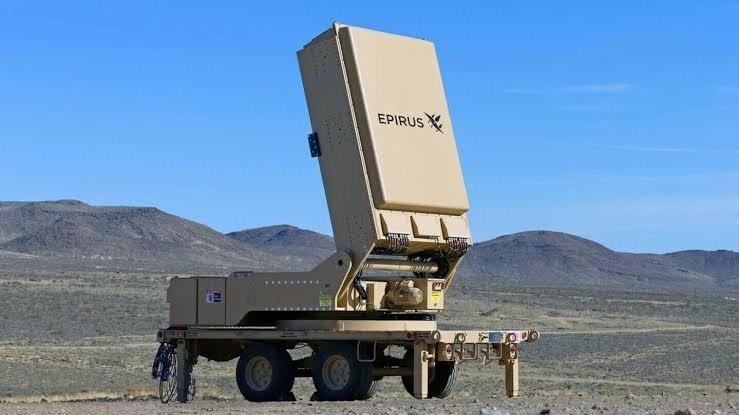
CALIFORNIA, United States — California-based defense technology company Epirus has integrated its Leonidas high-power microwave (HPM) weapon system into a U.S. Army command-and-control (C2) network during Operation Jailbreak Falcon Fury. The integration demonstrates how the system's sensors and microwave weapon can work with a broader military network to help operators select responses to different drone threats.
The Army has not disclosed the exact date or location of the demonstration, the specific command network used, or the number of drones involved.
Leonidas uses high-power microwave energy to disrupt or overload drone electronics, potentially disabling multiple unmanned aerial vehicles (UAVs) with a single burst. The integration supports the Army's wider effort to connect sensors, weapons and software from different manufacturers through an open-architecture approach.
Operation Jailbreak Advances Open-Architecture Systems
Operation Jailbreak is a U.S. Army initiative focused on establishing a “Right to Integrate” ecosystem, allowing equipment from different manufacturers to exchange data and operate together. A related hackathon at Fort Carson, Colorado, earlier in 2026 brought together more than 600 participants and over 50 defense companies. The effort includes encouraging vendors to open their application programming interfaces (APIs), reducing dependence on closed, single-vendor systems.
Army Secretary Dan Driscoll has linked the initiative to the rapid deployment of integrated interceptors required for operations such as Epic Fury. The broader objective is to reduce the need for soldiers to manually cross-reference information across multiple disconnected screens in tactical operations centers.
Leonidas GV to Debut at AUSA 2026
Epirus plans to present the Leonidas GV, a mobile variant developed in partnership with General Dynamics Land Systems, at the Association of the United States Army (AUSA) annual meeting in Washington, D.C., from October 12–14, 2026. Technical specifications for the GV have not been publicly released.
Previous Leonidas platform integrations include a Stryker armored vehicle, a General Dynamics Land Systems TRX tracked robotic vehicle, and a Leonidas Autonomous Ground Vehicle based on a Ford F-600 truck equipped with Kodiak Robotics artificial intelligence technology.
Tests Demonstrate Counter-Drone Capability
During a live-fire demonstration at Camp Atterbury, Indiana, Epirus reported that Leonidas neutralized all 61 target drones across five engagement scenarios. In one test, a single microwave burst disabled a swarm of 49 drones.
The results illustrate the system's potential to engage multiple drones simultaneously without requiring a separate physical interceptor for each target. Actual performance can vary depending on the targets and engagement conditions.
U.S. Army Contracts Support Development
The U.S. Department of Defense has supported Leonidas development through several contracts:
-
2023: Epirus received a $66.1 million contract to deliver four Indirect Fire Protection Capability–High Power Microwave (IFPC-HPM) prototypes. The company delivered all four by March 2024.
-
October 2024: Nearly $17 million was awarded for advanced sensors and closed-loop fire-control systems.
-
July 2025: The Army awarded $43.5 million for two second-generation system sets.
The latest network integration demonstrates Epirus's work to connect its microwave weapon with broader Army command systems. Further details about the Falcon Fury demonstration and the Leonidas GV's technical capabilities remain undisclosed.
——— End of Article ———