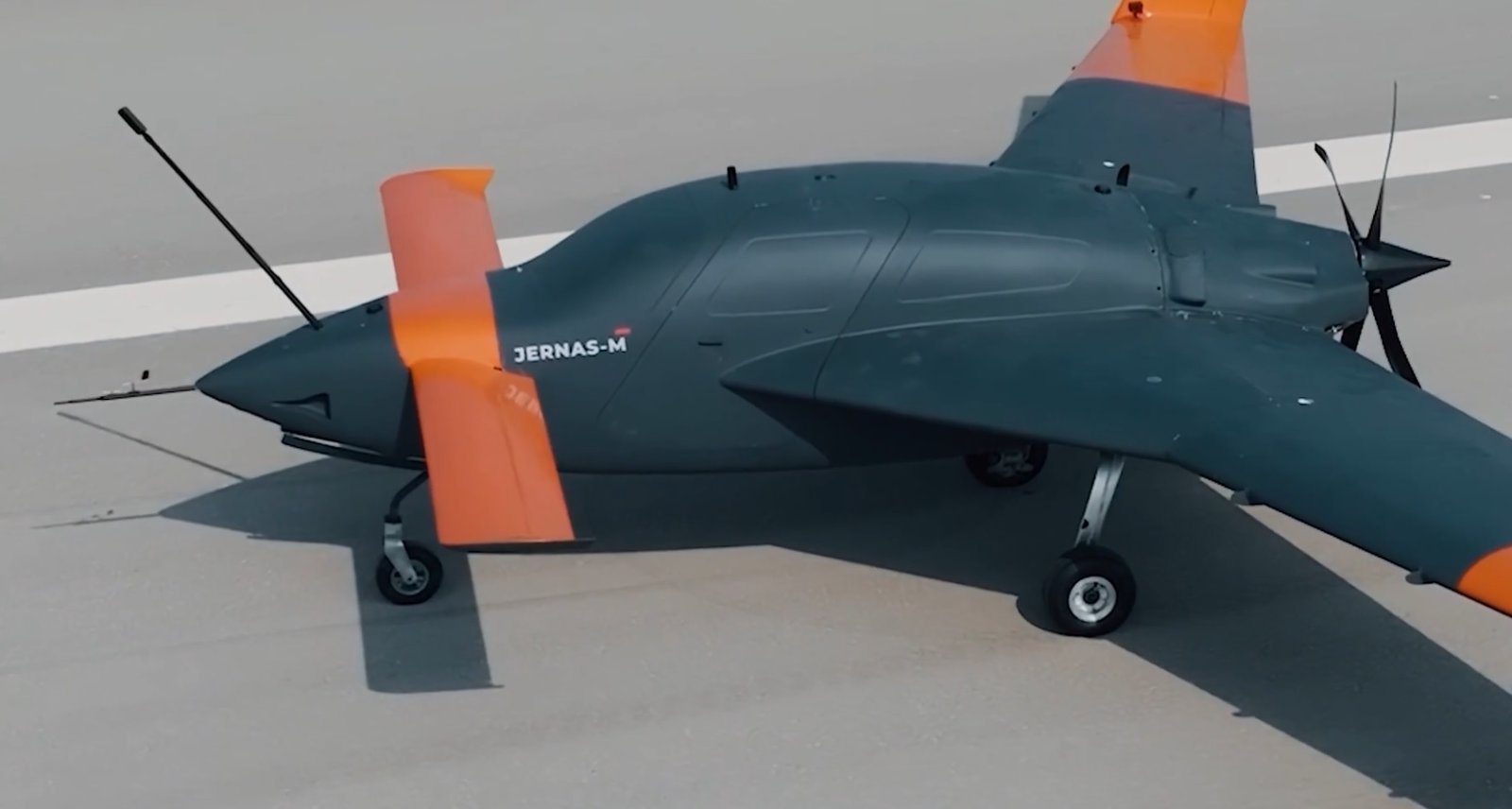
ABU DHABI — Abu Dhabi-based EDGE Group has released new flight test footage of its JERNAS-M unmanned aircraft, a medium-altitude, long-endurance (MALE) platform developed for intelligence, surveillance, reconnaissance (ISR), target tracking, and multi-mission operations.
The state-owned Emirati defence company shared the video on X, describing the JERNAS-M as a dependable and cost-effective solution designed for continuous surveillance and modern air defence missions. According to EDGE, the platform provides persistent monitoring and target tracking while supporting long-endurance operations.
Built for constant vigilance.
— EDGE (@_edgegroup) August 4, 2026
JERNAS-M provides dependable surveillance and target tracking in an efficient, cost-effective solution built for modern air defence. Delivering the capability that matters, where it matters most. pic.twitter.com/vY1StwATD1
Developed by ADASI
The JERNAS-M is being developed by ADASI, EDGE Group's autonomous systems subsidiary. The aircraft made its public debut at the Dubai Airshow 2025, where EDGE introduced 42 new defence products. Alongside the JERNAS-M, ADASI also unveiled the Strike fixed-wing weapon carrier and the Vortex-E counter-drone interceptor as part of its expanding unmanned systems portfolio.
The JERNAS-M builds on the earlier JERNAS-S programme, which is a smaller variant of the platform.
Flight Performance and Specifications
According to EDGE's published specifications, the JERNAS-M has a 10-metre wingspan, an empty weight of 590 kilograms, and a maximum take-off weight of 1,200 kilograms.
The aircraft is powered by an EP918Ti-185H four-stroke, four-cylinder horizontally opposed engine producing 185 horsepower at 5,800 rpm. It operates on standard automotive gasoline and carries 350 litres of fuel, with reported fuel consumption of approximately 17 litres per hour.
EDGE lists both the maximum and cruising speed at 240 km/h.
For intelligence, surveillance and reconnaissance (ISR) missions, the aircraft can remain airborne for up to 20 hours. When carrying its maximum payload of 280 kilograms, endurance is reduced to 12 hours.
The drone has a line-of-sight operational range of 200 kilometres, while its maximum operating altitude is 30,000 feet, according to official specifications.
Mission Payloads
The JERNAS-M is designed as a multi-mission platform capable of carrying different mission systems.
According to EDGE, it can be equipped with:
- Electro-optical sensors
- Radar systems
- Electronic warfare payloads
In a strike configuration, the aircraft can carry one RASH MK81 bomb together with four RASH-3 munitions, according to the company's published specifications.
The aircraft operates from conventional runways using tricycle landing gear and features a forward canard, winglets on the main wings, and a rear-mounted pusher propeller.
Airframe Design
Flight test footage released by EDGE shows an aircraft with a composite airframe featuring a forward canard, rear-mounted pusher propeller, cockpit canopy shape, fuselage design and landing gear arrangement that closely resemble the Velocity composite kit aircraft produced by Velocity Inc. of Sebastian, Florida, since the 1980s.
The civilian Velocity aircraft is designed for homebuilt aviation and traces its aerodynamic heritage to Burt Rutan's Long-EZ design.
EDGE has not issued an official statement confirming that the JERNAS-M is based on the Velocity airframe.
However, adapting an existing civilian aircraft design is a recognised aerospace development approach that can reduce structural development work, flight testing requirements and programme costs compared with developing an entirely new airframe.
Development Timeline
Speaking to EDR On-Line, Marcus de Jonge, Chief Development Officer at ADASI, said the current JERNAS-M is a pre-prototype aircraft that completed its first flights shortly before the opening of the Dubai Airshow in 2025.
According to de Jonge:
- An updated JERNAS-M design is scheduled to fly in late 2026.
- Production is planned for 2027.
He also said the smaller JERNAS-S, which features an 8-metre wingspan, 630-kilogram maximum take-off weight, and 155-kilogram payload, is further advanced and is expected to enter production in 2026.
Wider Unmanned Systems Strategy
At the Dubai Airshow 2025, EDGE also announced a joint venture with U.S. defence technology company Anduril focused on the Omen runway-independent unmanned aircraft.
While the partnership is centred on a different platform, industry observers have noted that cooperation in software and production could support the international reach of EDGE's wider unmanned systems portfolio.
The JERNAS-M forms part of EDGE's broader effort to expand its autonomous capabilities across air, land and sea domains. Positioned in the medium-altitude, long-endurance (MALE) category, the platform is intended to provide extended surveillance, reconnaissance and target-tracking capabilities while offering a lower-cost option than many purpose-built systems in the same class.
——— End of Article ———