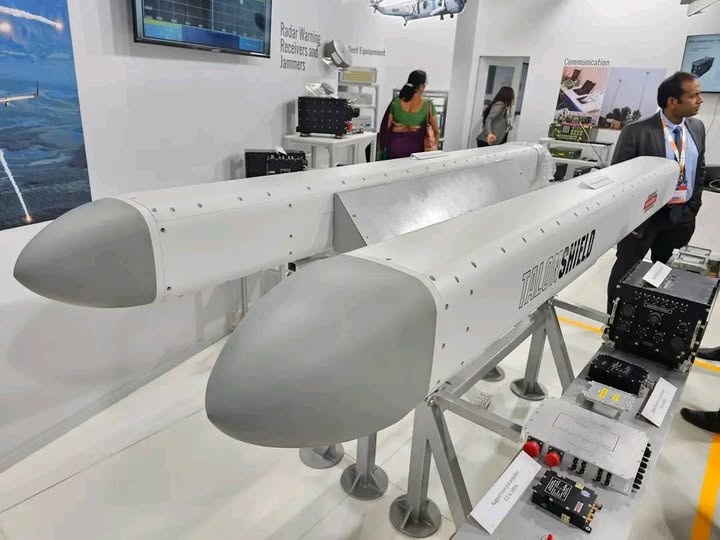
NEW DELHI — May 17, 2026 : Data Patterns (India) Ltd. is preparing to commence flight testing of its indigenously developed TALON SHIELD Airborne Self-Protection Jammer (ASPJ) pod with the Indian Air Force (IAF) in the coming months, as part of a broader effort to strengthen the electronic warfare capabilities of the Su-30MKI fighter fleet through domestically developed systems.
The TALON SHIELD programme is intended to provide the IAF with an indigenous airborne electronic warfare solution capable of countering modern radar-guided threats while reducing long-term reliance on imported defence equipment. According to programme details, the complete testing and certification process is expected to take between 18 months and two years.
The TALON SHIELD is a high-band self-protection jammer pod specifically designed for integration with the Su-30MKI multirole fighter aircraft. The system incorporates Active Electronically Scanned Array (AESA) technology based on Gallium Nitride (GaN) transmit-receive modules, enabling high-power electronic attack operations, agile beam steering and simultaneous multi-band functionality. The jammer is capable of operating across several frequency ranges, including L-band and S-band, to counter a broad range of airborne and ground-based radar systems.
A key component of the system is its Digital Radio Frequency Memory (DRFM)-based electronic warfare architecture. Using DRFM techniques, the pod can intercept hostile radar emissions, digitally process the received signals and retransmit manipulated responses designed to confuse enemy sensors and missile seekers. The system is designed to conduct multiple forms of electronic countermeasures, including noise jamming, deceptive jamming and velocity gate pull-off techniques against fire-control radars, search radars, airborne interception radars and radar-guided missile systems.
The TALON SHIELD is configured as a dual-pod arrangement mounted on the aircraft’s wingtip or underwing pylons. When operated together, the paired pods provide 360-degree electronic protection coverage around the aircraft. The system has been engineered for direct installation on the Su-30MKI without requiring significant structural modifications to the airframe.
Ground integration trials and hardware compatibility testing have already been completed on Su-30MKI platforms in coordination with the Electronics and Radar Development Establishment (LRDE) in Bengaluru. Data Patterns has also completed aerodynamic validation, liquid-cooling evaluations and prototype manufacturing ahead of the upcoming flight test campaign.
According to company officials, the upcoming trial programme will include captive carriage testing, avionics integration assessments, electromagnetic compatibility checks and live flight evaluations under operational conditions. The company has additionally offered the TALON SHIELD system for no-cost, no-commitment flight trials with the IAF.
The indigenous jammer pod is being positioned as a replacement for foreign-origin self-protection jammer systems currently used on the Su-30MKI fleet, including the Russian SAP-518 and Israeli EL/L-8222 electronic warfare pods. The programme aligns with India’s wider defence industrial strategy focused on increasing indigenous content in critical aerospace and electronic warfare technologies under the “Make in India” initiative.
The development is also linked to the IAF’s broader Super Sukhoi modernization programme, valued at approximately ₹65,000 crore, which aims to upgrade more than 250 Su-30MKI aircraft with new-generation indigenous systems. Planned upgrades under the programme include the Virupaksha AESA radar, next-generation Radar Warning Receivers (NG-RWRs), upgraded mission avionics and advanced electronic warfare suites intended to improve survivability in contested operational environments.
In November 2025, the Ministry of Defence issued a Request for Information (RFI) for the procurement of 100 Aircraft Self-Protection Jammer pods for the Su-30MKI fleet. The RFI specified a minimum indigenous content requirement of 50 percent and outlined a delivery timeline of 36 months following the award of a production contract. Data Patterns is currently preparing for the expected Request for Proposal (RFP) phase while continuing development and validation activities for the TALON SHIELD system.
Successful completion of the upcoming flight testing and certification campaign would enable operational integration of the TALON SHIELD across frontline Su-30MKI squadrons and support India’s continuing efforts to expand indigenous capabilities in advanced airborne electronic warfare systems.
——— End of Article ———