India’s Defence Research and Development Organisation (DRDO) has unveiled its latest underwater platform, the Manportable Autonomous Underwater Vehicle (MPAUV), a compact mine-hunting and surveillance system designed for rapid deployment in coastal and littoral zones. Displayed at a recent defence exhibition, the system reflects India’s accelerating push to expand its indigenous autonomous underwater capabilities.
Designed for Rapid Underwater Missions
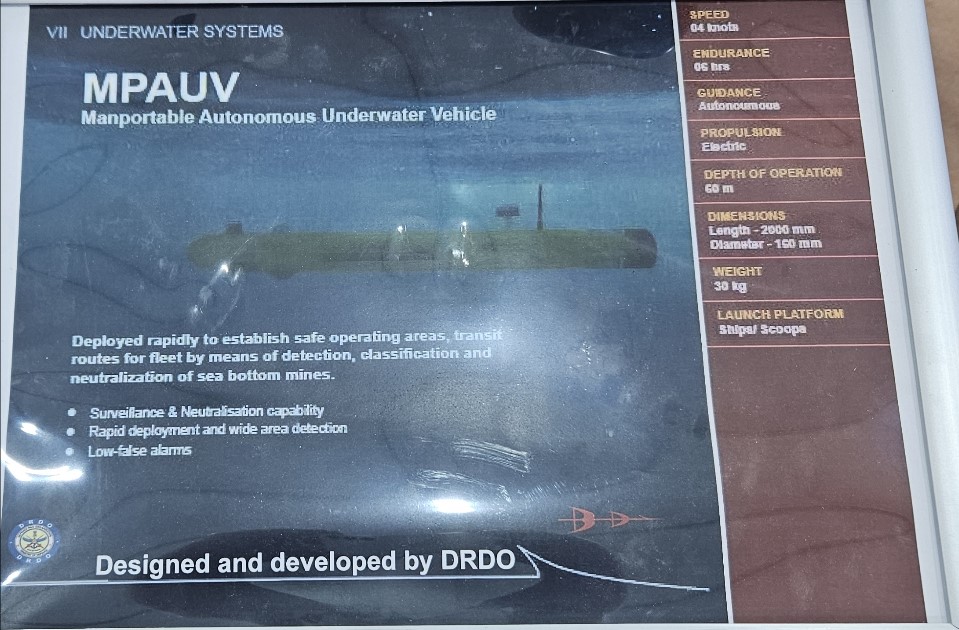
According to details released at the venue, the MPAUV is intended to be deployed quickly to secure safe operating areas and transit routes for naval vessels by detecting, classifying and neutralising sea-bottom mines. The vehicle is engineered to support fleets with fast-response underwater reconnaissance in both peacetime and conflict.
Despite its man-portable form, the system is built to deliver high underwater performance suited for mine countermeasure (MCM) operations.
Capabilities and Mission Role
DRDO states that the MPAUV integrates:
-
Surveillance & Neutralisation capability
-
Rapid deployment with wide-area detection
-
Low-false alarms for high mission reliability
By combining autonomy with compactness, the platform enables underwater route clearance and area sanitisation without the need for large support vessels.
Technical Specifications
Key specifications displayed include:
-
Speed: 4 knots
-
Endurance: 6 hours
-
Propulsion: Electric
-
Guidance: Autonomous
-
Operating Depth: 60 metres
-
Dimensions: 2000 mm (length), 160 mm (diameter)
-
Weight: 30 kg
-
Launch Platform: Ship / SCOOPA compatible
The MPAUV’s lightweight design allows operators to deploy it swiftly from small boats or larger ships, greatly enhancing flexibility in shallow-water operations.
Strengthening Indigenous Underwater Systems
The platform—marked “Designed and developed by DRDO”—highlights India’s growing commitment to unmanned underwater systems. As global navies increasingly rely on AUVs for mine warfare, seabed mapping, and coastal surveillance, DRDO’s MPAUV is set to become an essential asset in the Indian Navy’s evolving undersea operations.
The system adds to India’s expanding catalogue of indigenous marine robotics intended to bolster maritime security across the Indian Ocean Region.
——— End of Article ———