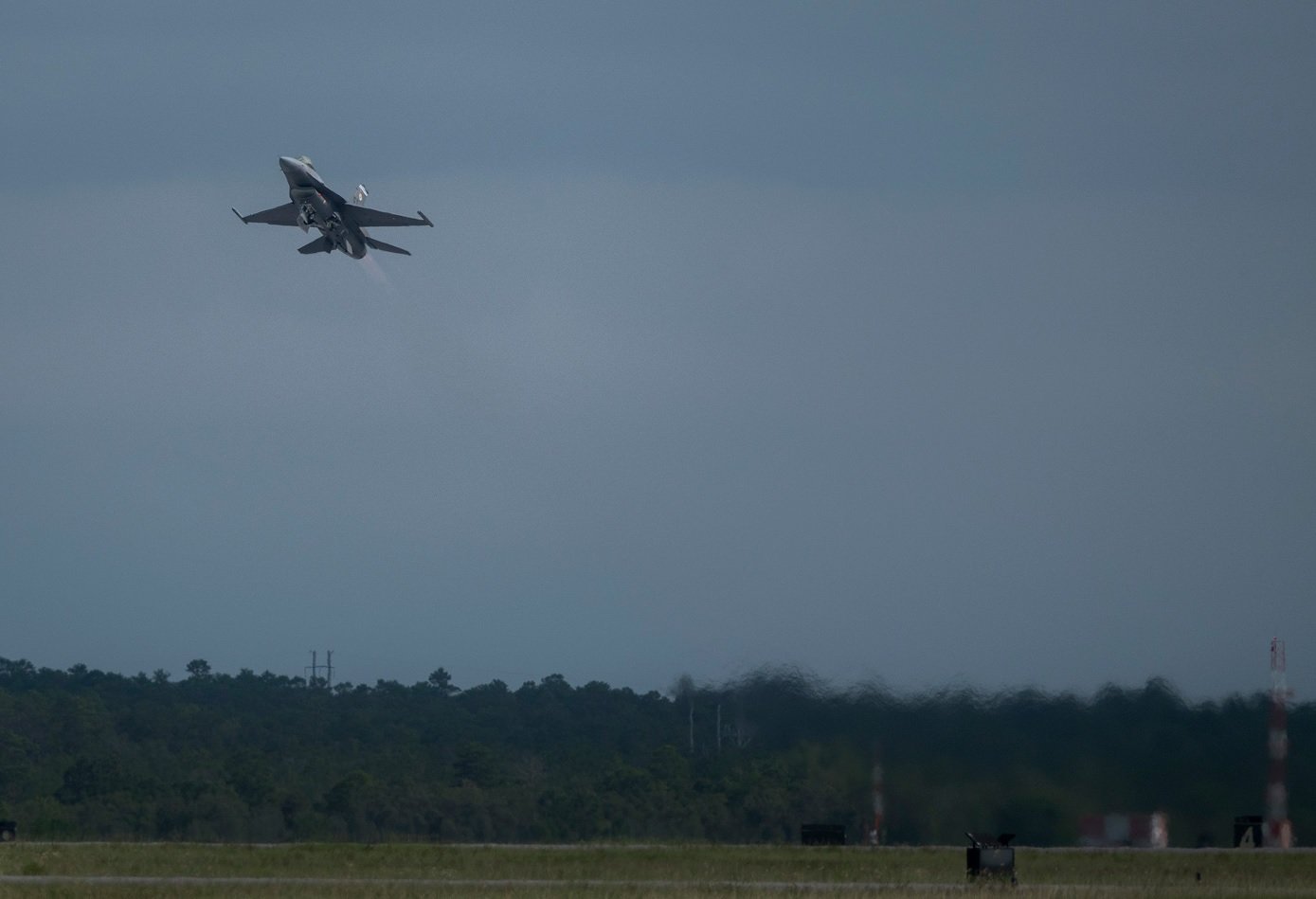
EGLIN AIR FORCE BASE, Fla. — The U.S. Defense Advanced Research Projects Agency (DARPA) and the U.S. Air Force have begun flight testing of standard F-16 fighter aircraft controlled by an artificial intelligence (AI) agent under the Viper Experimentation and Next-generation Operations Model (VENOM) program.
The latest milestone moves AI flight technology from simulation environments and specialized research aircraft to operational F-16 fighters modified for autonomous testing. According to DARPA, the effort is intended to accelerate the development and testing of trusted autonomous air combat capabilities using conventional military aircraft.
The VENOM program is a joint initiative between DARPA and the U.S. Air Force and builds directly on DARPA's earlier Air Combat Evolution (ACE) program, which developed the AI algorithms used for autonomous flight.
From Experimental Aircraft to Standard F-16 Fighters
The new flight tests follow earlier demonstrations conducted with the X-62A Variable In-flight Simulation Test Aircraft (VISTA), a specially modified research aircraft used during the ACE program. During those tests, an AI agent successfully controlled the aircraft during within-visual-range air combat against human pilots.
VENOM expands that work by adapting standard F-16 fighters into autonomous-capable flying testbeds. DARPA said using operational aircraft provides a more practical platform for developing and evaluating AI technologies intended for future military aviation.
Testing is being conducted at Eglin Air Force Base, Florida, with support from the 96th Test Wing. According to DARPA, modified F-16s first flew in June 2026 to verify that the new autonomous systems operated safely with the aircraft. In July 2026, flight testing advanced to missions in which an AI agent controlled the aircraft while a pilot remained in the cockpit to supervise operations.
VENOM Autonomy Kit Enables AI Flight Without Changing Core Software
The autonomous capability is provided through the VENOM Autonomy Kit (VAK), which was designed and integrated by multiple contractors during the ACE program.
The system connects directly with the F-16's flight controls and mission systems while leaving the aircraft's core software unchanged. According to DARPA, this approach simplifies integration and allows AI capabilities to be tested on standard fighters without modifying the jet's underlying software.
During testing, the aircraft remain fully crewed. A pilot can switch between manual flying and AI control using a physical switch inside the cockpit.
DARPA describes this arrangement as a "human-on-the-loop" approach, where the pilot continuously monitors the AI's actions and can immediately take back control if required. The agency said this provides a safe environment for evaluating autonomous flight systems while maintaining human oversight throughout each mission.
"These groundbreaking flight tests of VENOM-modified F-16s advance the infrastructure needed to develop trusted, autonomous air combat capabilities," said Brig. Gen. James "Fangs" Valpiani, Ph.D., DARPA program manager. "The Air Force and DARPA team has automated flight controls and sensors on a standard F-16 without changing the jet's core software. This enables an efficient pipeline for developing dominant AI for aerial combat, allowing us to rapidly innovate for the warfighter."
VENOM Aircraft to Support DARPA's AIR Program
Following the initial flight testing, the VENOM fleet will become the primary flying test platform for DARPA's Artificial Intelligence Reinforcements (AIR) program.
While the ACE program concentrated mainly on close-range air combat, AIR is intended to evaluate AI agents in more complex operational scenarios, including beyond-visual-range engagements and multi-aircraft operations.
According to DARPA, the program will also support future operational concepts in which human pilots command and coordinate teams of autonomous uncrewed aircraft, including efforts associated with the Collaborative Combat Aircraft (CCA) program.
"The emerging threat environment, especially as it relates to aerial combat, is growing increasingly complex," Valpiani said. "AI has tremendous potential to help humans manage this complexity in beyond-visual-range combat, but many hard questions remain concerning the performance and trustworthiness of combat AI in the extreme fog and friction of modern warfare. The AIR program aims to apply cutting-edge combat agents to operationally relevant scenarios to address these questions and field war-deterring, war-winning capabilities to our warfighters."
Leadership Changes Announced
DARPA also announced leadership changes as the program transitions into its next phase.
Brig. Gen. James Valpiani will conclude his tenure as DARPA program manager later this month. Lt. Col. Patrick "Dice" Highland, Ph.D., who recently joined DARPA, will become the incoming AIR program manager.
"I'm incredibly proud of the AIR program's role in advancing our nation's combat autonomy, demonstrated by this VENOM milestone," Highland said. "We now have the opportunity to create dominant autonomy for beyond-visual-range, multi-ship combat. These flights give us an early glimpse of how AI agents may begin actively transforming air warfare."
Terry Wilson, Ph.D., Director of AI Development and Transition for the Air Force Research Laboratory's Autonomy Capability Team, will continue serving as deputy program manager for both the VENOM and AIR programs to provide technical and operational continuity across participating organizations.
"I share Gen. Valpiani's deep appreciation for the incredible dedication of our DARPA and industry teammates, joint engineers, the System Program Office, Eglin's test and maintenance crews, and the entire AIR and VENOM ecosystem which has made this milestone possible," Wilson said. "I look forward to unleashing the VENOM platform and moving these capabilities out of simulation and into the sky."
Future Testing
DARPA plans to expand live flight testing under the AIR program by evaluating AI models in increasingly complex operational scenarios. The agency said the objective is to accelerate AI model development while supporting future multi-ship autonomous air combat operations.
According to DARPA, a total of six F-16 aircraft are planned for the VENOM fleet. All aircraft will remain crewed during testing, with human pilots supervising AI-controlled flights as the program continues to mature autonomous combat aviation technologies.
——— End of Article ———