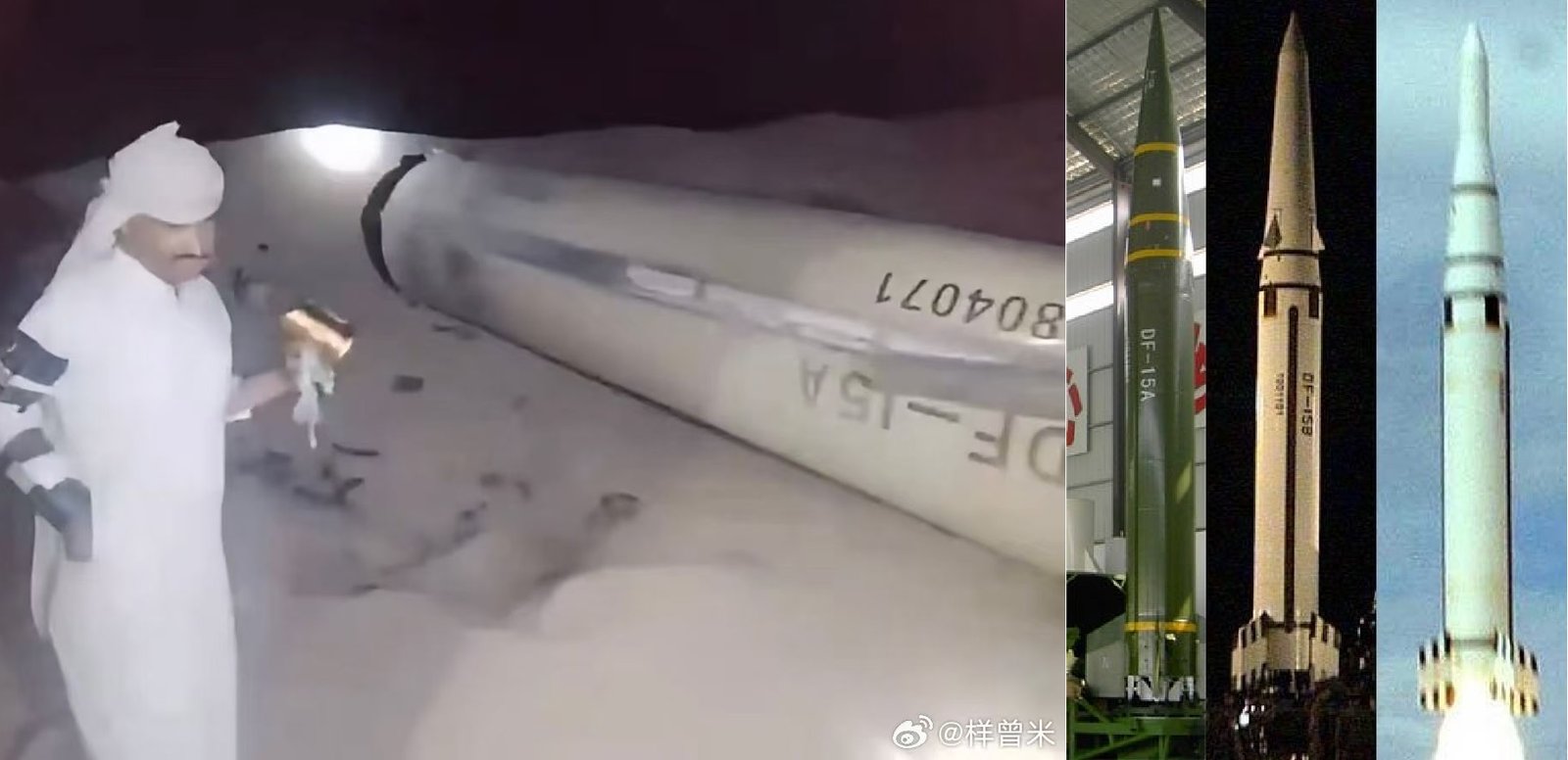
MA’RIB, Yemen — Debris identified by open-source defense analysts as the booster stage of a Chinese-made DF-15A short-range ballistic missile has been documented in the Raghwan district of Ma’rib Governorate.
Photographs of the wreckage circulated through regional military monitoring and open-source intelligence accounts. Analysts including MenchOsint and OSINTWarfare identified the cylindrical debris as a DF-15A booster based on its structure, aerodynamic fins and casing characteristics.
The discovery comes amid renewed fighting around Ma’rib involving Houthi forces, also known as Ansar Allah, and forces aligned with Yemen’s internationally recognized government. Saudi Arabia has continued airstrikes in support of government forces in the area.
INTERESTING: Chinese-made DF-15A missile booster found in Ma'rib, Yemen.
— Clash Report (@clashreport) September 14, 2026
Houthis don't have these missiles. Their arsenal is Iranian-derived.
Saudi Arabia has a documented history of secret Chinese ballistic missile purchases (DF-3A, DF-21).
Analysts are pointing to this as… pic.twitter.com/3JGGFYc2lk
The DF-15A is a Chinese solid-fuel, single-stage short-range ballistic missile. Its range is generally reported at around 600 kilometers, although some technical references give a range of 600–900 kilometers. It carries a conventional warhead, with published estimates varying between 500 and 750 kilograms.
The reported identification has attracted attention because Saudi Arabia has a documented history of acquiring Chinese ballistic missiles, although neither Saudi Arabia nor China has publicly confirmed that Riyadh operates the DF-15A.
Saudi Arabia’s longest-range ballistic missile in service is widely identified as the Chinese DF-3 (CSS-2), which was acquired in 1988 and publicly displayed by Saudi Arabia in 2014. The missile is estimated to have a range of approximately 2,500 kilometers and is associated with a warhead of about 2,000 kilograms.
Saudi Arabia’s longest-range ballistic missile in service is the Chinese DF-3 (CSS-2), publicly displayed in 2014.
— CrystalAura (@Ahmed_kv44) September 14, 2026
An estimated ~2,500 km range with a ~2,000 kg warhead, acquired in 1988.
DF-21 (CSS-5) is also widely reported in Saudi service, but never publicly displayed. pic.twitter.com/bybc8jcOYV
Saudi Arabia also acquired DF-21 (CSS-5) medium-range ballistic missiles from China, with the acquisition reported around 2007 and subsequently confirmed in U.S. government records. The DF-21 is widely reported to be in Saudi service but has not been publicly displayed. Publicly released information has also indicated Chinese assistance with Saudi ballistic-missile production infrastructure.
The Houthis are not publicly known to operate the DF-15A. Their missile arsenal has included systems derived from older Soviet designs and Iranian-associated technology. No evidence presented so far links the Ma’rib debris to a Houthi-operated DF-15A.
Some analysts have also raised the possibility of a Pakistani connection, citing the long-standing military relationship between Saudi Arabia and Pakistan and their Strategic Mutual Defence Agreement signed in September 2025. Pakistan does not publicly operate the DF-15A, instead fielding ballistic missiles including the Ghaznavi and Shaheen families. No physical evidence has publicly linked Pakistani forces or equipment to the Raghwan debris.
The location and reported trajectory have led some open-source analysts to assess that the missile may have been launched from Saudi territory. However, this has not been officially confirmed.
Saudi Arabia’s Ministry of Defense and the Chinese government have not publicly commented on the reported debris. Further evidence or official statements will be required to confirm the missile’s origin and operator.
——— End of Article ———