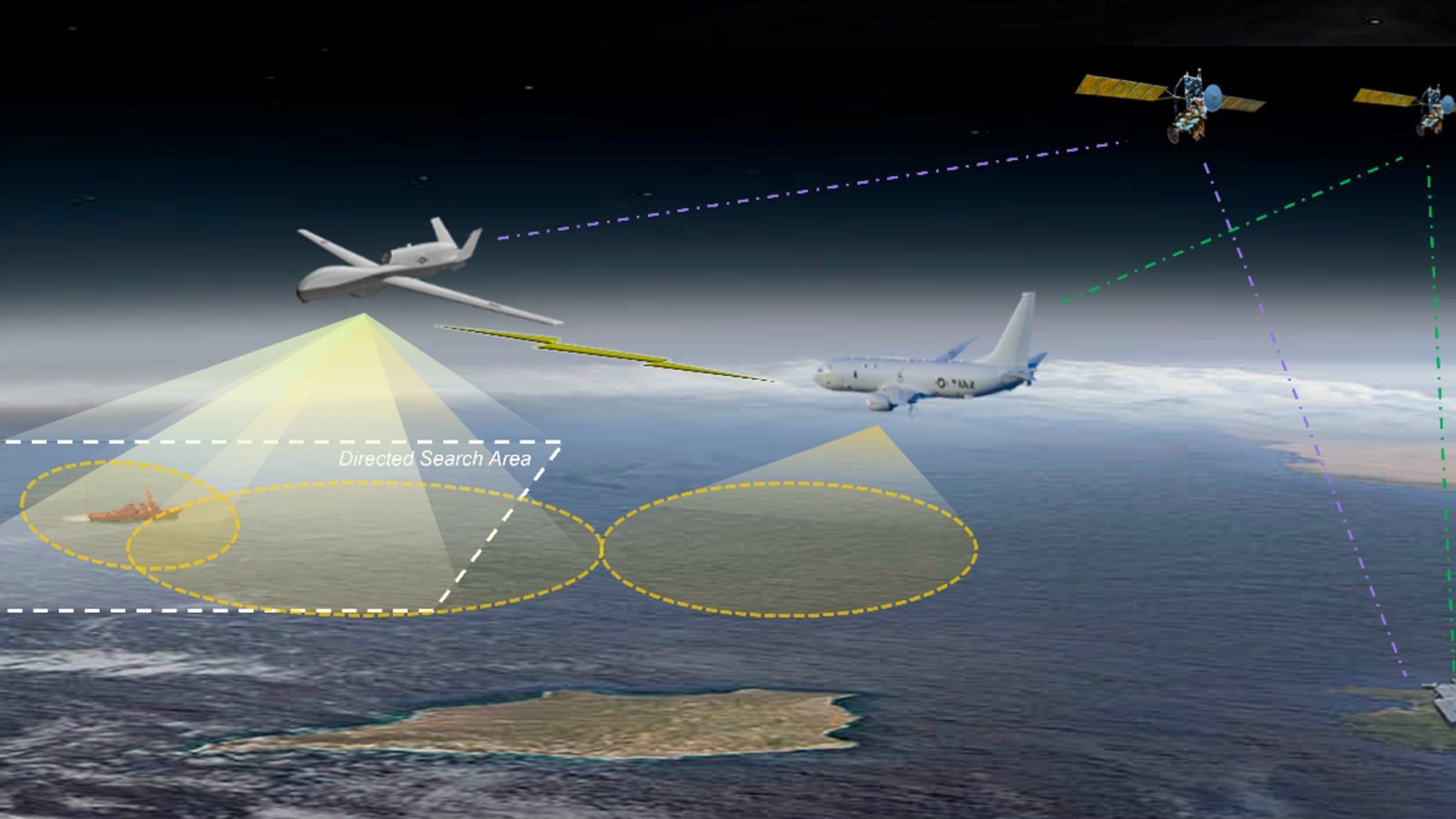
SAN DIEGO, Calif. — Boeing and Northrop Grumman have successfully completed a jointly funded laboratory demonstration of automated manned-unmanned teaming (MUM-T) between the Boeing P-8A Poseidon maritime patrol aircraft and the Northrop Grumman MQ-4C Triton unmanned aircraft system.
The demonstration marked the first time the two platforms collaborated through automated mission control using an open systems architecture, allowing them to exchange mission tasking and intelligence without relying entirely on manual operator inputs.
During the laboratory simulation, an operator aboard the P-8A Poseidon transmitted machine-readable and machine-actionable mission tasking to a simulated MQ-4C Triton using Universal Command and Control Interface (UCI) formatted messages. The Poseidon directed the unmanned aircraft to travel to a designated operational area and collect intelligence.
After receiving the tasking, the MQ-4C Triton autonomously planned and executed the mission using onboard artificial intelligence (AI) algorithms. The aircraft employed its sensors according to the assigned mission, processed the collected information onboard, and automatically transmitted the intelligence back to the P-8A crew. To replicate real-world operational conditions, the data exchange was conducted through a simulated satellite communication relay.
According to the companies, the demonstration showed how crewed and uncrewed maritime platforms can work together more efficiently by sharing intelligence and coordinating missions through standardized digital interfaces.
Open Systems Architecture
Instead of using a dedicated point-to-point connection between the two aircraft, the demonstration relied on the Universal Command and Control Interface (UCI), a machine-to-machine collaboration standard built on Open Mission Systems (OMS) and the Autonomy–Government Reference Architecture.
This standardized approach allows military platforms using the same architecture to communicate and operate together without requiring custom software integration. Boeing and Northrop Grumman said the common interface can support interoperability with other U.S. and allied military systems that use the same standards while reducing integration time and cost.
Operational Benefits
The companies said the demonstration highlighted several operational advantages for maritime patrol and reconnaissance missions.
By allowing the MQ-4C Triton to autonomously carry out assigned tasks and process information before sending results to the P-8A, operator workload can be reduced while enabling crews to focus on mission management.
Automated machine-to-machine intelligence sharing can also speed up the delivery of operational information to commanders, improving decision-making during maritime intelligence, surveillance, reconnaissance and targeting (ISR&T) missions as well as anti-surface warfare operations.
The use of standardized interfaces also makes future integration between crewed and uncrewed aircraft less complex and more cost-effective across U.S. and allied forces.
Company Statements
Jane Bishop, vice president and general manager of Northrop Grumman's Global Surveillance Division, said the MQ-4C Triton and P-8A Poseidon form the backbone of the U.S. Navy's maritime patrol and reconnaissance force by providing complementary capabilities.
She said the demonstration highlighted the flexibility of both systems, the companies' continued investment in advanced technologies, and the value of industry collaboration. Bishop added that Northrop Grumman remains committed to advancing technologies that support U.S. and allied operators against evolving maritime threats.
Tory Peterson, vice president of Boeing's P-8 Program, said the demonstration expands real-world interoperability between the P-8A Poseidon and MQ-4C Triton for the United States and allied operators.
He said Boeing's continued investment is intended to help current and future P-8A operators enhance mission capability through evolutionary upgrades while building on the aircraft's existing maritime patrol and reconnaissance roles.
About the Aircraft
The Boeing P-8A Poseidon is a multi-mission maritime patrol and reconnaissance aircraft designed to conduct anti-submarine warfare (ASW), anti-surface warfare (ASuW), intelligence, surveillance and reconnaissance (ISR), and search and rescue (SAR) missions.
The Northrop Grumman MQ-4C Triton is a high-altitude, long-endurance unmanned aircraft system developed for persistent maritime intelligence, surveillance and reconnaissance operations. Built at Northrop Grumman's facility in Palmdale, California, the aircraft also supports signals intelligence, early threat prediction, and search and rescue missions. It is operated by the U.S. Navy and the Royal Australian Air Force.
The companies said the demonstration is part of their ongoing investment to accelerate advanced maritime capabilities for U.S. and international operators through open systems architecture and automated collaboration between crewed and uncrewed platforms.
——— End of Article ———