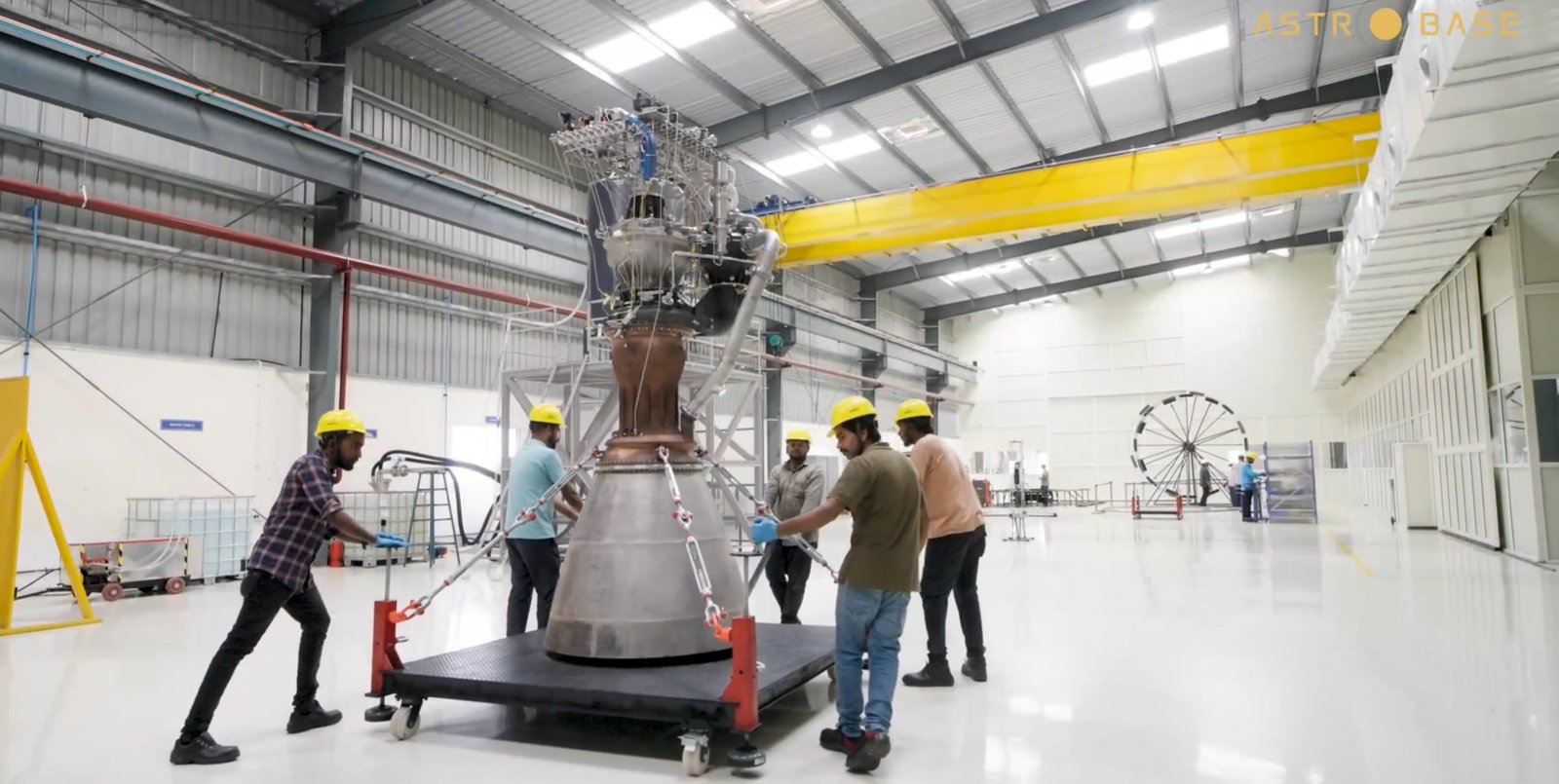
BENGALURU — Bengaluru-based space startup Astrobase Space Technologies has unveiled EVEREST, India's first fully integrated 80-tonne-class (800 kN) Full-Flow Staged Combustion (FFSC) rocket engine, marking a significant milestone for the country's private space industry.
Designed, manufactured, and integrated entirely in India, EVEREST is powered by liquid oxygen (LOX) and liquid methane (methalox). According to the company, the engine is intended to power future medium-lift launch vehicles and is designed with reusability in mind.
EVEREST uses the Full-Flow Staged Combustion (FFSC) cycle, in which both the fuel and oxidiser pass through separate pre-burners before driving the turbopumps and entering the main combustion chamber. This propulsion architecture is designed to improve efficiency and support repeated engine use. The company said the engine produces 800 kN of vacuum thrust, has a specific impulse of around 340 seconds, and offers a throttle range of 50% to 110%.
Founded in 2024 by former ISRO propulsion scientist Devakumar Thammisetty and former CoinDCX co-founder Neeraj Khandelwal, Astrobase has established a 46,000-square-foot assembly and integration facility in Bengaluru, equipped with India's largest industrial metal 3D printer for manufacturing key engine components. The company also operates a 21.5-acre propulsion test facility near Anantapur, Andhra Pradesh, where the full-engine hot-fire test is planned.
Astrobase previously completed a sub-scale hot-fire test in September 2025 and high-speed turbopump testing in January 2026. The company said the next major milestone will be the full-engine hot-fire test, followed by vehicle integration and preparations for its targeted 2029 orbital flight.
The company plans to manufacture up to 50 engines annually, conduct about one hot-fire test each week, and test around 20 engines before its first orbital mission. The EVEREST engine programme is supported by the IN-SPACe Technology Adoption Fund.
Astrobase said the long-term goal is to develop launch-on-demand capability while expanding India's indigenous launch vehicle and reusable rocket technology. The unveiling of EVEREST comes weeks after Skyroot Aerospace's Vikram-1 mission, highlighting continued progress in India's commercial space sector.
——— End of Article ———