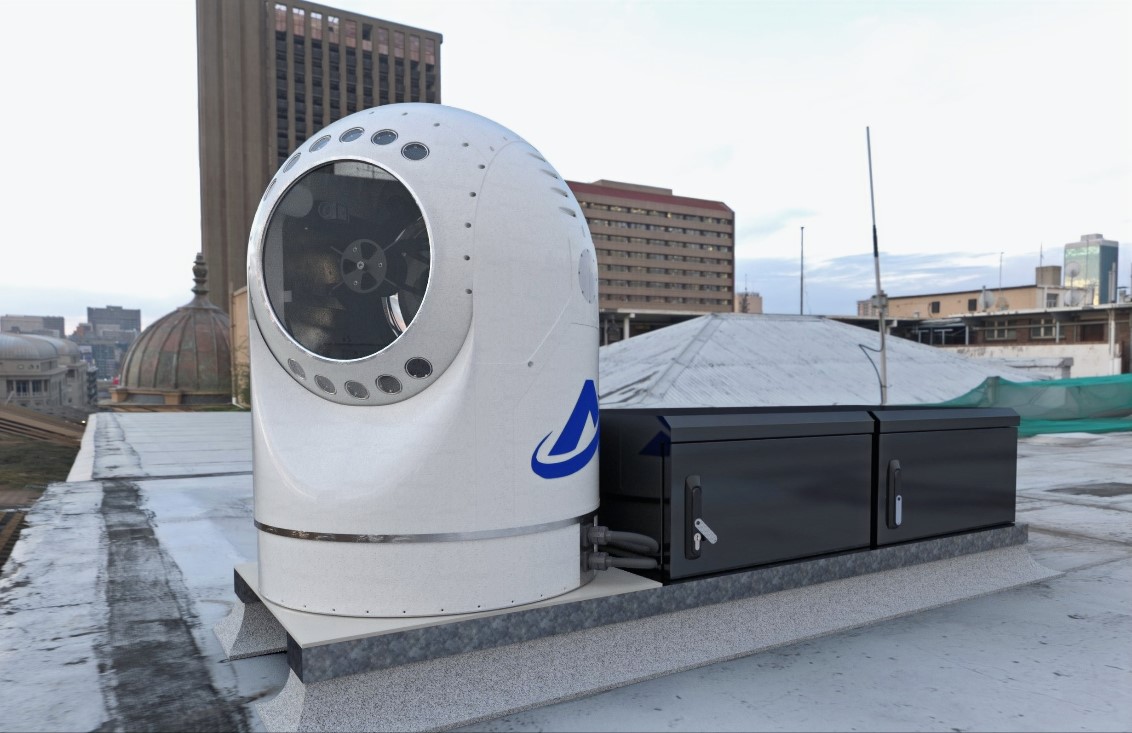
OXFORD, United Kingdom — May 27, 2026 : Archangel Lightworks, an Oxford-based laser communications company, has successfully completed field trials of its TERRA-M system, which the company describes as the world’s smallest deployable operational optical ground station. Funded by the UK Defence Science and Technology Laboratory (Dstl), the demonstration marked the United Kingdom’s first successful optical downlink from space using a deployable laser communications ground station and represented a significant step in secure, high-speed satellite connectivity.
The multi-day trials were conducted earlier this month in the Mediterranean region and demonstrated the secure transfer of data between a low Earth orbit (LEO) satellite and the TERRA-M system. During multiple satellite passes lasting approximately 90 seconds each, the system successfully downloaded many gigabits of data. According to the company, the tests were conducted using the U.S. Space Development Agency’s laser communication standards and repeated across multiple passes to verify reliability and operational performance.
Compact System Designed for Rapid Deployment
TERRA-M has been developed as a smaller and more flexible alternative to conventional optical ground stations. The system features an optical head measuring 1.1 meters in height and 0.7 meters in diameter with a 30-centimeter aperture, allowing it to operate without requiring an external protective dome or a dedicated building.
Archangel Lightworks said the modular system was engineered using low size, weight, power and cost (SWaP-C) principles, enabling transportation by light vehicle or aircraft and deployment on building rooftops or in remote areas lacking communications infrastructure. Unlike traditional fixed installations, TERRA-M is designed for rapid deployment and redeployment at the point of need while supporting autonomous, multi-mission operations.
The company added that the system is interoperable with a broad range of laser communication terminals and standards, making it adaptable to both commercial and government satellite architectures.
Laser Communications for Secure, High-Speed Data Transfer
Laser communications, also known as free-space optical communications, transmit information using low-power, non-visible light rather than traditional radio frequencies (RF). The technology enables higher-volume data transfer and provides a more secure alternative to radio-based transmission because narrow optical beams have a substantially lower probability of interception or detection.
Archangel Lightworks stated that TERRA-M currently supports transmit and receive speeds of up to 10 gigabits per second, while future development efforts are aimed at enabling terabit-per-second downlinks to support expanding satellite data requirements.
The company said optical ground station infrastructure is becoming increasingly important as satellite traffic grows and computing capabilities gradually expand into orbit through emerging orbital data centers. The technology is designed to provide seamless connectivity between networks in space and communications systems on Earth while reducing dependence on terrestrial and subsea cable infrastructure.
Commercial and Defense Applications
According to Archangel Lightworks, the technology has dual-use applications across defense and commercial sectors. Military uses include intelligence, surveillance and reconnaissance operations, where secure and rapid transfer of large volumes of information is critical.
Commercial applications include satellite internet backhaul, Earth observation data transfer and future connectivity requirements for orbital computing infrastructure. The company also said laser communication systems can support space exploration missions, including the Artemis program, while helping extend high-volume satellite connectivity to underserved communities and reducing the digital divide.
Company and Government Statements
“The TERRA-M is uniquely capable of rapid, secure data transfer with satellites while also being small enough to be deployed and redeployed at the point of need,” said Richard Johanson, CEO of Archangel Lightworks.
“We are on a pathway to providing resilient, large-scale deployable networks of optical ground stations. The demand for space-based information and connectivity solutions continues to grow exponentially, and we are pleased that our technology will play a role in this exciting new global communications infrastructure,” Johanson added.
UK Space Minister Liz Lloyd welcomed the successful demonstration and highlighted its strategic significance for Britain’s growing space sector.
“Archangel Lightworks is a prime example of British innovation leading the world in next-generation space technology,” Lloyd said. “The successful trials of the TERRA-M show the UK is at the forefront of laser communications, developing the kind of cutting-edge products that will underpin the future of global connectivity.”
“Investing in homegrown capability like this strengthens our national security, drives economic growth, and brings opportunities to communities that need them most,” she added. “The UK Government is proud to have supported Archangel Lightworks, and this is a clear demonstration of what our space sector can deliver.”
Funding, Customers and Future Deployment
Archangel Lightworks confirmed that TERRA-M systems and ground-station-as-a-service contracts are already being purchased and delivered to customers. The company has established memoranda of understanding with telecommunications firms Starcloud and Omantel alongside several commercial agreements.
Supported by the UK Space Agency, the Department of Science, Innovation and Technology and the UK Ministry of Defence, Archangel Lightworks recently completed an oversubscribed Series A funding round worth $13.5 million (£10 million), bringing its total funding to approximately $20 million. Institutional investors in the round include Santander Alternative Investments, the National Security Strategic Investment Fund (NSSIF), Blackfinch Ventures, Oxford Capital, Lycka Limited and Oxford Science Enterprises.
The company said it is targeting wider deployment of TERRA-M systems by 2027 to support commercial broadband constellations, government sovereign communications networks and resilient high-volume data transfer from proliferated low Earth orbit satellite constellations.
——— End of Article ———