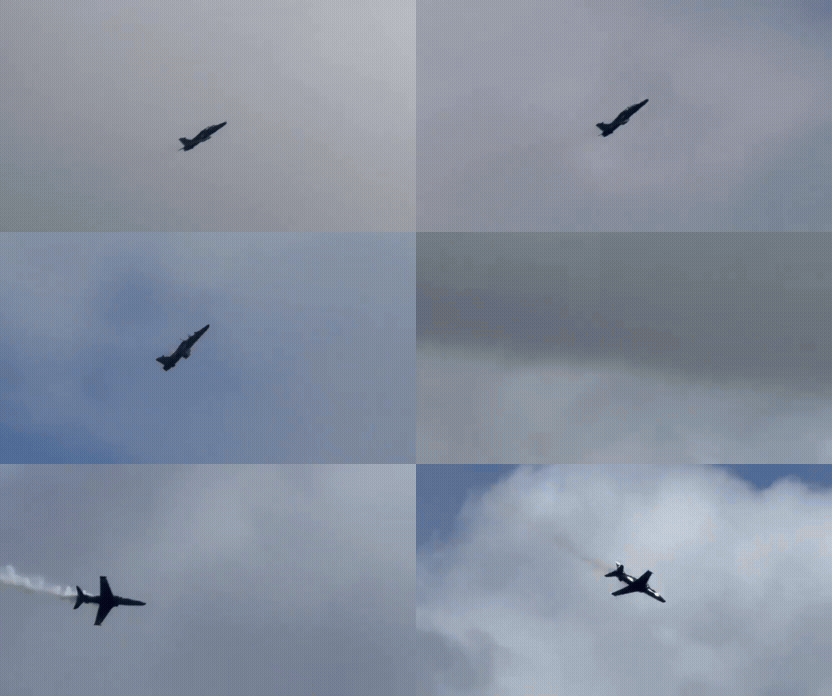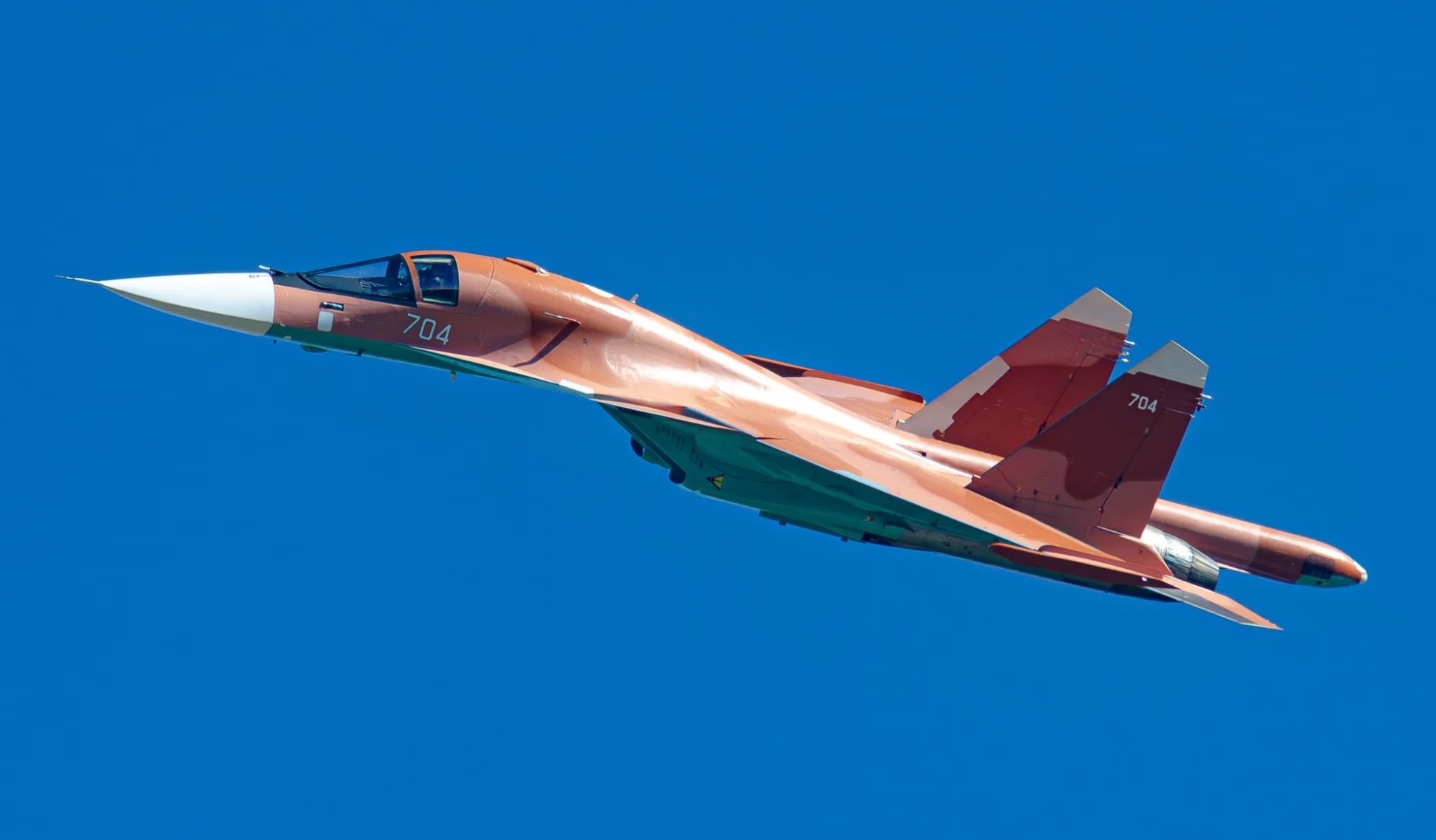
MOSCOW, Russia — May 25, 2026: Export-configured Sukhoi Su-34 fighter-bombers intended for the Algerian Air Force have been observed conducting training operations in Russia, marking a significant stage in Algeria’s ongoing combat aviation modernisation programme. Newly emerged footage showed aircraft carrying tail numbers 703 and 704 operating at Zhukovsky Airfield near Moscow, where Algerian pilots are reportedly completing advanced flight and operational training before the aircraft are formally delivered.
Zhukovsky Airfield, located outside Moscow, serves as the home base of the M. M. Gromov Flight Research Institute (LII) and is widely used for aircraft testing, avionics certification, pilot conversion, and evaluation programmes. According to regional defence analysts and open-source intelligence assessments, the observed flights are part of a structured pre-delivery process designed to familiarise Algerian aircrew with the aircraft and prepare them for operational deployment once transferred to Algeria.
Export Su-34E Aircraft Seen in Desert Camouflage
The aircraft observed during training are identified as the Su-34E, also referred to in defence reporting as the Su-34ME, an export version of Russia’s Su-34 “Fullback” twin-seat fighter-bomber. Unlike aircraft operated by the Russian Aerospace Forces, the Algerian-bound jets feature a distinct desert camouflage pattern in brown and yellow tones, adapted for North African operational environments and desert-based missions.
The Su-34E preserves the core combat characteristics of the Russian platform, including a side-by-side twin-seat cockpit intended to improve crew coordination during long-duration strike missions. The aircraft are designed for long-range precision attack operations and retain all-weather strike capability supported by advanced avionics and mission systems.
According to available information, the export aircraft include terrain-following and side-looking radar systems for low-altitude interdiction missions, enabling improved navigation and targeting performance in contested operational environments. The platform also maintains compatibility with a broad range of guided and unguided munitions, including precision-guided air-to-surface missiles, anti-ship weapons, guided glide bombs, and heavy strike ordnance.
Customer-Specific Modifications for Algeria
The Algerian Su-34E fleet reportedly incorporates several modifications compared with aircraft operated by Russia, including an enhanced electronic warfare system and customer-specific sensor fairings tailored to Algeria’s operational requirements. The aircraft are also configured for sustained operations in desert conditions while preserving the Su-34’s long-range strike profile, supersonic performance, and heavy payload capacity.
The training programme at Zhukovsky reportedly includes test flights, familiarisation sorties, and pilot conversion activities, allowing Algerian aircrew to gain operational experience before aircraft handover. Such programmes are standard practice for advanced combat aircraft deliveries and are intended to reduce transition time once the aircraft enter national service.
Algeria’s Su-34 Procurement Programme
Algeria became the first confirmed international customer for the Su-34 export platform after signing a contract in 2019 for 14 Su-34E fighter-bombers, according to defence reporting. The procurement formed part of a broader defence package that also included Su-57E and Su-35E combat aircraft.
Negotiations surrounding the acquisition, however, date back nearly a decade. Initial discussions reportedly began around 2016, when Algeria considered a smaller order of approximately 12 aircraft to gradually replace aging Soviet-era strike platforms in frontline service.
Production of the Algerian aircraft is being carried out at the Novosibirsk Aircraft Plant, with export-configured examples first observed during testing activities in 2025 before entering the current training and pre-delivery phase.
Role Within the Algerian Air Force
Once delivered, the Su-34E is expected to gradually replace Algeria’s Su-24M tactical strike aircraft, which have served for decades as a key component of the country’s bombing and interdiction capability. The aircraft will also complement Algeria’s broader Russian-origin fleet, which includes Su-30MKA multirole fighters, MiG-29 variants, and Yak-130 advanced jet trainers.
The acquisition reflects Algeria’s long-standing defence relationship with Moscow and forms part of a wider military modernisation effort focused on expanding long-range strike, multi-role aviation, and precision engagement capabilities.
Increased Logistics Activity Linked to Deliveries
The progress of the Su-34E programme also coincides with increased logistical activity between Russia and Algeria. Independent tracking data reportedly identified at least 167 military cargo flights between Russian state airfields linked to the United Aircraft Corporation (UAC) and Algerian military air bases over a 14-month period leading into mid-2026.
The movements are believed to involve transfers of technical components, support equipment, maintenance systems, spare parts, and associated defence infrastructure connected to Algeria’s expanding inventory of Russian-built military platforms.
No official statement has been released regarding the exact delivery timeline for the Su-34E aircraft or whether Algeria plans to expand procurement beyond the publicly reported 2019 contract for 14 aircraft. However, the continued pilot training activity at Zhukovsky Airfield indicates that the aircraft are progressing toward operational transfer and eventual integration into Algerian Air Force service.
——— End of Article ———