U.S
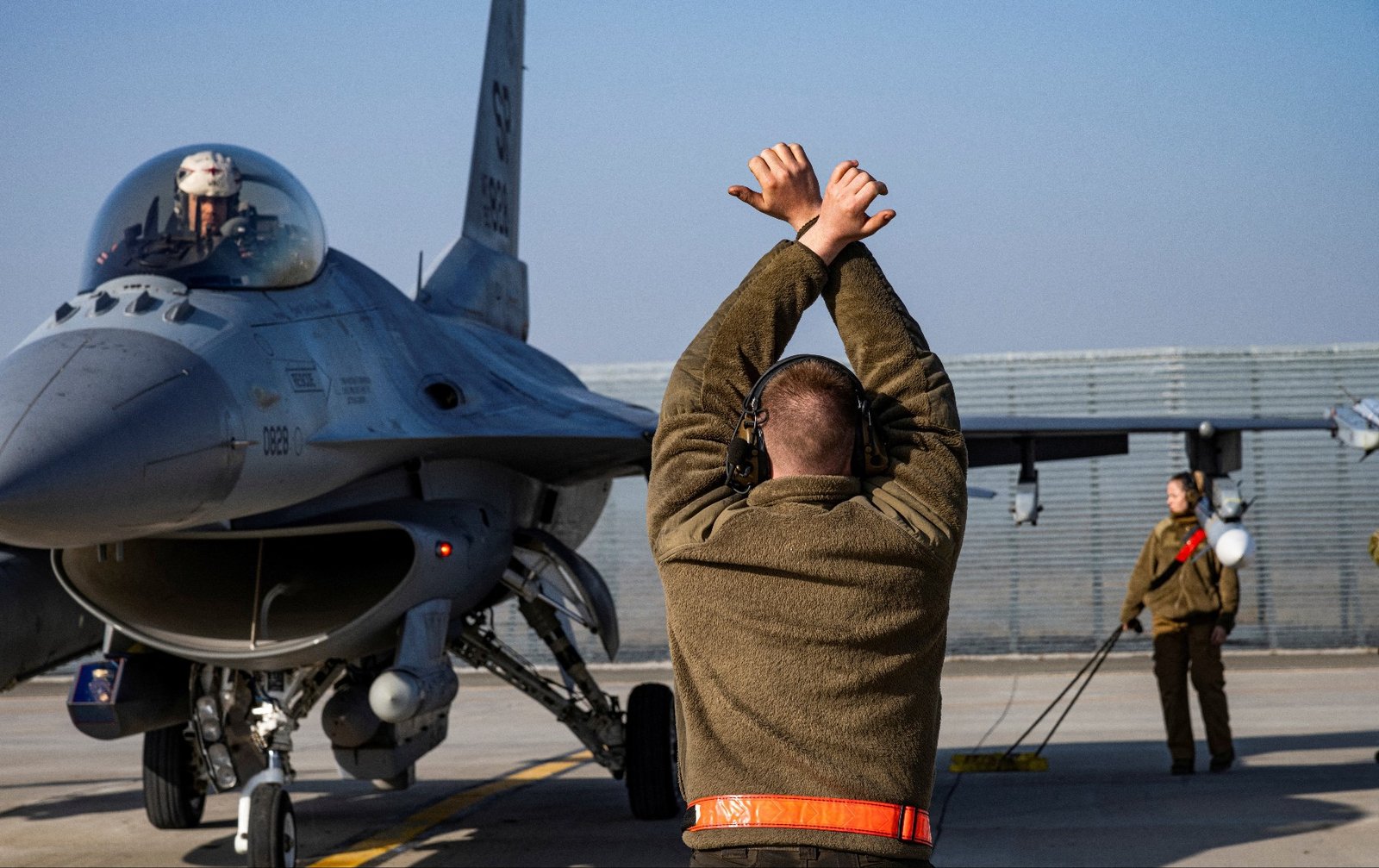
WASHINGTON — The United States continued training Ukrainian military personnel during the second quarter of 2026, including instruction for F-16 fighter pilots and ground crews, according to a joint report from the inspectors general of the U.S. Department of Defense, Department of State and U.S. Agency for International Development. The report, released on August 13 as part of ongoing congressional oversight of U.S. activities related to Ukraine under Operation Atlantic Resolve, covers the second quarter of 2026. F-16 Pilot and Ground Crew Training According to the report, the United States continued training Ukrainian F-16 pilots in line with commitments coordinated through the Air Force Capability Development Coalition. The United States co-leads the coalition with Denmark and the Netherlands. The training effort also includes Ukrainian ground personnel responsible for the operation and maintenance of the F-16 aircraft. The broader F-16 program involves training and sustainment support from several international partners. Ukraine began receiving F-16 fighter jets in the summer of 2024, while Ukrainian pilots had already begun training on the aircraft under the previous U.S. administration. Ukrainian pilots entering the F-16 training program have generally had previous experience operating Soviet-era aircraft, including the MiG-29 and Su-27. The training also requires specialized preparation for ground personnel responsible for maintaining and supporting the aircraft. Training on Bradley, Stryker and HIMARS U.S.-supported training during the reporting period was not limited to aviation. American personnel also trained Ukrainian forces to operate, maintain and repair several U.S.-supplied weapons systems. These included Bradley infantry fighting vehicles, Stryker armored personnel carriers and HIMARS rocket systems. The instruction covered both the use of the systems and maintenance activities needed to keep them operational. A total of 575 Ukrainian Armed Forces personnel completed training during the second quarter of 2026. The training was conducted at military bases in Germany, Poland, Romania, Spain, Kosovo, Ukraine and the United States. The number of personnel completing training was 29 percent lower than in the first quarter of 2026, according to the report. U.S. F-16 Training and Sustainment Support The current training effort follows a U.S. State Department determination in May 2025 approving a possible $310.5 million Foreign Military Sale to Ukraine for F-16 training and sustainment. The package covers aircraft modifications and upgrades, personnel training for aircraft operation, maintenance and sustainment, spare parts, consumables, repair and return support, ground-handling equipment, software, technical documentation, studies and surveys, as well as U.S. government and contractor engineering, technical and logistics support. The U.S. government said the proposed package was intended to ensure Ukrainian pilots receive effective training and increase interoperability between Ukraine and the U.S. Air Force. The F-16 support effort is part of the wider international coalition supporting Ukraine's transition to Western aircraft. The coalition's activities include pilot and maintainer training, sustainment support and other measures required to operate the aircraft. Continued Training Requirement Training Ukrainian personnel on Western military systems remains an ongoing requirement because the equipment requires specialized skills for operation, maintenance and sustainment. The inspectors general report confirms that U.S.-supported training continued during the second quarter of 2026, covering both F-16 aviation personnel and Ukrainian forces operating ground-based U.S.-supplied systems. The report is part of the regular oversight process for U.S. programs and operations supporting Ukraine. Under U.S. law, the Special Inspector General for Operation Atlantic Resolve is required to provide quarterly reports to Congress covering U.S.-funded programs and operations related to Ukraine.
Read More → Posted on 2026-08-14 14:03:13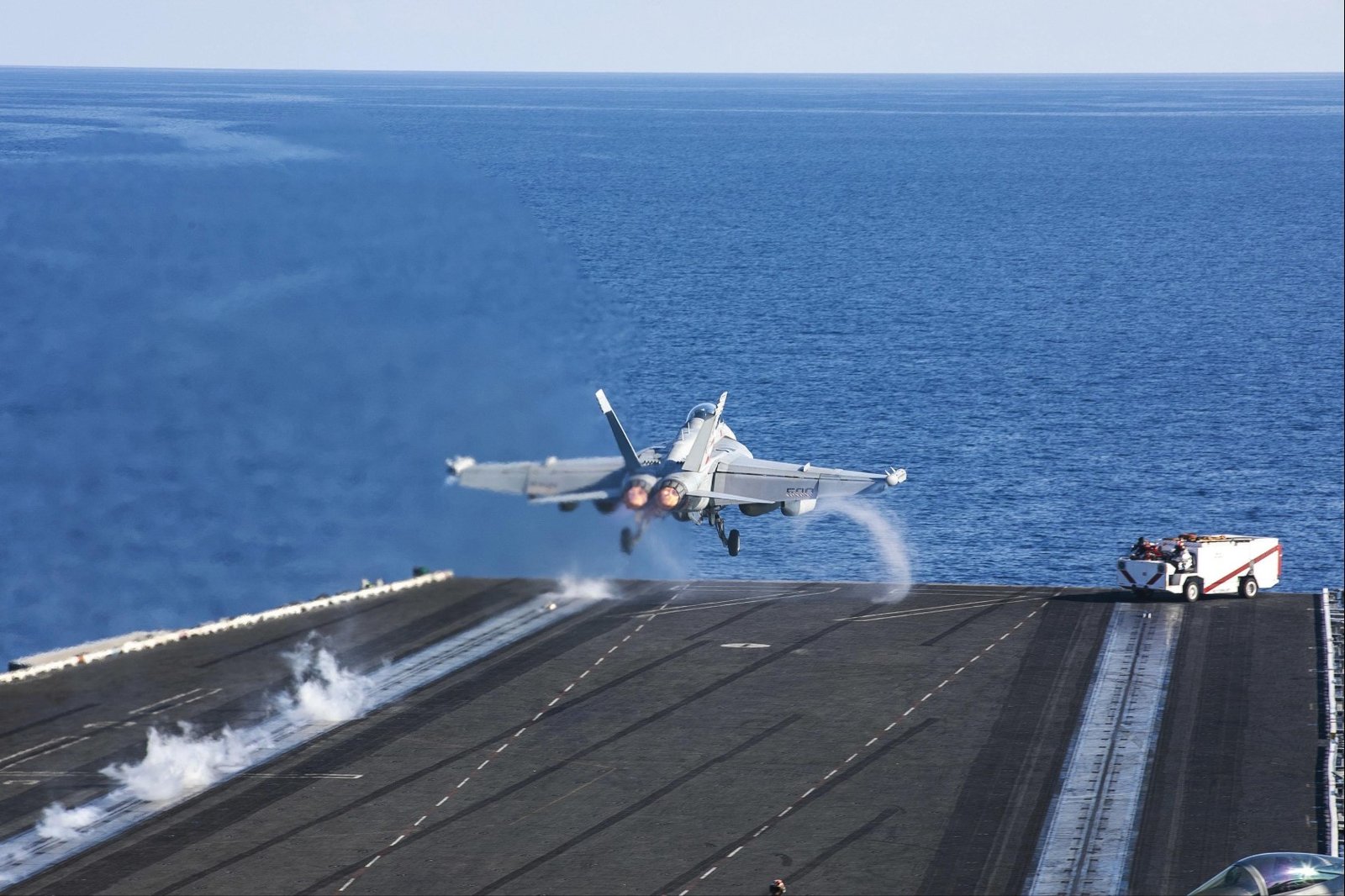
U.S
WASHINGTON — President Donald Trump has directed the U.S. Navy to replace the Electromagnetic Aircraft Launch System (EMALS) and Advanced Weapons Elevators (AWE) with steam-powered catapults and hydraulic systems on future Gerald R. Ford-class aircraft carriers, beginning with the future USS Doris Miller (CVN-81). Trump signed a National Security Presidential Memorandum on August 13 titled “Rebuilding the United States Navy and America’s Shipbuilding Industrial Base.” The memorandum is primarily focused on rebuilding the U.S. Navy and strengthening the country’s shipbuilding industrial base, but it also directly intervenes in the detailed engineering of the Ford-class carrier program. The memorandum gives the Secretary of War, in consultation with the Secretary of the Navy, 60 days to submit a plan to the President through the Director of the Office of Management and Budget (OMB) and the Assistant to the President for National Security Affairs (APNSA). The plan must identify the measures required to replace EMALS and Advanced Weapons Elevators with steam and hydraulic systems for the construction of CVN-81, including the required timelines and resources. The first three Ford-class carriers — USS Gerald R. Ford (CVN-78), the future USS John F. Kennedy (CVN-79) and USS Enterprise (CVN-80) — will retain EMALS. Unless the policy changes again, USS Doris Miller and subsequent carriers would incorporate the steam and hydraulic systems. Major Change to the Ford-Class Design The Ford class was designed from the beginning around extensive electrification. Its two A1B nuclear reactors provide substantially greater electrical generating capacity than the preceding Nimitz-class design, while electricity replaces many functions that previously depended on steam, hydraulic or mechanical equipment. EMALS uses electrical energy and linear induction motors to accelerate aircraft along the catapult track. The system provides more precise control of the acceleration delivered to an aircraft than a conventional steam catapult. The Navy says EMALS is designed to launch aircraft ranging from lightweight uncrewed aircraft to heavy strike fighters. The system can adjust the launch profile according to aircraft requirements, while its smoother acceleration can reduce stress on airframes. Replacing EMALS on CVN-81 is therefore considerably more complicated than exchanging one catapult for another. A steam catapult requires high-pressure steam from the ship's propulsion system, together with substantial piping, accumulators and associated water and condensation systems. The Ford-class design was developed without much of the infrastructure used to support traditional steam catapults. As a result, restoring steam systems would require changes to internal compartments, energy distribution and other supporting ship systems. USS Doris Miller Is Already Under Construction The future USS Doris Miller is the fourth Ford-class carrier and is being built at Huntington Ingalls Industries' Newport News Shipbuilding. Because construction is already underway, the presidential directive comes after the detailed design of the Ford-class has been developed and after work on CVN-81's original systems has already begun. General Atomics, which produces EMALS and the Advanced Arresting Gear (AAG), received the contract for the systems for Doris Miller in 2023. The company has said that work on the EMALS and AAG equipment for CVN-81 is already nearly 50 percent complete. Changing the system at this stage could therefore require already completed work to be abandoned or redesigned, followed by the design, production and integration of replacement equipment. The exact financial and schedule impact has not yet been established. The 60-day Navy study ordered by Trump is intended to determine the engineering requirements, timelines and resources involved. Ford Program's Difficult Beginning The Ford-class introduced 23 significant new systems, including EMALS, Advanced Arresting Gear, Advanced Weapons Elevators, new reactors, new radar systems and extensive automation. The introduction of so many new technologies created significant technical and reliability challenges during the early years of the program. Problems involving EMALS, AAG and the weapons elevators contributed to delays in bringing USS Gerald R. Ford into full operational service. Government reviews, including work by the Government Accountability Office, previously highlighted reliability problems and the risks associated with installing immature systems aboard the first ship while development was still continuing. Trump's criticism of EMALS therefore dates back to the early development period of the Ford program. However, EMALS has since accumulated substantial operational experience. By March 2026, USS Gerald R. Ford had completed 36,863 electromagnetic aircraft launches, according to Pentagon figures. USS Gerald R. Ford's 326-Day Deployment USS Gerald R. Ford returned to Naval Station Norfolk on May 16, 2026, after a 326-day deployment. The deployment was the longest U.S. carrier deployment since the Vietnam War era. During the deployment, the carrier sailed more than 57,700 nautical miles and operated across multiple U.S. fleet areas. Carrier Air Wing Eight recorded more than 5,760 flying hours and 12,200 aircraft launches using EMALS during the deployment. The figures provided significant operational experience with the electromagnetic launch system after the reliability problems seen during the early stages of the Ford program. The Navy has also stated that EMALS and AAG support higher aircraft launch and recovery rates than the systems used on Nimitz-class carriers. The Electric Carrier The Ford-class was designed as a highly electrified carrier rather than simply as a Nimitz-class carrier with new catapults. The electrical architecture, reactor-generated power and automated systems were developed together as part of the carrier's overall design. EMALS is integrated throughout the ship and crosses 48 separate ship construction zones. Removing it would therefore affect areas beyond the equipment directly installed beneath the flight deck. Steam catapults would require high-pressure steam to be distributed from the propulsion plant through substantial pipework to the launch machinery. Supporting equipment would also require space for water, condensation and maintenance systems. Much of this infrastructure was deliberately reduced or eliminated during the Ford-class design process. The last U.S. aircraft carrier built with traditional steam catapults was USS George H.W. Bush (CVN-77), commissioned in 2009. No new sets of the C-13 steam catapult used on Nimitz-class carriers have been manufactured in almost two decades. Reintroducing the system would therefore also require the United States to rebuild or reactivate parts of an industrial base that is no longer producing the equipment at its previous scale. The White House memorandum links the return to steam and hydraulic systems to its broader objective of rebuilding the U.S. maritime industrial base. Work Already Completed on CVN-81 The timing of the order creates a significant engineering issue because CVN-81 was being developed as part of the existing Ford-class design. General Atomics' work on the EMALS and AAG equipment for Doris Miller is nearly 50 percent complete, according to the company. The change would therefore involve more than cancelling future EMALS deliveries. The Navy would have to determine what equipment already produced for the carrier can be retained, what must be removed or redesigned and how the replacement steam and hydraulic systems can be integrated into the ship. The eventual cost remains uncertain until the Navy completes the study ordered by Trump. Estimates of the potential impact have included the possibility of costs reaching billions of dollars, but the memorandum itself does not establish a final figure. The construction schedule is another major issue because the redesign would be taking place on a carrier already under construction. Operational Advantages of EMALS Steam catapults remain a proven technology and have launched aircraft from U.S. carriers for decades. However, EMALS provides more precise control over aircraft acceleration. The system can adjust the energy delivered during launch, allowing it to accommodate different aircraft weights and launch requirements. This is particularly relevant as carrier air wings increasingly incorporate uncrewed aircraft. The Navy's Naval Air Systems Command describes EMALS as a system capable of launching aircraft from lightweight uncrewed platforms through heavy strike fighters. The MQ-25 Stingray represents an early step in the U.S. Navy's move toward greater use of carrier-based uncrewed aircraft. Future Ford-class carriers are expected to remain in service for many decades, meaning their launch systems will need to support multiple generations of aircraft. EMALS also contributes to the Ford class's manpower reduction. The class was designed to operate with roughly 500 fewer sailors than a Nimitz-class carrier. The reduction comes from many aspects of the ship's automation and design, including systems that replace manpower-intensive steam and hydraulic equipment. The Navy has also designed the Ford class for a higher sortie generation rate than previous carriers. China Has Also Adopted Electromagnetic Catapults The U.S. decision comes as China has adopted electromagnetic launch technology for its newest aircraft carrier. China commissioned the 80,000-tonne Fujian in November 2025. Unlike the ski-jump-equipped Liaoning and Shandong, Fujian is equipped with three electromagnetic catapults. During trials, the People's Liberation Army Navy demonstrated electromagnetic launches involving the J-15T fighter, J-35 stealth fighter and KJ-600 fixed-wing airborne early warning aircraft. China has therefore moved from ski-jump carrier operations to electromagnetic catapult operations with its latest carrier design. France has also selected EMALS and Advanced Arresting Gear for its future nuclear-powered Porte-Avions de Nouvelle Génération (PA-NG) aircraft carrier. The adoption of electromagnetic launch systems by China and France highlights the different direction being taken by several countries developing their next-generation carrier aviation capabilities. A Major Engineering Intervention The memorandum's decision to return to steam is also notable because it comes alongside criticism of iterative design changes as a cause of cost increases and delays in U.S. shipbuilding. The same memorandum calls for measures to rebuild the U.S. naval shipbuilding industrial base, including plans for a fifth public Navy shipyard, additional submarine drydock capacity and a Component Repair Center for submarine components. It also calls for increased production of Virginia-class attack submarines and Columbia-class ballistic missile submarines, as well as greater foreign involvement in certain shipbuilding activities under conditions involving investment in U.S. shipyards and workforce training. These measures are intended to address broader problems in U.S. shipbuilding capacity. The carrier decision, however, introduces a substantial design change into an existing carrier program. Navy Faces a 60-Day Deadline The U.S. Navy now has 60 days to prepare the plan ordered by Trump. The plan must determine the engineering changes, timelines and resources required to replace EMALS and Advanced Weapons Elevators with steam and hydraulic systems on CVN-81. The study will also determine the practical effects on the carrier's construction and the industrial base required to produce the replacement systems. The future USS Doris Miller is therefore set to become the first Ford-class carrier affected by the return to steam-powered launch technology, while USS Gerald R. Ford, USS John F. Kennedy and USS Enterprise will continue operating with EMALS. The final direction for CVN-81 will depend on the outcome of the Navy's 60-day assessment and any subsequent policy decisions.
Read More → Posted on 2026-08-14 13:44:00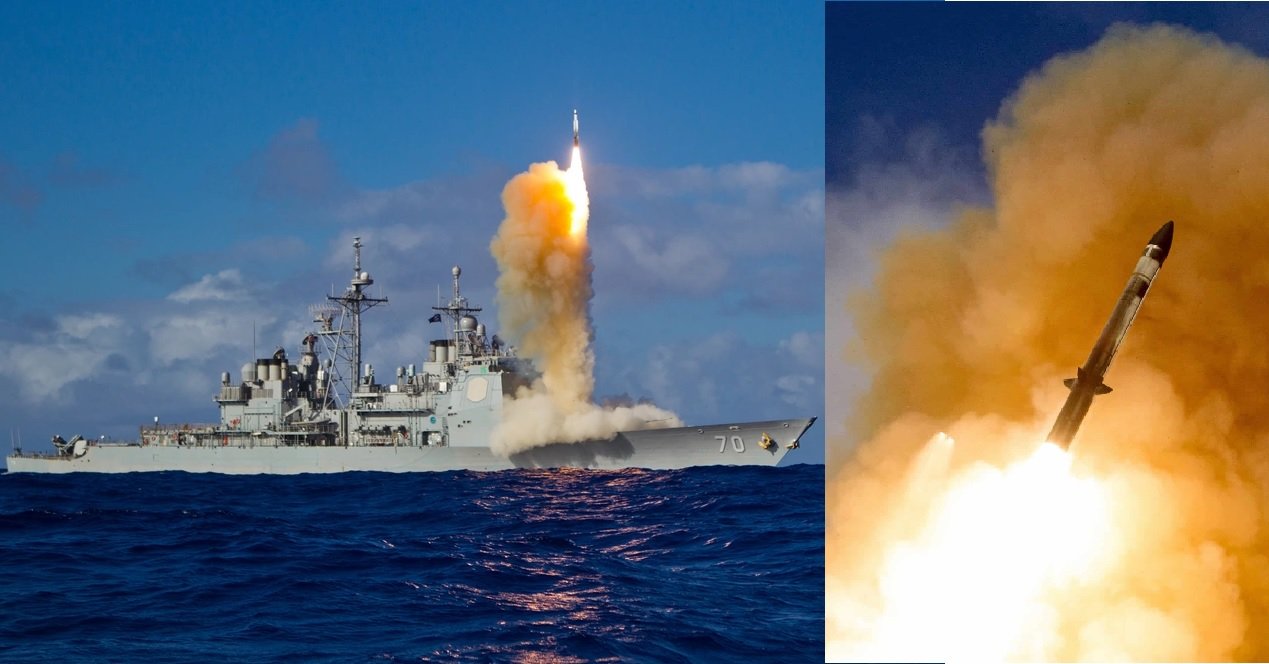
U.S
WASHINGTON — The U.S. Department of War has signed two framework agreements with Boeing and RTX to increase production of key components for the Standard Missile-3 (SM-3) Block IB and Block IIA interceptors. The agreements are intended to strengthen the SM-3 supply chain and accelerate the delivery of completed interceptors to U.S. Navy forces. The SM-3 is a ship-launched interceptor used as part of the Aegis Ballistic Missile Defense System for ballistic missile defense operations. Boeing and RTX to Support Higher SM-3 Production Under the new framework agreements, Boeing will lead manufacturing efforts for key SM-3 components. The Department of War said the move is intended to address supply-chain bottlenecks and speed the movement of munitions from production facilities to operational forces. The agreements cover both the SM-3 Block IB and SM-3 Block IIA, two variants of the interceptor used with the Aegis missile defense system. “These agreements ensure our Warfighters get the munitions they need to win,” said Michael P. Duffey, Under Secretary of War for Acquisition and Sustainment. Duffey said the Department is working to stabilize supply chains, expand munitions production and strengthen the U.S. defense industrial base. Acquisition Strategy Supports Production Expansion The agreements were facilitated by the Department of War’s Acquisition Transformation Strategy (ATS). The strategy is designed to reduce administrative delays and allow the government to work more directly with suppliers throughout the defense supply chain. The department said this approach is intended to help increase production and improve the movement of components and completed weapons. The latest agreements specifically focus on the component supply chain supporting SM-3 production. SM-3 Block IB and Block IIA The SM-3 is a kinetic, exo-atmospheric ballistic missile interceptor. Instead of using an explosive warhead to destroy its target, the interceptor uses a kinetic warhead to destroy an incoming ballistic missile through direct impact outside the atmosphere. The SM-3 Block IB incorporates a two-color infrared seeker and an improved steering system compared with earlier versions. These improvements provide enhanced capability against ballistic missile targets. The SM-3 Block IIA was jointly developed by the United States and Japan. It features a larger-diameter design, larger rocket motors and an enhanced kinetic warhead compared with earlier SM-3 variants. The Block IIA is designed to provide greater engagement capability over wider areas. RTX’s Raytheon business is the prime contractor for the SM-3 missile, with production work carried out at facilities in Tucson, Arizona, and Huntsville, Alabama. Boeing has supplied critical hardware for SM-3 variants used with the Aegis system. Agreements Follow Earlier Production Efforts The new agreements build on earlier U.S. efforts to increase SM-3 production. In February 2026, Raytheon signed separate framework agreements covering the SM-3 Block IB, SM-3 Block IIA, Tomahawk, AMRAAM and SM-6. Those agreements were aimed at increasing overall production rates for the covered systems. In early August 2026, Raytheon also received a $745 million contract from the Missile Defense Agency to manufacture and assemble SM-3 Block IIA interceptors for the United States and Japan under a Foreign Military Sales arrangement. Work under that contract is expected to continue through February 2031. The August 14 agreements with Boeing and RTX are focused specifically on the components required for SM-3 production. No Production Quantities or Financial Details Released The Department of War did not disclose the financial value of the two new framework agreements or specific production quantity targets. The department said the agreements are focused on stabilizing the supply chain, removing production bottlenecks and supporting higher SM-3 interceptor production. The effort comes as the United States continues to strengthen its munitions production capacity and the readiness of its naval missile defense forces.
Read More → Posted on 2026-08-14 13:26:25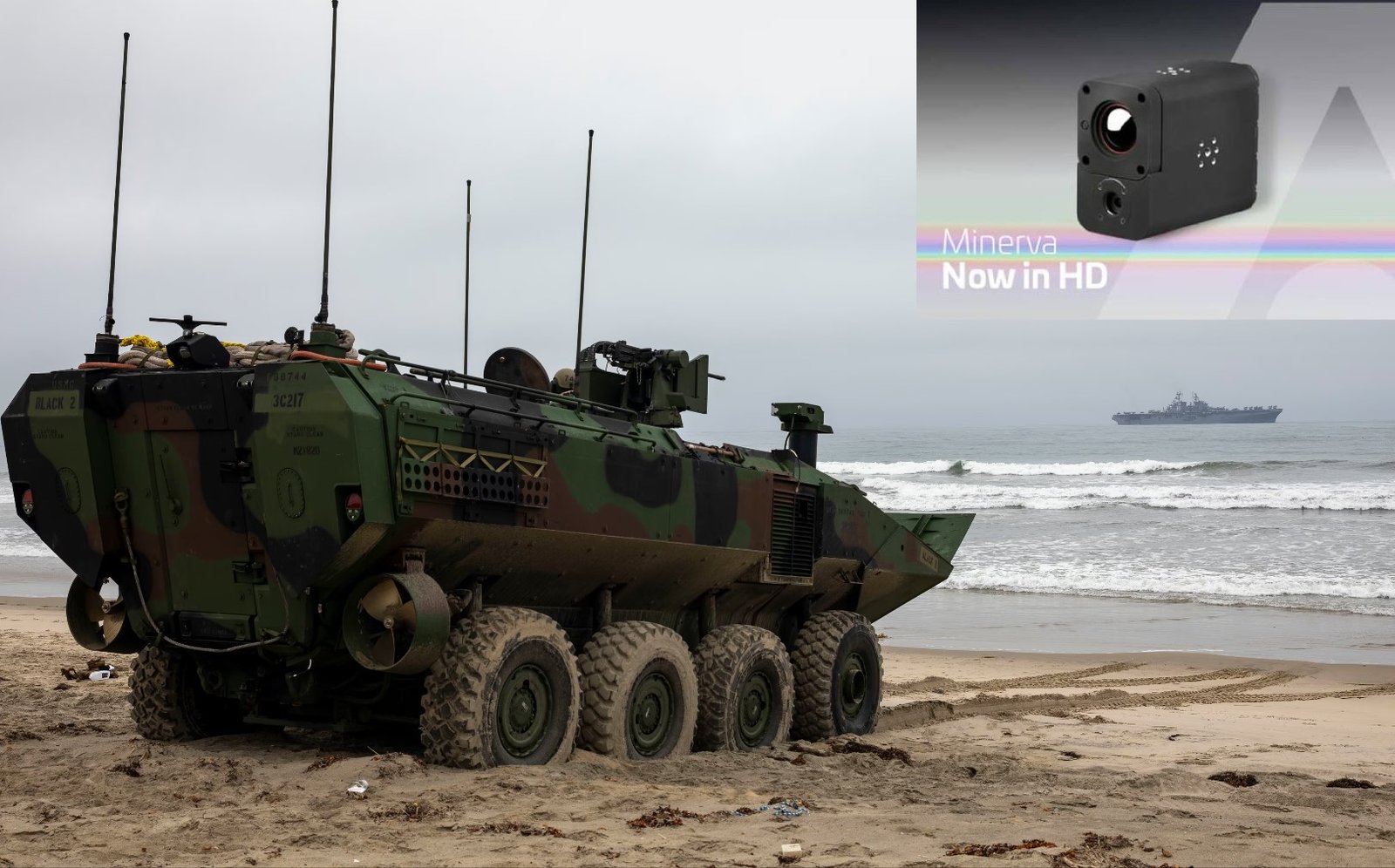
U.S
WASHINGTON — Thales Defense & Security, Inc. (TDSI) has received an order to supply the U.S. Marine Corps with more than 400 SharpView Dual Camera – Minerva imagers for its Amphibious Combat Vehicles (ACVs). The cameras will be installed on the ACV-P Personnel and ACV-C Command variants, replacing legacy imaging systems and improving crew visibility and situational awareness in conditions such as darkness, dust, smoke, glare and adverse weather. Minerva combines an uncooled Long Wave Infrared (LWIR) thermal detector and a visible-light camera in one compact housing. It features a 1280 × 1024 LWIR detector with a 12-micron pixel pitch and a 1920 × 1080 full-HD visible module. The system provides digital 60 Hz video through 3G-SDI, with low-latency output and automatic image processing. The dual-band system is designed to help crews detect obstacles, navigate and maintain situational awareness during day and night operations. Its integration with existing vehicle systems also allows the Marine Corps to replace legacy cameras without developing a new vehicle imaging architecture. The Minerva camera is designed and manufactured by Thales in Canada and was launched in 2022. Thales said its combat imaging systems are used by more than 50 armed forces worldwide, building on more than 30 years of experience in cooled and uncooled thermal imaging. “Marines depend on cutting-edge and robust technology to make rapid decisions in highly demanding and dynamic environments,” said Chris Beauparant, Vice President of Sensors and Missile Systems at Thales Defense & Security, Inc. He said Minerva provides crews with a more complete picture of the battlefield and helps them identify hazards sooner and maneuver more effectively. Thales confirmed the order in an announcement published on August 11, 2026. The cameras will be used on both new and existing ACV-P and ACV-C vehicles. The Minerva system has also been selected for evaluation and testing under the U.S. Army's XM30 program, which focuses on next-generation combat vehicles with improved crew protection and situational awareness. The Marine Corps' ACV program, led by BAE Systems, includes the ACV-P, ACV-C, ACV-30 fire-support variant and ACV-R recovery variant, with current plans calling for around 632 vehicles. Thales already supplies related electro-optical systems for U.S. Marine Corps ground vehicles, including cooled SharpView cameras for the Marine Air Defense Integrated System (MADIS) and Catherine thermal imagers for the ACV-30.
Read More → Posted on 2026-08-14 13:21:14
World
KYIV, Ukraine, August 14, 2026 — Ukraine has begun combat testing of its first jet-powered interceptor drones designed to counter Russia’s growing use of jet-powered Shahed-type attack drones. Former Ukrainian Defence Minister Mykhailo Fedorov said on August 14, after visiting a production facility, that one Ukrainian team had developed a jet-powered interceptor capable of reaching speeds of more than 600 km/h. 🇺🇦 Ukraine begins combat testing of its first jet-powered interceptor drones, designed to counter Russia’s growing use of jet-powered Shahed-type attack drones.The new interceptor can exceed 600 km/h, with developers awaiting the first confirmed combat results. pic.twitter.com/pZNNpWCuIA — The Defense News (@TheDefenseNews) August 14, 2026 “The system is now undergoing combat testing,” Fedorov said. Developers are awaiting the results of the trials, including the first confirmed shoot-downs of enemy targets. Fedorov said Russia is gradually replacing conventional Shahed drones with faster jet-powered versions, describing the development as a change in the strategy of aerial warfare. He said Ukraine must respond quickly to keep pace with each new technological development. Ukraine launched a coordinated interceptor-drone programme through the Defence Ministry last year. The programme focused on opening the market to manufacturers, conducting combat tests and increasing government procurement. Through Brave1, Ukraine’s defence technology cluster, manufacturers have received grants, while their systems have been assessed and supported during testing. Fedorov said several Ukrainian companies now have solutions designed to counter jet-powered drones and called for increased investment in research, development, testing and production. He said the immediate task is to increase efforts to counter the threat as quickly as possible. Other Ukrainian companies are also developing faster interceptors. SkyFall’s P1-SUN JetKiller has been reported at around 370 km/h, with the system already recording interceptions of jet-powered threats and moving toward mass production. British-Ukrainian company Firebolt Engineering’s Griffen jet-powered interceptor exceeds 350 km/h and has reportedly achieved a confirmed shoot-down of a Russian Geran-2, a Shahed-type drone. Separate reports said at least two Ukrainian companies were testing jet-powered interceptors by early June 2026, with one having already downed a Geran drone. Ukrainian military leadership has previously said Russia intends to increase the share of jet-powered systems, potentially to half of its long-range one-way attack drone inventory. Ukraine is also expanding the use of slower interceptor drones. On August 12, the Defence Ministry approved the TAF Kolibri-i10, developed by TAF Industries, for service. It can exceed 200 km/h, has a range of up to 25 km, an endurance of more than 20 minutes and an operating altitude of up to 3,000 meters. It is primarily intended to counter reconnaissance and other fixed-wing drones such as Molniya, Orlan and Zala. The combat testing of the new 600-km/h interceptor is part of Ukraine’s wider effort to develop faster systems as Russia increases its use of jet-powered attack drones.
Read More → Posted on 2026-08-14 12:51:32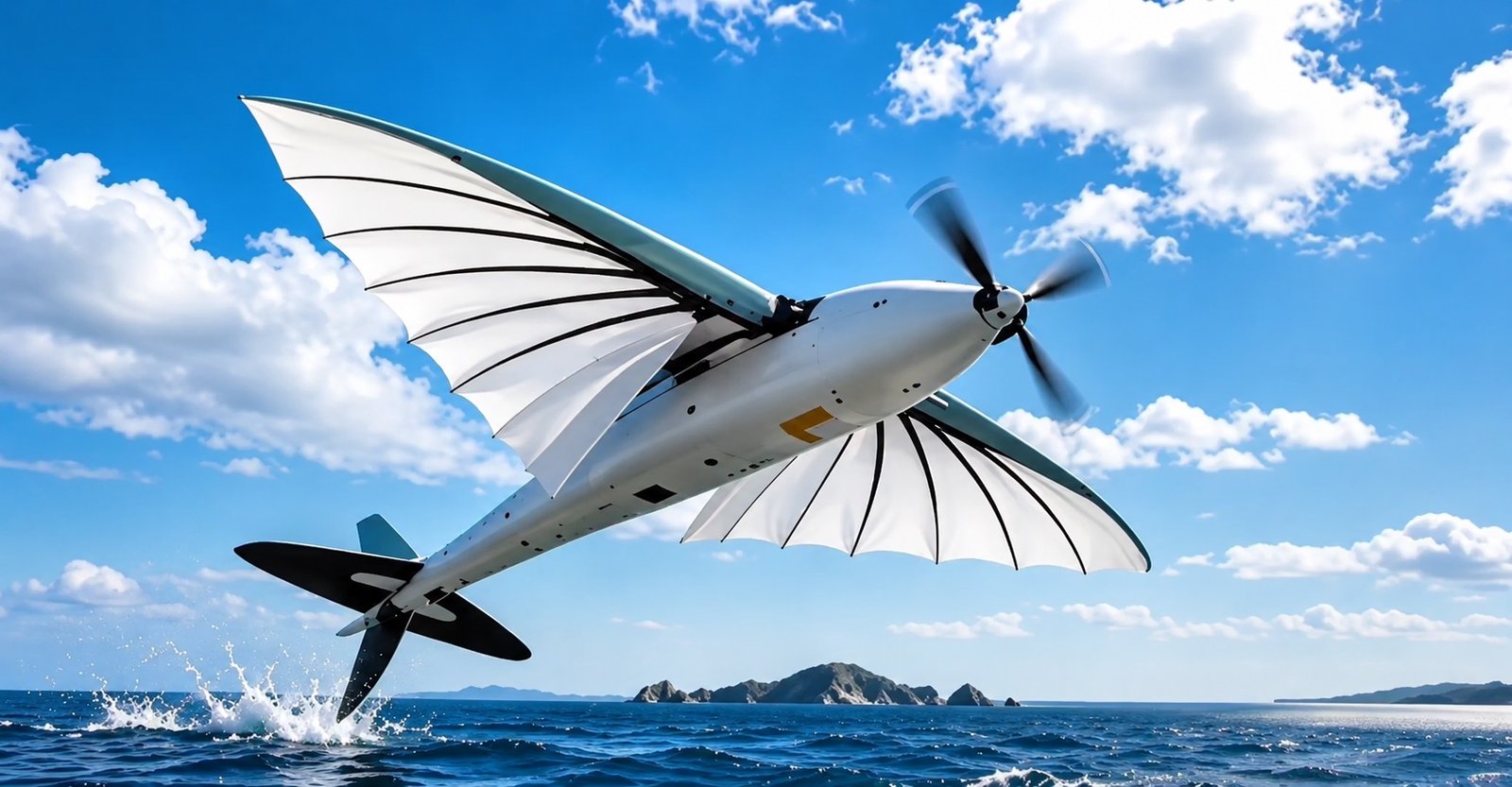
World
CHANGSHA, China — Chinese technology company Changsha Nighthawk Intelligent Technology is completing testing of its SkyX bionic amphibious system and preparing for serial production, according to Chinese reports and coverage including CGTN. Inspired by a flying fish, the SkyX is designed to operate in three modes: aerial flight, surface gliding and underwater travel. In the air, its wings unfold into a fixed-wing configuration while a front propeller provides thrust, giving the system an endurance of up to one hour. When entering the water, the wings fold inward to create a streamlined shape and reduce drag, while a tail propeller provides underwater propulsion. The company states that the vehicle can reach underwater speeds of up to 50 km/h (31 mph). China’s Changsha Nighthawk Intelligent Technology is preparing the SkyX bionic amphibious drone for serial production, with the system designed for air, surface and underwater operations, up to 1 hour of flight endurance and underwater speeds of up to 50 km/h pic.twitter.com/LH3skqVDY2 — The Defense News (@TheDefenseNews) August 14, 2026 Changsha Nighthawk says comparable foreign amphibious systems typically reach about 6 km/h (3.7 mph) underwater and have aerial endurance of roughly six minutes. Development began with a concept prototype in 2021, and the team has now completed five generations of prototypes. The fifth generation entered cross-medium testing in 2025. Real-world water tests have demonstrated flight, underwater movement, mode switching, surface jumping and passage under bridges. The system uses adaptive flight controls, combined ducted and propeller propulsion, and sealing measures to handle the major difference between air and water environments. Its range and maximum diving depth have not been publicly released, while development continues on water-exit reliability, complex sea conditions and payload capacity. The SkyX is being considered for emergency rescue, ocean monitoring, environmental data collection and search-and-rescue operations. Defense-related applications, including reconnaissance, have also been discussed, but available information does not indicate that the vehicle has been configured or armed for a specific military strike role. The project is being developed by a team of eight people that originated from a university drone club. The team has received 200,000 yuan from the Hunan provincial university student entrepreneurship investment fund, is listed on the Hunan equity exchange's student innovation and entrepreneurship board, and plans to raise 500,000 yuan for further engineering optimization and small-batch delivery. It is also applying for patents covering power systems, structure and algorithms. The project remains focused on prototype optimization, reliable air-water transitions and preparations for limited production.
Read More → Posted on 2026-08-14 12:01:33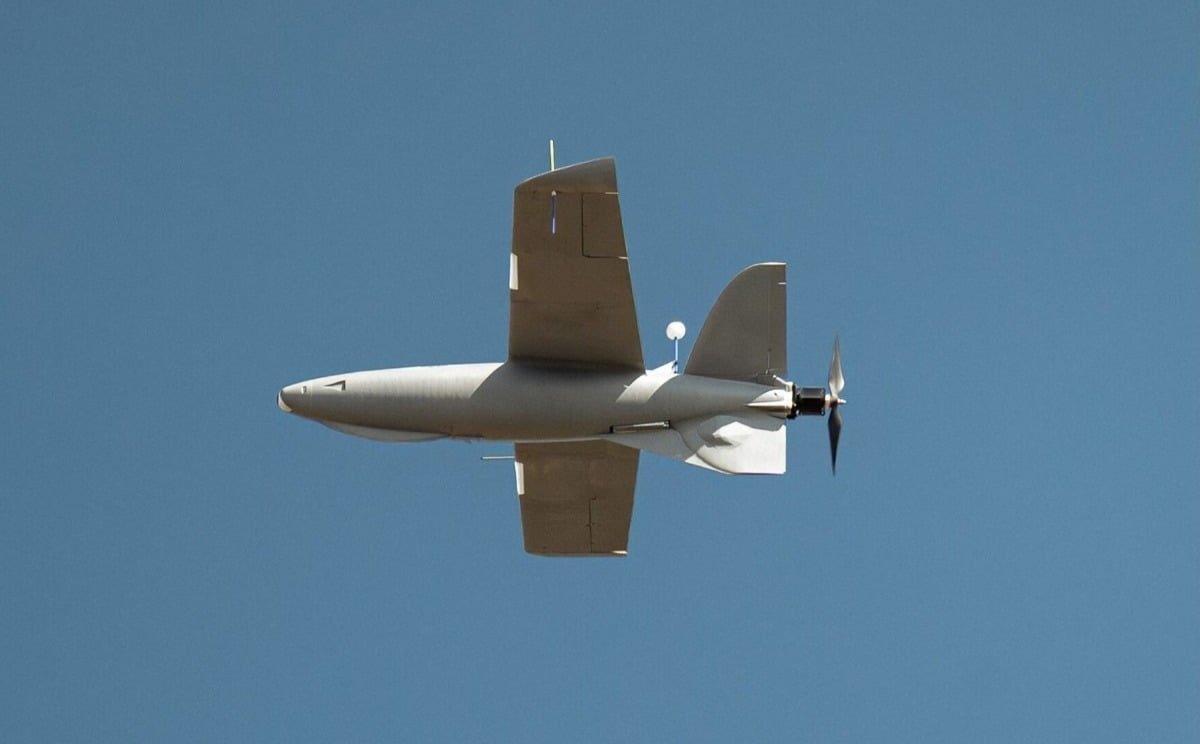
World
KYIV, Ukraine — Ukrainian defense-technology company Ukrainska Bavovna has unveiled the Last Shadow T200, a fixed-wing interceptor drone designed for city air defense and frontline operations against Russian unmanned aerial vehicles. The system was presented at an event organized by the Technological Forces of Ukraine association. According to information provided by the company to Militarnyi, the T200 is designed to intercept Shahed (Geran), Gerbera, Molniya, Lancet, Orlan and Zala drones. Development began last year. The T200 has a maximum speed of 300 km/h, a practical ceiling of 5,000 meters, and a maximum climb rate of 35 meters per second. Its propulsion system provides about 7 kilograms of thrust, although the company says normal flight uses much less of the available power. The drone has an endurance of about one hour at a cruising speed of 130 km/h, and around 40–50 minutes at higher interception speeds. Its initially stated operational range was 70 kilometers, but recent combat trials saw the aircraft cover 122 kilometers while maintaining a stable, high-quality video link with ground control. The interceptor is designed to operate in heavy electronic-warfare environments. It uses beacon-based navigation, a jamming-resistant Sine.link data channel, and systems that switch between video channels and frequency bands to counter Russian interference, including the Shtora image-spoofing system. Target detection is supported by a movable, gimbal-mounted camera that can be raised and lowered. It can tilt from -80 to +45 degrees and provides thermal imaging. Ukrainska Bavovna is also integrating an automated terminal-guidance system. The operator will designate the target using a switch, after which the onboard autopilot will control the final approach. The T200 uses a codified warhead and initiation board, with a PWM signal used when engaging aerial targets. Its 2.5-kilogram shaped-charge warhead was developed by Rendrock Ukraine. Both the drone and warhead have been codified. The T200 is launched from a pneumatic catapult, which can be deployed in less than five minutes. Its airframe is currently produced using 3D printing, but the company plans to switch to molding within several months to increase structural strength and enable reusable landings. Small-scale serial production has already begun following state codification. Ukrainska Bavovna said it focuses on maximizing the use of Ukrainian-made components and also provides joint research and development, testing, and maintenance, repair and overhaul services to foreign partners. For operator training, it works with the Dovzhyk pilot school, where more than 70 veterans prepare crews to operate various drones, including interceptors.
Read More → Posted on 2026-08-14 11:42:27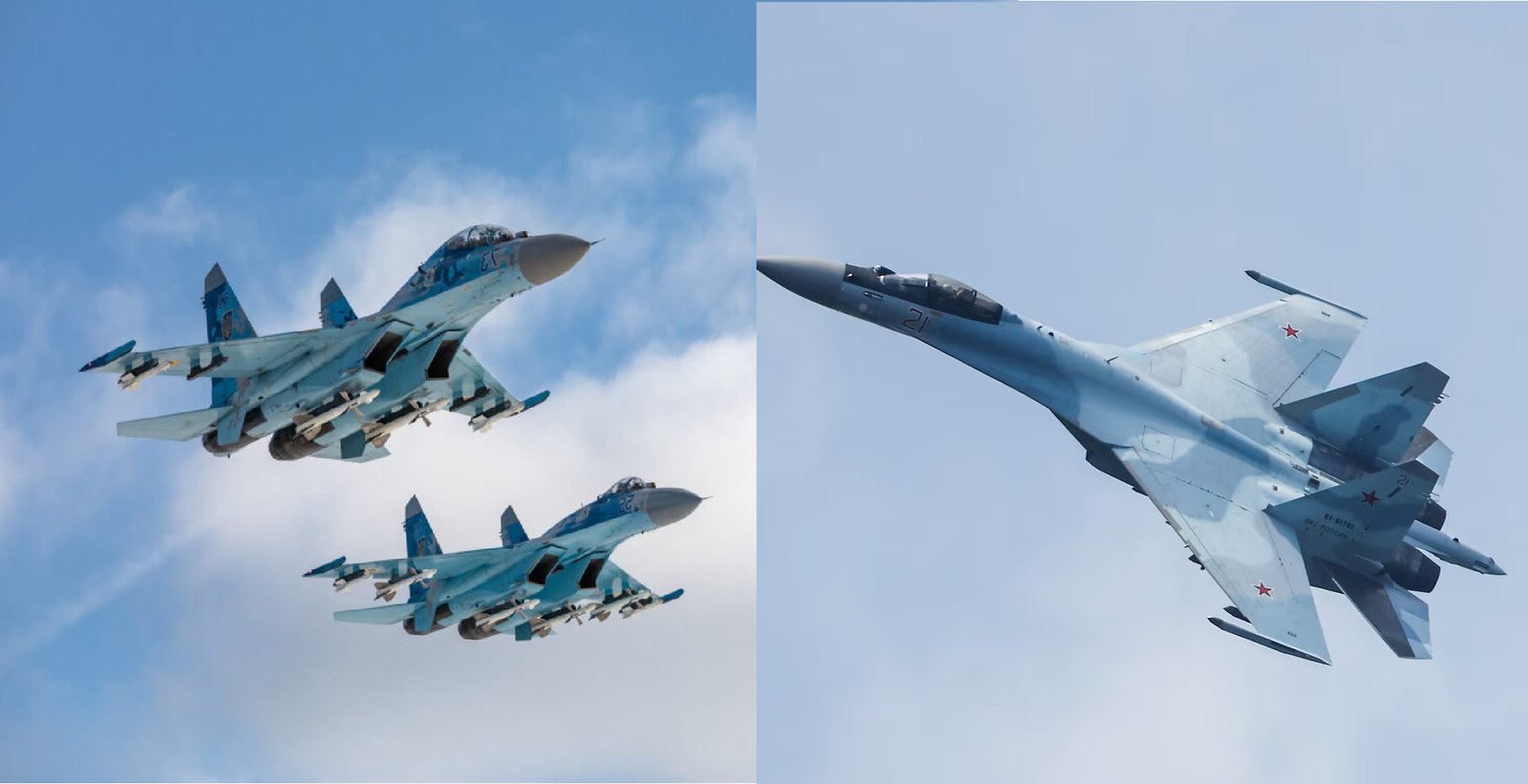
World
MOSCOW, Russia — A Russian Su-35S fighter pilot destroyed two Ukrainian Su-27 aircraft during a single air engagement, according to Sergey Kobylash, commander of the Russian Air Force and deputy commander-in-chief of the Russian Aerospace Forces. Kobylash described the incident in an interview with Krasnaya Zvezda published around the 114th anniversary of the Russian Air Force on August 12. Russian media, including Izvestia, subsequently reported his account. According to Kobylash, the young pilot was conducting a combat air patrol to provide cover for an advancing group of Russian ground forces. After reaching the assigned area, he used the Su-35S's onboard radar to search for airborne targets. Despite electronic jamming by Ukrainian forces, the pilot detected two Ukrainian Su-27 fighters. Kobylash said the pilot decided to engage even though he was facing two aircraft. During the engagement, the Su-35S pilot carried out a manoeuvre to obtain a more favourable tactical position and then launched three guided air-to-air missiles. Kobylash said both Ukrainian Su-27s were destroyed. The Russian commander did not provide the exact date or location of the engagement, and the name of the pilot was not disclosed. Ukrainian sources have not publicly confirmed the loss of the two Su-27s in connection with this particular account. Kobylash presented the incident as an example of Russian air operations during the ongoing conflict. He also referred to the continued effectiveness of Russian army aviation helicopters under current combat conditions. The account is based on statements made by the Russian Air Force commander in the Krasnaya Zvezda interview and subsequent Russian media reports.
Read More → Posted on 2026-08-14 11:15:56
U.S
HUNTSVILLE, Alabama — Leidos’ AGM-190A “Havoc Spear” small cruise missile has entered operational use, with the weapon undergoing flight testing and having already been deployed in military exercises and combat, Leidos CEO Tom Bell said during the company’s second-quarter 2026 earnings call. Bell did not disclose the locations or dates of the combat deployments, current production volumes, contract values or a specific expansion timeline. The U.S. Air Force designated the Leidos Small Cruise Missile as the AGM-190A in February 2026, while Air Force Special Operations Command (AFSOC) announced the Havoc Spear name in May 2026. AFSOC said Secretary of the Air Force Troy Meink selected the name during a November 2025 visit to AFSOC headquarters at Hurlburt Field. Leidos is now discussing a larger procurement and expansion of the missile with the U.S. Air Force and U.S. Special Operations Command (SOCOM). Bell said the discussions also include developing the AGM-190A into a broader “family of systems.” The roughly 200-pound-class missile was developed by Leidos Dynetics, with development beginning around 2021 and drawing on experience from the GBU-69/B Small Glide Munition. In 2022, Leidos signed a Cooperative Research and Development Agreement with SOCOM to develop the weapon as a low-cost, adaptable delivery platform. Testing included AC-130J launch development, with successful store-separation testing in December 2023 and the first guided flight test in late 2024. By May 2025, testing had demonstrated a standoff range of more than 400 nautical miles (about 740 km) from a C-130 aircraft. The AGM-190A uses a Pratt & Whitney TJ150-7 turbojet, reaches high-subsonic speeds of around Mach 0.8, and has a service ceiling of about 9,000 meters. Its modular hardware and open-system software are designed to support mission adaptability, including operation in GPS-denied environments and terminal guidance options. A warhead in the 23 kg (50 lb) class has also been reported. The missile can be launched from several platforms and systems, including AC-130J Ghostrider gunships, MC-130J aircraft, MQ-9 Reapers, OA-1K Skyraider II aircraft, conventional wing pylons, palletized drop systems and ramp-mounted launch tubes. In July 2026, SOCOM awarded Leidos a $27.2 million contract modification for AGM-190A All Up Rounds. Work in Huntsville, Alabama, is scheduled to continue through February 2029. LCCM Expansion The AGM-190A also forms the basis for Leidos’ Low-Cost Containerized Munitions (LCCM) framework announced earlier this year. Bell said the small cruise missile program helped position Leidos for the broader family-of-systems approach. Under May 2026 Department of War framework agreements involving Leidos, Anduril, CoAspire and Zone 5, Leidos is to deliver an initial 3,000 LCCM units. The LCCM is approximately twice the size of the AGM-190A and has greater fuel capacity, while using a modular airframe and common Weapon Open Systems Architecture. Production is planned to begin in 2027, with Leidos targeting 3,000 units before the end of the decade. The broader LCCM effort aims for more than 10,000 missiles over three years beginning in 2027. The system is initially planned for ground launch from containers, with maritime and air-launched variants also possible. Leidos has estimated the addressable market for low-cost and containerized munitions at more than $44 billion over the next 10 years. The company is positioning Havoc Spear, LCCM and the Indirect Fire Protection Capability (IFPC) as key parts of its defense-technology expansion. For LCCM, a production-readiness and scaling review is scheduled for later in August 2026, followed by full flight testing next summer and then full-rate production. Leidos reported about $4.6 billion in second-quarter 2026 revenue, up 7% year over year, and raised its full-year guidance. The company said its defense business also recorded accelerating revenue and a high book-to-bill ratio.
Read More → Posted on 2026-08-14 11:07:25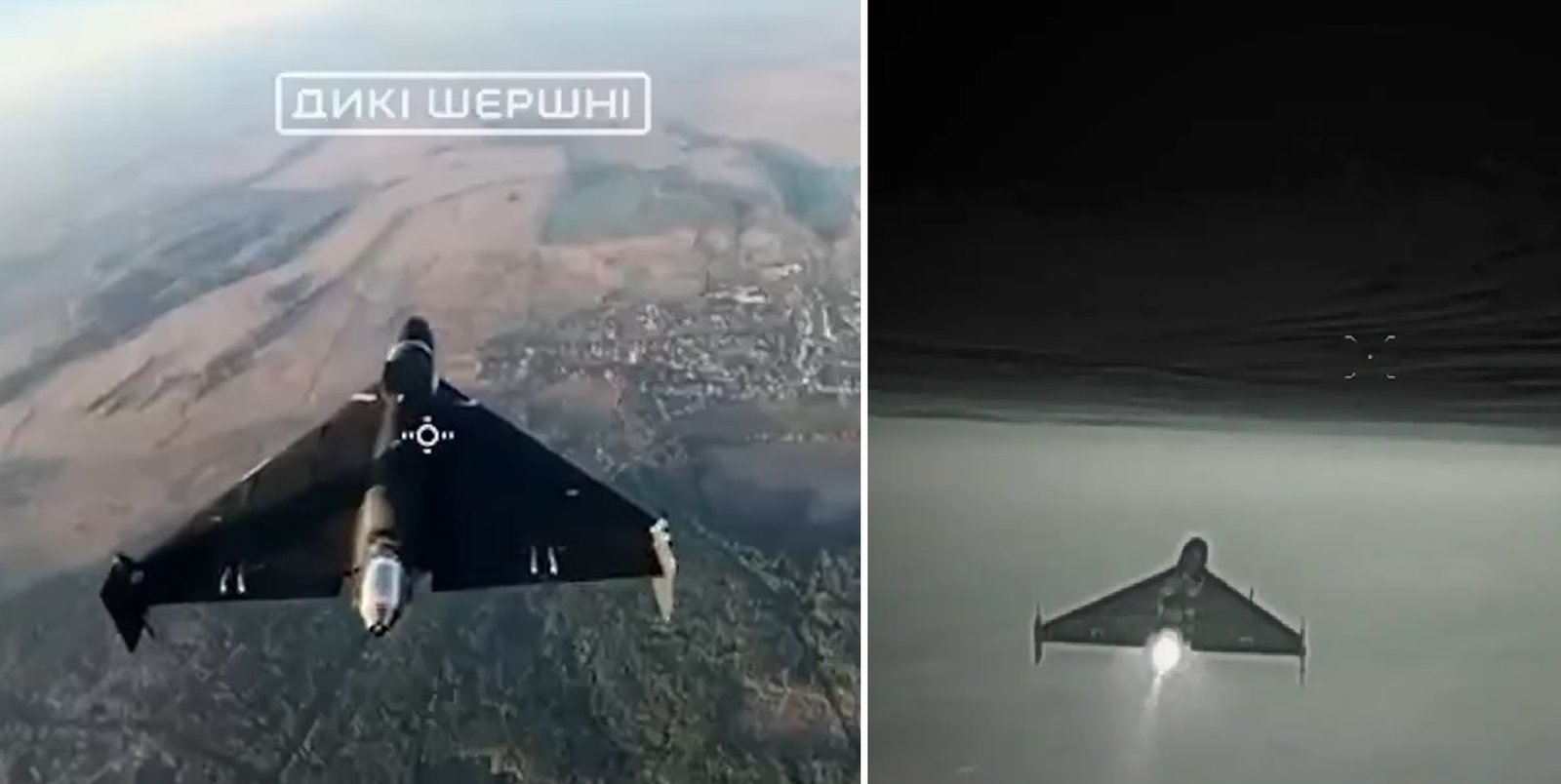
World
KYIV, Ukraine — Russia is increasingly using jet-powered attack drones against Ukraine, with the drones accounting for as much as two-thirds of some attack waves, according to Col. Yuriy Ihnat, spokesperson for the Ukrainian Air Force. Ihnat gave the assessment to Business Insider on Thursday. Earlier Ukrainian estimates had put the share of jet-powered drones at up to 20%. In 2025, such drones appeared only rarely in Russian attacks. In early June, Ukraine's then-Commander-in-Chief Gen. Oleksandr Syrskyi said Russia planned to increase their share to 50% of its attack-drone mix. The jet-powered drones are variants of the Geran series, Russia's version of Iranian-designed Shahed-type one-way attack drones. The standard Geran-2 uses a propeller and flies at about 185 km/h, while newer versions use mini turbojet engines. The Geran-3 typically cruises above 320 km/h. The Geran-4 can reach about 500 km/h, while the larger Geran-5 can reach up to about 600 km/h and has a shape closer to a small cruise missile. Their ranges generally fall between 850 and 1,000 km or more, with warheads ranging from 50 kg to 90 kg. Many of the newer drones use Chinese-made TeleFly turbojet engines. Ukraine says Russia has also sharply increased production and use of these systems. About 1,400 jet-powered Geran drones were reportedly launched during the first months of 2026, compared with 180 recorded during all of 2025. Ukrainian intelligence has also reported production of newer Geran-4 and Geran-5 models reaching about 3,000 units per month, while production of the earlier Geran-3 has reportedly stopped. The higher speed creates additional problems for Ukrainian air defenses. Ukrainian forces have reported interception rates of 92–96% against slower propeller-driven Shahed/Geran drones in some assessments, particularly in deeper rear areas. However, faster jet-powered drones reduce the reaction time available to mobile fire groups and interceptor drones, which can have top speeds of around 300–370 km/h. This can require more capable surface-to-air missiles or other air-defense systems. On Thursday, Ukrainian President Volodymyr Zelenskyy said a Russian jet-powered drone struck the locomotive of a passenger train in the Odesa region. The train was carrying 340 people, and the locomotive engineer and his assistant were killed. The same day's overnight attacks involved more than 130 attack drones across 11 Ukrainian regions. Russia continues to combine jet-powered drones with conventional kamikaze drones and decoys, putting additional pressure on Ukraine's air-defense network. Source : businessinsider
Read More → Posted on 2026-08-13 16:00:22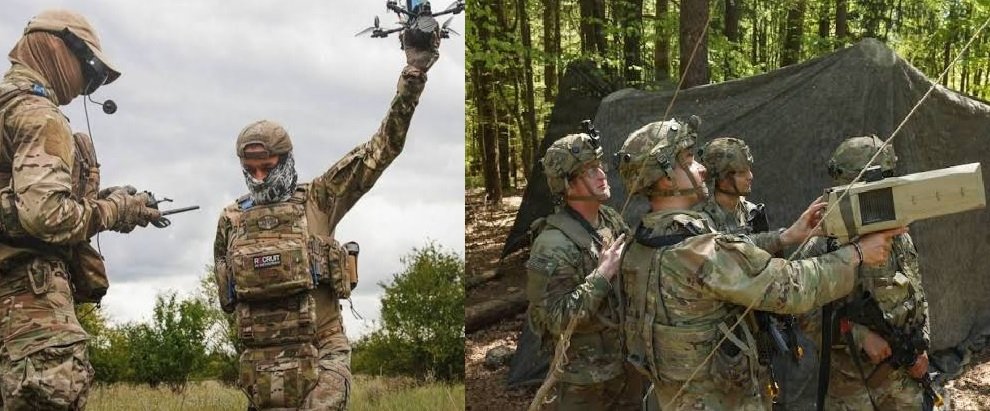
U.S
HOHENFELS, Germany — Ukrainian drone operators outperformed U.S. Army forces during the Combined Resolve exercise in Germany earlier this year, highlighting the difference in battlefield experience between Ukrainian drone units and American troops. The exercise was held in April and May 2026 at the Joint Multinational Readiness Center in Hohenfels. Around 3,500 U.S. personnel participated, mainly from the 3rd Armored Brigade Combat Team of the 1st Cavalry Division, which was rotating from Fort Hood, Texas. Their mission was to advance against positions held by the training center's opposition force, which was reinforced by Ukrainian troops from the 412th Regiment of Unmanned Systems Forces, known as Nemesis. U.S. forces used standard electronic warfare and counter-drone systems, while Ukrainian operators used combat experience gained during the war with Russia. Ukrainian reconnaissance drones located U.S. vehicles, with heavy armored vehicles also becoming easier to detect because they raised dust while moving. The reconnaissance drones were followed by systems simulating munition drops and first-person-view (FPV) kamikaze drones. No live ammunition was used. A simulated hit was recorded when a drone flew extremely close to or hovered over a target. The Ukrainian operators eliminated the attacking U.S. armored brigade so quickly that vehicles and troops marked as destroyed had to be returned to the exercise as reinforcements, or "re-spawned," to keep the training going. U.S. drone operators initially had less ability to quickly troubleshoot problems and prepare drones under conditions similar to combat. The scenario was repeated over roughly two weeks, allowing American forces to improve. They dispersed their forces more effectively, improved camouflage and made better use of electronic warfare systems. Midway through the exercise, the Ukrainian operators switched sides and demonstrated how uncrewed systems could support offensive operations. U.S. troops then applied those methods with greater effect. General Alexus Grynkewich, NATO's Supreme Allied Commander Europe, said this type of training experience cannot be replicated in the United States and highlighted the significant changes seen after NATO forces train with Ukrainian units. The results were not isolated. In 2023, a U.S. officer involved in training Ukrainian troops recognized that American forces had much to learn about drone warfare and helped develop a program that was later introduced more widely. In May 2025, Ukrainian drone operators defeated a simulated force involving British, Estonian and U.S. troops during exercises in the Baltics. In spring 2026, Ukrainian UAV operators participating in NATO exercises on Gotland also outperformed Swedish troops opposing them. Combined Resolve is a recurring U.S. Army Europe and Africa exercise focused on large-scale ground combat. The participation of Ukrainian forces provides U.S. and NATO troops with practical experience against the smaller front-line drones that have become central to combat in Ukraine. U.S. Army officials have also said that newer Mobile Brigade Combat Teams equipped with more recent equipment and tactics have performed better in similar exercises. The Pentagon has increased investment in drone and counter-drone technology, expanded efforts to study Ukrainian methods and tested Ukrainian drones for possible procurement. The exercise highlighted the practical advantage Ukrainian units have gained through years of continuous combat adaptation, including the rapid repair and modification of drones under pressure. U.S. and NATO forces are using joint exercises with Ukrainian personnel to incorporate these battlefield lessons into their own training. Source : wsj
Read More → Posted on 2026-08-13 15:49:57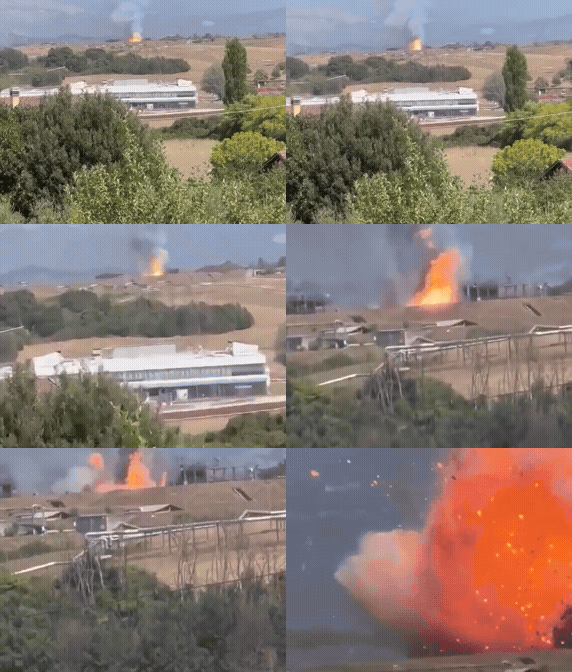
Europe
ROME — A fire followed by a powerful explosion occurred Thursday afternoon at the KNDS Ammo Italy ammunition facility in Colleferro, about 50–60 kilometers southeast of Rome. The plant, formerly known as Simmel Difesa, produces medium- and large-caliber ammunition for ground and naval forces, along with solid propellants for missiles and aerospace vehicles. The site covers about 100 hectares and is classified as a high-risk industrial facility under Italy’s Seveso regulations. BREAKING:A large explosion and fire hit a munitions plant in Colleferro, south of Rome, Italy.The blast occurred at the plant owned by the major Italian defense manufacturer KNDS Ammo Italy, which produces medium- and large-caliber ammunition and solid rocket fuels. 🇮🇹 pic.twitter.com/MM1PuWXEyG — Visegrád 24 (@visegrad24) August 13, 2026 According to local reports citing emergency services and authorities, the first alert was received around 2:45 p.m. local time. The fire started in the powder-pressing workshop before the explosion. The blast was heard in nearby towns including Artena, Valmontone, Labico, Paliano and Serrone. Videos and eyewitness reports showed smoke and flames at the site. Firefighters, Carabinieri and other emergency teams responded to the facility near the Quarto Chilometro/Via Ariana area toward Artena. Operations were complicated by the risk of further detonations. The affected area was reported to be limited to part of the production and storage zone. No deaths or injuries were reported. Around 24 workers were at the facility and all were accounted for and safe. The mayor of Colleferro said the explosion involved a mixer used in the production process. The Carabinieri and Velletri prosecutor’s office have opened an investigation. The preliminary focus is on the fire, but the exact cause remains under investigation and will require technical assessments. Second European Ammunition Plant Incident This Week The Colleferro explosion follows a August 10 fire and explosions at an EMCO defense plant near Belitsa, close to Tryavna in central Bulgaria. The facility is involved in ammunition assembly, loading and related activities. Workers were evacuated, with no injuries reported. Secondary fires and unexploded materials required further safety operations. The cause remains under investigation, while EMCO has ruled out human error. KNDS Ammo Italy is part of the Franco-German KNDS defense group. The Colleferro site has more than a century of explosives and ammunition production history, including earlier ownership by Bombrini Parodi Delfino. The company also operates a demilitarization facility in nearby Anagni and supplies medium- and large-caliber ammunition to more than 40 countries. Italian authorities continue to secure and monitor the Colleferro facility as the investigation continues.
Read More → Posted on 2026-08-13 15:40:35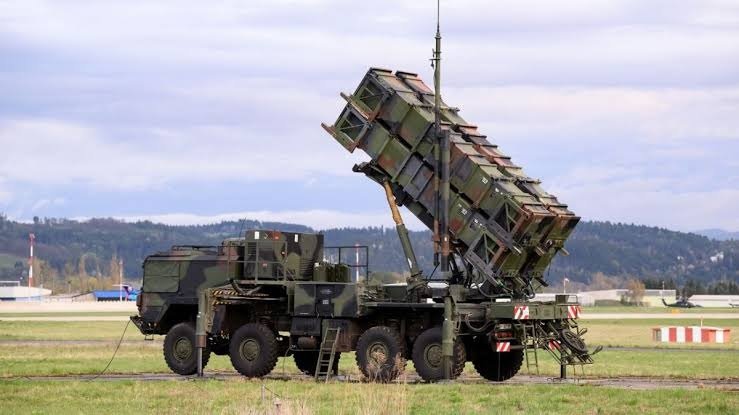
Europe
WARSAW, POLAND — Poland is considering sending another batch of missiles for Patriot air defense systems to Ukraine, with a final decision expected in the coming days, Deputy Defense Minister Magdalena Sobkowiak-Czarnecka said in an interview with RMF FM. She said Poland’s national security remains the main consideration, but the recent Russian missile incident in Polish airspace has influenced the assessment. Defense Minister Władysław Kosiniak-Kamysz is currently leaning toward approving another transfer. “Despite all the political fuss there was earlier about whether we were right to hand over the missiles, today he leans toward sending more, because he would rather see a missile like that shot down over Ukrainian territory than have it fly into ours,” Sobkowiak-Czarnecka said. Poland is also discussing the issue with NATO and the United States. Previous Patriot Missile Transfer Poland confirmed in July that it had transferred five PAC-3 missiles for Patriot systems to Ukraine several months earlier. Prime Minister Donald Tusk said the transfer was made at the request of NATO Secretary General Mark Rutte and U.S. Supreme Allied Commander Europe Gen. Alexus Grynkewich, following consultations among countries operating Patriot systems. Polish officials said the transfer was marginal and did not affect Poland’s air defense capabilities. Warsaw also received assurances that significantly more missiles and systems could be provided within 24 hours if Poland itself faced a threat. Russian Kh-101 Incident The new transfer discussion follows the July 29-30 Russian attack on Ukraine, when a Russian Kh-101 cruise missile entered Polish airspace and crashed near Tarnawa-Kolonia in the Lublin Voivodeship, about 90-95 kilometers from the Ukrainian border. The missile crashed in an uninhabited area, leaving a crater about 10 meters wide. There were no casualties or significant damage to buildings. Polish forces detected the object at about 3:40 a.m. and scrambled an F-16 to identify and intercept it. The object later disappeared from radar, while a Mi-24 helicopter located the crash site. Poland tracked multiple aerial targets during the attack. One came within about five kilometers of the Polish border before turning back. Investigators later confirmed that the missile was a Russian Kh-101 manufactured in the second quarter of 2026 at a facility in the Moscow region. Poland subsequently summoned the Russian ambassador and delivered a protest note. Earlier Russian Drone Incursion The incident followed a September 2025 violation in which between 19 and 23 Russian drones entered Polish airspace during a large-scale attack on Ukraine. Polish and NATO aircraft, including Polish F-16s and Dutch F-35s, responded, and some drones were shot down. Poland temporarily closed airspace around several airports, including Warsaw’s main international airports, and invoked Article 4 of the NATO treaty for consultations among allies. Poland currently operates two Patriot batteries and is awaiting additional systems. Warsaw has also provided substantial military assistance to Ukraine since 2022. No final decision on the new Patriot missile transfer has been announced, but Sobkowiak-Czarnecka said the decision is expected within days.
Read More → Posted on 2026-08-13 15:31:04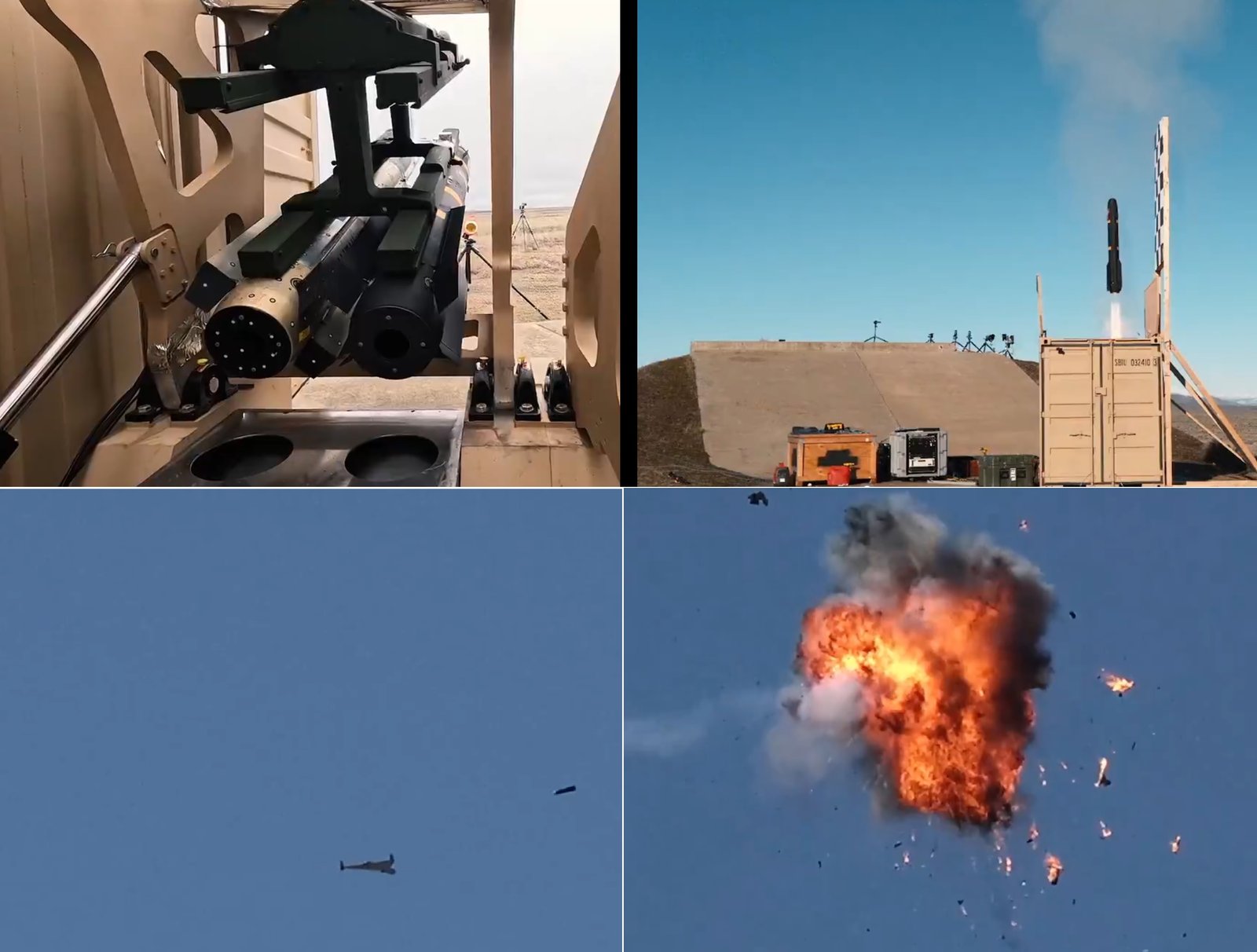
U.S
Washington, U.S. — Lockheed Martin has released new video footage of live-fire testing of its GRIZZLY containerized missile launcher, describing the system as production-ready. The launcher is designed to provide an affordable, reloadable and mobile missile-launch capability for distributed operations. GRIZZLY places a missile launcher inside a standard 10-foot Tricon shipping container, allowing it to be transported by truck, rail or ship using existing logistics equipment. Lockheed Martin developed the system in about six months using internal funding, combining existing launcher and weapon designs, including the fielded M299 launcher. Built fast. Built flexible. Built for the mission.GRIZZLY™ is an affordable, reloadable and production-ready containerized launcher designed to bring mobility and adaptability to the fight.The future of defense is here — and it’s containerized. 📦🚀 pic.twitter.com/HZiboJY3jE — Lockheed Martin (@LockheedMartin) August 12, 2026 Live-Fire Testing In March 2026, Lockheed Martin completed GRIZZLY's first integrated live-fire tests at Yakima Training Center, Washington. A Hellfire missile was launched from the container in both vertical and angled configurations. The tests confirmed the system could load and launch a missile from the containerized setup and meet the required trajectory parameters. GRIZZLY can carry up to eight ready-to-fire missiles and supports toolless reloading. It can operate from ground locations or ships, use internal or external power, and can be remotely operated. The launcher is also designed to work with different command-and-control and sensor systems rather than one dedicated network. JAGM Demonstration Against a Drone In June 2026, Lockheed Martin conducted another major test at Yuma Proving Ground, Arizona. GRIZZLY fired a Joint Air-to-Ground Missile (JAGM) to intercept a Group 3 one-way attack drone. The demonstration integrated GRIZZLY with Lockheed Martin's Sanctum counter-unmanned aircraft system battle manager and Fortem R-40 radars. The radars detected and tracked the target, Sanctum processed the engagement data, and GRIZZLY launched the JAGM. Lockheed Martin said the integration and live-fire testing were completed in less than 45 days. JAGM was developed as a successor to the Hellfire and TOW missiles. It uses a dual-mode seeker with laser and millimeter-wave radar guidance, giving it flexibility for different operating conditions. Use of Existing Missiles Lockheed Martin says the use of established missiles such as Hellfire and JAGM allows military units to rely on existing missile stocks, training and logistics rather than introducing a completely new munition. The company is also developing the related Kodiak containerized launcher. In August 2026, Kodiak completed its first integrated live-fire test at Yakima Training Center using a Reduced-Range Practice Rocket associated with GMLRS-family munitions. Kodiak is designed to carry up to 12 GMLRS rockets and provide containerized offensive-fire capability across land, air and maritime platforms. Production Plans Lockheed Martin CEO Jim Taiclet said in early August 2026 that the company had pre-funded GRIZZLY production as part of its Sanctum counter-drone architecture and directed teams to prepare for 1,000 units. The company plans to seek U.S. military contracts and potential export sales while continuing work with the U.S. government on further development. The GRIZZLY concept reflects growing interest in containerized launchers that can use existing transportation infrastructure while distributing missile-launch capability across different locations. Its live-fire demonstrations with both Hellfire and JAGM have established the system's ability to launch different missiles from a standard containerized platform.
Read More → Posted on 2026-08-13 14:34:01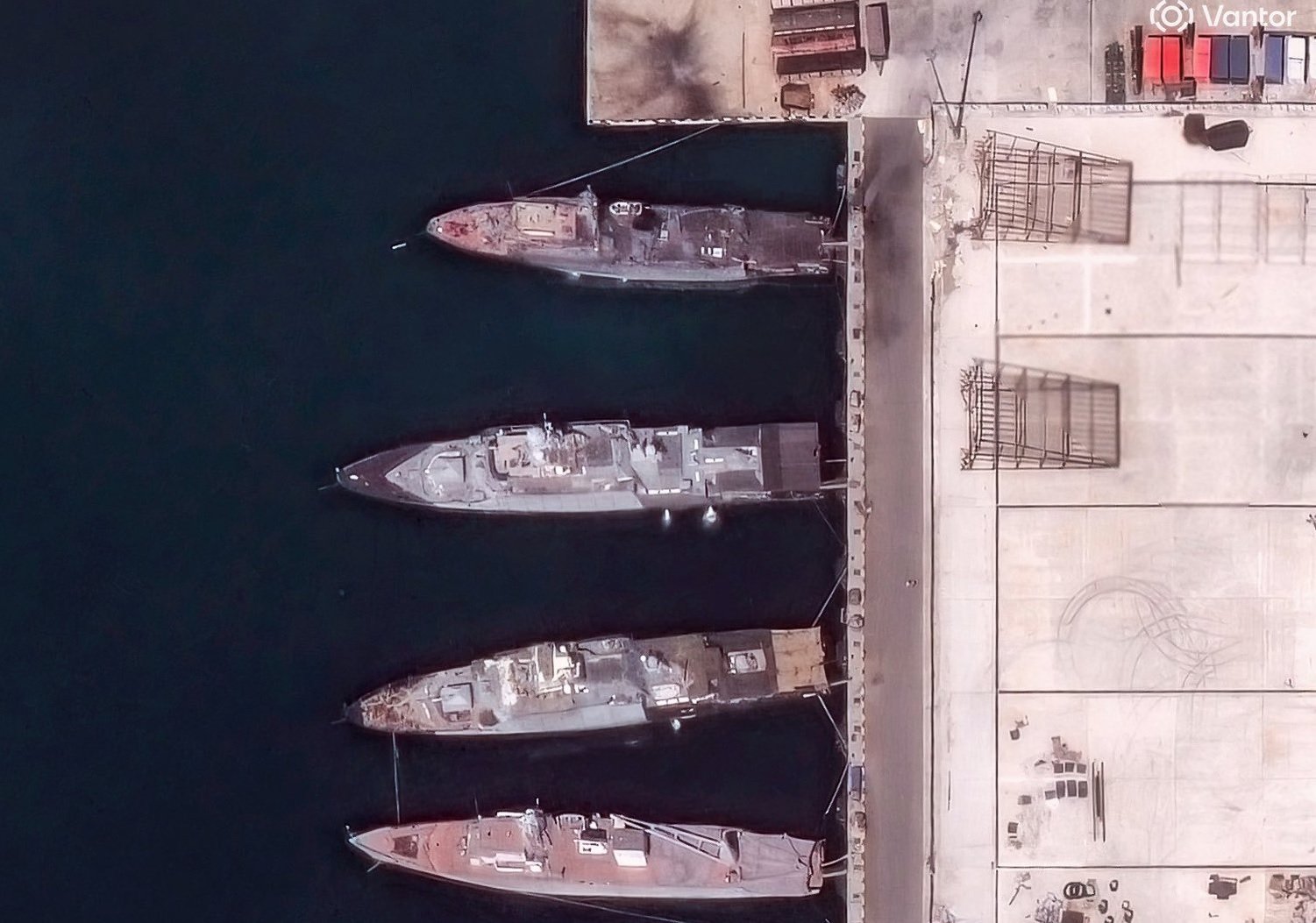
Satellite Images Reveal Four Russian Warships Damaged in Ukrainian Strike on Novorossiysk Naval Base
World
NOVOROSSIYSK, KRASNODAR KRAI — Ukrainian forces carried out a coordinated overnight strike on Russia’s Black Sea Fleet naval base and port facilities in Novorossiysk, Krasnodar Krai, on August 12, damaging four Russian warships, according to Ukraine’s General Staff. The attack involved drones and missiles and also affected air-defense equipment and infrastructure at the major Black Sea port. Russian regional authorities reported civilian casualties and damage to residential and other facilities. Four Russian Warships Damaged Ukraine’s General Staff said four Russian naval vessels sustained varying degrees of damage during the operation. They were: Admiral Makarov, a Project 11356R frigate Admiral Essen, a Project 11356R frigate A Project 21631 Buyan-M small missile ship Vasily Bykov, a Project 22160 patrol ship The two frigates are equipped to launch Kalibr cruise missiles. The Ukrainian military said the damage to the vessels was being assessed. Satellite imagery released after the attack showed visible damage to at least three of the vessels, including the two frigates and the Vasily Bykov. Open-source analysts identified damage around areas associated with the frigates’ missile-launch systems, although the full extent of the damage and the time required for repairs have not been independently established. The attack is significant for the Black Sea Fleet because Admiral Makarov and Admiral Essen are among its surface ships capable of carrying and launching Kalibr cruise missiles. Both frigates had also previously been reported damaged during Ukrainian attacks on Novorossiysk earlier in 2026. Satellite images don't lie. 📸Ukraine just took out a significant chunk of the Russian Navy in Novorossiysk. 4 warships confirmed hit, including two Admiral Grigorovich-class frigates. 🚢💥Russia is losing the battle for the sea without Ukraine even having a traditional navy. https://t.co/ti1oDfSopy pic.twitter.com/dwEYimSgkh — Ukraine News 🇺🇦 (@Ukrainene) August 13, 2026 Air Defense and Port Infrastructure Hit Ukrainian officials also reported strikes against Russian air-defense and port facilities. The reported targets included a 30N6E radar associated with an S-300 air-defense system, facilities at several naval berths and infrastructure at the Sheskharis oil terminal. Ukrainian President Volodymyr Zelenskyy said the operation combined drones, missiles and naval unmanned systems. Ukrainian officials described the operation as involving several domestically developed systems working together. The attack also affected civilian port infrastructure. Two major grain terminals in Novorossiysk suspended operations following the strikes, according to Russian and industry sources. Novorossiysk is an important Russian port for grain and other commodity exports. Civilian Damage Reported Russian authorities reported damage across parts of Novorossiysk following the attack. Krasnodar Governor Veniamin Kondratyev said people were killed, including an eight-year-old child, while others were injured. Novorossiysk Mayor Andrei Kravchenko said more than two dozen residential buildings, businesses and other facilities were damaged. The city also temporarily suspended its water supply and declared an emergency. Russian authorities also reported that air defenses engaged Ukrainian drones during the attack. Novorossiysk’s Role in the Black Sea Fleet Novorossiysk has become an important base for Russia’s Black Sea Fleet after repeated Ukrainian attacks on Russian naval assets in and around Crimea. Russia has moved a number of naval vessels to the eastern Black Sea, including Novorossiysk, as Ukraine has expanded its use of long-range drones and other weapons against naval targets. The latest attack therefore targeted Russian naval assets at a port that has increasingly been used to support Black Sea Fleet operations. The strike also came amid continued Ukrainian attacks on Russian military and energy infrastructure in the Black Sea region, while Russia continues to conduct attacks against Ukrainian ports and shipping infrastructure. The precise extent of the damage to the four warships and their operational status remains under assessment. Available satellite imagery confirms visible damage to several vessels, but there is no indication that the four ships were sunk in the August 12 attack.
Read More → Posted on 2026-08-13 14:14:45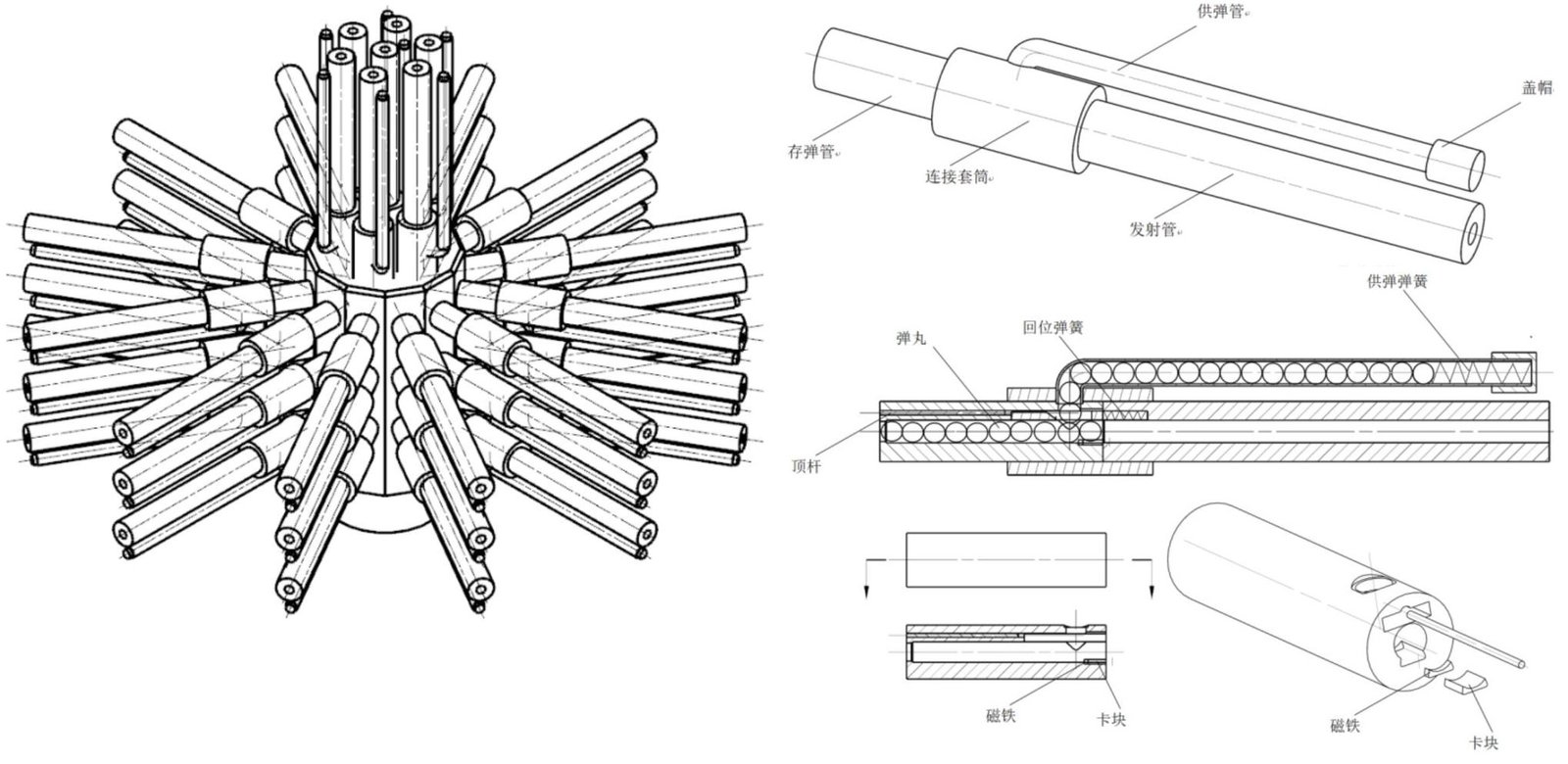
World
Chongqing, China — Chongqing Jianshe Industry (Group) Co., Ltd., a state-owned Chinese defense company under China South Industries Group Corporation, has filed a patent for a multi-azimuth steel-ball launching structure designed to counter unmanned aerial vehicles (UAVs). The patent, CN121977393A, titled “Structure for multi-azimuth launching steel balls,” was filed on March 30, 2026, and published on May 5, 2026. The company is based in Chongqing’s Banan District. Chongqing Jianshe Industry traces its history to the Hubei Arsenal established in 1889, later known as the Hanyang Arsenal. The company specializes in light weapons and related equipment and manufactures full-caliber firearms, including the QBZ-191 assault rifle family, as well as automotive parts and other products. It holds hundreds of patents and operates multiple production bases. Multi-barrel design The patented system uses several barrel assemblies connected to a common front combustion chamber. Each assembly has a feed tube containing spherical steel projectiles, a storage tube and a launch tube. A spring in the feed tube automatically moves the next steel ball into the storage tube after firing. The combustion chamber has multiple connection points on its front and circumference, allowing several barrels to be installed at different angles for multi-directional firing from a common propellant source. The launch tube has an internal diameter slightly smaller than the steel projectile, allowing gas pressure to force the ball through the barrel. The steel balls and propellant are loaded separately. Firing and loading mechanism When the system fires, propellant gas from the combustion chamber pushes a pusher rod. This moves a locking and gas-blocking component so that its projectile-passing hole becomes misaligned with the storage-tube feed opening, sealing the opening and preventing gas leakage. After chamber pressure falls, a return spring resets the blocking component and realigns the openings. The feed-tube spring then pushes the next steel ball into the storage tube. The blocking component also has a slope that helps move a partially advanced projectile back into the feed tube during the sealing process. A magnet inside the storage tube holds the forwardmost steel ball slightly off-centre to help prevent jamming. Anti-drone purpose The patent states that the design addresses limitations of conventional single-projectile firearms and existing shotguns against small, fast-moving drones. Conventional shotguns can experience projectile collisions inside the barrel, which can increase dispersion at longer distances. By placing steel balls in separate tubes and mounting multiple barrel assemblies at different angles, the patented design aims to create a wider spatial coverage pattern against approaching UAVs. The structure is intended primarily for individual or light anti-drone use. However, the patent remains pending and does not confirm that a completed production weapon has entered service or that the system has been operationally deployed. Images associated with the patent show technical drawings of the multi-barrel arrangement and its internal components.
Read More → Posted on 2026-08-13 13:58:50
U.S
LONDON — Saab UK, Aquark Technologies and the Royal Navy’s Disruptive Capabilities and Technologies Office (DCTO) have completed a UK trial demonstrating that a distributed network of Saab Giraffe 1X radars can maintain a coherent air picture without relying on GPS or other satellite-based timing. The trial was conducted in June 2026 and combined Saab’s Giraffe 1X radar with Aquark’s AQlock quantum timing technology. Saab said the demonstration is believed to be a world first for a distributed high-performance military radar network maintaining a coherent operational picture using independent quantum timing sources. QinetiQ and the Defence Science and Technology Laboratory (DSTL) also participated in the trial. Trial tested radar operation without GNSS timing Modern distributed radar networks require precise timing to combine tracking information from multiple sensors into a single air picture. Global Navigation Satellite Systems (GNSS), including GPS, are commonly used as an external timing reference. However, GNSS signals can be jammed, spoofed or otherwise disrupted, creating a challenge for networked sensors operating in contested environments. During the trial, multiple Giraffe 1X radars tracked live aerial targets while using independent AQlock quantum timing sources. The test team then introduced controlled timing errors to reproduce conditions associated with GNSS spoofing and denial. According to Saab, the radars continued to combine their tracking data into a single coherent air picture without GNSS timing. The network showed predictable performance degradation when timing was deliberately disrupted and recovered rapidly after synchronisation was restored. It also remained operational under representative GNSS-denied and spoofed conditions. AQlock quantum clocks provided independent timing Two AQlock 2.0 cold-atom clocks were deployed at separate locations during the trial. The systems reached an acceptable timing signal from a cold start in less than 30 minutes and provided the sole timing reference for the two operational radar systems. Aquark’s AQlock technology uses a cold-atom approach based on its Super-Molasses Trap method. The company has previously worked with the Royal Navy on trials involving its cold-atom technology. Quantum timing provides a local source of highly accurate time without requiring an external satellite signal. In a distributed radar network, this can allow geographically separated sensors to remain synchronised when satellite-based timing is unavailable or cannot be trusted. Giraffe 1X used in the distributed network The Giraffe 1X is Saab’s compact 3D multi-mission radar. Saab says it can detect, track and classify air targets, including small unmanned aerial vehicles, and can be deployed in mobile or fixed configurations. The radar is also used for applications including ground-based air defence, counter-UAS operations, weapon locating and sea-surface surveillance. Saab UK has been producing Giraffe 1X systems at its Fareham facility. In May 2026, the company announced that it had completed its 100th Giraffe 1X radar in the UK. The June trial extended the radar's use into a distributed configuration in which separate radar locations maintained a combined air picture using independent quantum timing sources. The Royal Navy’s experimental ship XV Patrick Blackett and DSTL also acted as network rebroadcast nodes during the trial, according to information released about the demonstration. Saab highlights potential for GPS-denied operations Andy Fraser, Group Managing Director at Saab UK, said the trial demonstrated a practical capability by combining quantum timing technology with the Giraffe 1X radar. “This trial is a great example of how collaboration can accelerate innovation,” Fraser said. “By combining quantum timing technology with Saab’s advanced Giraffe 1X radar system, we have demonstrated a practical capability that could help customers continue to operate effectively when it matters most.” Matthew Aldous, Timing Lead at Aquark Technologies, described the trial as a milestone for UK sovereign quantum technology and as the first known deployment of a pair of British-built cold-atom systems against a defence requirement. The results were announced by Saab UK on August 12, 2026. The companies said the work forms part of wider efforts to develop radar and timing capabilities for military operations where satellite navigation and timing services may be disrupted or compromised.
Read More → Posted on 2026-08-13 13:43:54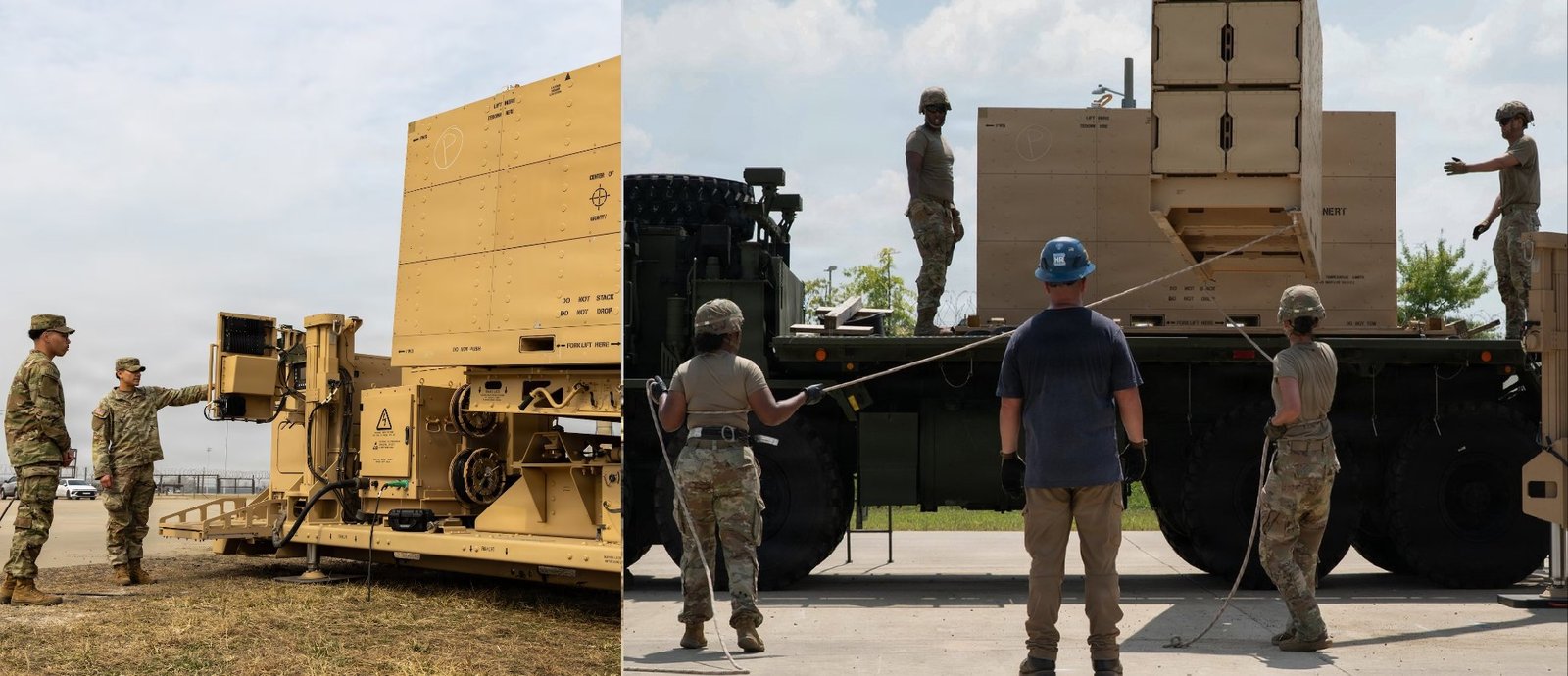
U.S
CAMP HUMPHREYS, South Korea — Soldiers from the U.S. Army’s 35th Air Defense Artillery Brigade conducted training on the deployment of the Indirect Fire Protection Capability (IFPC) system at Camp Humphreys, South Korea. According to Eighth Army, personnel from Delta Battery, 6th Battalion, 52nd Air Defense Artillery Regiment, guided IFPC equipment into position during the exercise. The training was intended to prepare soldiers to employ the system in support of air and missile defense operations. IFPC role in layered air defense The IFPC is a mobile, ground-based air defense system designed to counter subsonic cruise missiles, unmanned aerial systems, rockets, artillery and mortars. It is intended to protect fixed and semi-fixed locations, including forward operating bases and critical infrastructure. The system is designed to fill a defensive gap between short-range air defense systems and longer-range systems such as the Patriot and Terminal High Altitude Area Defense (THAAD). The IFPC Increment 2 configuration uses the Enduring Shield launcher, with interceptor rounds stored in sealed, ready-to-fire magazines. The configuration is designed to support rapid reloading while reducing the exposure of personnel handling munitions. The system also provides 360-degree radar coverage and is integrated with the Army’s Integrated Battle Command System (IBCS). IBCS connects sensors and weapons systems across the Army’s air and missile defense network. IFPC deployment in South Korea The 35th Air Defense Artillery Brigade, based at Osan Air Base, has operated the IFPC in South Korea since at least September 2025. During that month, U.S. Army Chief of Staff Gen. Randy George visited the unit and was photographed in front of an IFPC launcher. The deployment was the system’s first confirmed overseas deployment. In March 2026, the Army again positioned the IFPC at Camp Humphreys during the Freedom Shield exercise. The deployment was used to test the system’s integration into a networked, layered air defense architecture alongside Patriot and Avenger systems. The August 5 training continues the brigade’s work to maintain operational proficiency with the system as part of ongoing air and missile defense operations in South Korea. Production and additional interceptor development The IFPC program has progressed through several Army contracting stages. In November 2024, Dynetics, a Leidos subsidiary based in Huntsville, Alabama, received a $4.1 billion indefinite-delivery/indefinite-quantity agreement covering low-rate initial production, full-rate production and lifecycle support. The initial order included 18 launchers. In April 2026, Dynetics received a separate $617 million contract for the fiscal year 2026 production buy. The contract covers launchers, magazines, trainers, logistics support and related items, with deliveries scheduled through November 2029. The Army is also pursuing a second interceptor for the IFPC system. In 2025, Boeing and Lockheed Martin were selected to continue development of competing medium-range interceptor designs. The additional interceptor is intended to engage cruise missiles and drones alongside the system’s baseline interceptor, which is currently based on the AIM-9X Sidewinder. The latest training at Camp Humphreys reflects the continued fielding and training of the IFPC system with U.S. Army air and missile defense forces in South Korea.
Read More → Posted on 2026-08-13 13:33:24
U.S
HUNTSVILLE, Ala. — Gen. Michael Guetlein, director of the U.S. military’s Golden Dome missile defense initiative, said the program remains on track to deliver its initial operational capabilities in mid-2028 at a projected cost of $185 billion, while warning that a funding gap in fiscal year 2027 could put the program at serious risk. Guetlein made the remarks during the annual Space & Missile Defense Symposium in Huntsville, Alabama. Guetlein Maintains $185 Billion Cost Estimate Guetlein said the current Golden Dome cost estimate remains $185 billion. The figure was initially set at $175 billion and later increased by $10 billion to accelerate space capabilities that were not part of the original architecture. “I’m on record, and I’m still up here saying the exact same number: $185 billion,” Guetlein said, emphasizing the need to keep the large missile defense effort affordable. The estimate is significantly below a separate Congressional Budget Office assessment released in May 2026. The CBO estimated that a notional national missile defense architecture broadly consistent with the capabilities described for Golden Dome could cost about $1.2 trillion over 20 years. However, the CBO noted that its calculation was based on a notional architecture because the Defense Department had not publicly released enough details about the final system. Guetlein has argued that the CBO estimate does not represent the architecture currently being developed by the Pentagon. He said the assumptions used for the higher estimate involve different technologies and requirements. Contracts and Testing Underway Guetlein said several major elements of Golden Dome are already under contract. These include radars, launchers, space-based interceptors, a hypersonic ballistic tracking system and a space data network. The program has also moved into construction, with the first operational site established and groundwork underway at locations including Joint Expeditionary Base Fort Story in Virginia. According to Guetlein, two tests have already been completed successfully, demonstrating elements involving command and control, sensor networks and effectors against current threats. Details of the tests remain classified. One of the major tests conducted in summer 2026 at White Sands Missile Range, New Mexico, was described as the most complex integrated missile defense test conducted there. The exercise involved the Missile Defense Agency, Space and Missile Defense Command and other organizations. Guetlein said the test met all of its objectives after six months of preparation. A more complex test is planned for 2027. Space-Based Interceptors Remain a Major Element Space-based interceptors are a major part of the publicly described Golden Dome architecture. The Space Force has advanced a competition involving 12 companies for related technology development, with the first of four planned development gates completed. The space component has also been an important factor in the debate over the program’s potential long-term cost. The CBO's May assessment included a large space-based interceptor constellation in its notional architecture, contributing substantially to its $1.2 trillion estimate. FY2027 Funding Creates Risk The immediate concern for Golden Dome is its funding structure. About $22.5 billion has been appropriated for the program so far, with approximately 95 percent committed to specific work and about 90 percent obligated. Much of the funding has been provided through congressional reconciliation rather than the regular defense budget. For fiscal year 2027, the administration has requested approximately $17.5 billion for Golden Dome. Only about $400 million is included in the base budget, with the remaining funding dependent on a proposed reconciliation package. A Congressional Research Service summary similarly reports a $17.5 billion FY2027 Golden Dome request, with the overwhelming majority sought as mandatory funding through reconciliation. Guetlein warned that the program does not have a reliable funding path if the FY2027 reconciliation funding is not approved. “We’ve got to figure out, as a nation, a different way of funding Golden Dome, at least for 2027. Right now, that’s under reconciliation,” he said. “If they don’t figure it out, there is no Golden Dome because there is no funding.” He also said a continuing resolution would not provide the baseline needed to sustain the effort at its planned level. Pentagon Examining Contingency Options Pentagon officials are examining possible contingency measures if Golden Dome funding is delayed or interrupted. One option under consideration involves the Space Force continuing investment in certain shared space capabilities that also support the broader Golden Dome architecture. No final decision has been made on those options. The broader FY2027 defense budget request is approximately $1.5 trillion, including base funding and proposed reconciliation resources. Other major defense modernization programs, including efforts to modernize the U.S. nuclear triad, are also being funded alongside Golden Dome. For now, Guetlein said the program remains focused on its mid-2028 initial operational capability target. The next phase will depend not only on continued testing, contracting and construction, but also on whether Congress provides the funding required for fiscal year 2027. Source : TWZ
Read More → Posted on 2026-08-13 13:09:29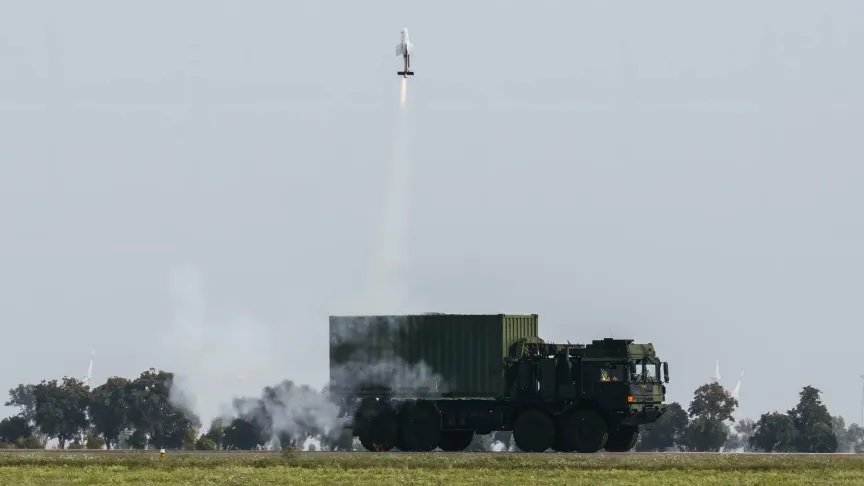
U.S
COCHSTEDT, Germany — Rheinmetall has successfully demonstrated the launch of its FV-014 loitering munition from the company’s Containerized Missile Launcher (CML), a modular multi-launcher designed for loitering munitions and guided missiles. The live-fire demonstration took place in July 2026 at the National Test Centre for Unmanned Aerial Systems operated by the German Aerospace Centre (DLR) in Cochstedt, Saxony-Anhalt. During a customer demonstration, the FV-014 was launched from a Rheinmetall HX truck in both stationary and moving configurations. The system then carried out simulated operational profiles and attack flights. The FV-014 and CML are both Rheinmetall developments. FV-014 combines reconnaissance and precision strike The FV-014 is designed as a portable reconnaissance and strike system that combines target observation, tracking and precision engagement. Rheinmetall describes the system as bridging the tactical gap between reconnaissance drones and conventional artillery. The drone has a flight endurance of up to 70 minutes and a range of up to 100 kilometres. Its data-link range is up to 60 kilometres. A 360-degree swivelling gimbal in the nose allows the system to observe potential targets over extended periods. Rheinmetall states that the FV-014 has an approximate launch weight of 20 kilograms. The system carries an HEDP (High-Explosive Dual Purpose) warhead with a penetration capability of more than 600 millimetres against armoured targets. The warhead is also intended for use against unarmoured targets and infrastructure. The FV-014 uses an electric propulsion system and an aerodynamic wing design. Rheinmetall says the design is intended to reduce acoustic, radar and infrared signatures. The system is also designed to operate in environments affected by GNSS interference. After being launched from a transport and launch container using a booster, the FV-014 unfolds its wings and transitions into aerodynamic flight. Its endurance provides time for reconnaissance, target selection and an attack decision. Human control and swarm operations The FV-014 is controlled through a ground station with continuous human-in-the-loop oversight. Operators can identify and track targets, conduct an attack or abort the mission if circumstances change. Its software architecture also supports swarm operations. Rheinmetall says multiple FV-014 systems can be controlled simultaneously by a single operator, allowing several targets to be engaged or enabling coordinated attacks against defended areas. The system is designed to operate as part of Rheinmetall’s reconnaissance and strike network. It can also be integrated with other systems, including the LUNA NG reconnaissance drone, to support the flow of information from reconnaissance to engagement. Containerized Missile Launcher The CML is based on a standard 20-foot container and was publicly presented by Rheinmetall for the first time at Eurosatory 2026 in June. The launcher can accommodate up to 18 FV-014 systems. Rheinmetall describes it as a modular, networked system that can operate from different platforms. The container can be deployed as a standalone system or mounted on platforms including trucks, trains and ships. An integrated power supply and communication modules support autonomous operation, while a battery system and sleep mode allow the launcher to remain in standby before being activated. The CML can connect to command, control, communications, computers and intelligence (C4I) networks. Rheinmetall says communication can be supported through radio and satellite links, depending on the configuration. The standardized container format is intended to simplify transport and deployment across different platforms. Rheinmetall expands FV-014 programme The July demonstration follows earlier FV-014 testing and demonstrations. In February 2026, Rheinmetall demonstrated the system to a potential NATO customer at the DLR National Test Centre for Unmanned Aerial Systems in Cochstedt. That demonstration involved simulated mission scenarios and attack flights. In April 2026, Rheinmetall announced a framework agreement worth billions of euros with the German Armed Forces for large quantities of FV-014 loitering munitions. The first call-off was valued at approximately €300 million, while deliveries are scheduled to begin in the first half of 2027 following qualification. The company says the FV-014 is developed and manufactured entirely within the European Union and is designed for industrial-scale production. The CML demonstration adds a mobile multi-launch capability to the system, allowing the FV-014 to be deployed from containerized launchers on land and maritime platforms. COCHSTEDT, Germany, August 13, 2026 — Rheinmetall has successfully demonstrated the launch of its FV-014 loitering munition from the company’s Containerized Missile Launcher (CML), a modular multi-launcher designed for loitering munitions and guided missiles. The live-fire demonstration took place in July 2026 at the National Test Centre for Unmanned Aerial Systems operated by the German Aerospace Centre (DLR) in Cochstedt, Saxony-Anhalt. During a customer demonstration, the FV-014 was launched from a Rheinmetall HX truck in both stationary and moving configurations. The system then carried out simulated operational profiles and attack flights. The FV-014 and CML are both Rheinmetall developments. FV-014 combines reconnaissance and precision strike The FV-014 is designed as a portable reconnaissance and strike system that combines target observation, tracking and precision engagement. Rheinmetall describes the system as bridging the tactical gap between reconnaissance drones and conventional artillery. The drone has a flight endurance of up to 70 minutes and a range of up to 100 kilometres. Its data-link range is up to 60 kilometres. A 360-degree swivelling gimbal in the nose allows the system to observe potential targets over extended periods. Rheinmetall states that the FV-014 has an approximate launch weight of 20 kilograms. The system carries an HEDP (High-Explosive Dual Purpose) warhead with a penetration capability of more than 600 millimetres against armoured targets. The warhead is also intended for use against unarmoured targets and infrastructure. The FV-014 uses an electric propulsion system and an aerodynamic wing design. Rheinmetall says the design is intended to reduce acoustic, radar and infrared signatures. The system is also designed to operate in environments affected by GNSS interference. After being launched from a transport and launch container using a booster, the FV-014 unfolds its wings and transitions into aerodynamic flight. Its endurance provides time for reconnaissance, target selection and an attack decision. Human control and swarm operations The FV-014 is controlled through a ground station with continuous human-in-the-loop oversight. Operators can identify and track targets, conduct an attack or abort the mission if circumstances change. Its software architecture also supports swarm operations. Rheinmetall says multiple FV-014 systems can be controlled simultaneously by a single operator, allowing several targets to be engaged or enabling coordinated attacks against defended areas. The system is designed to operate as part of Rheinmetall’s reconnaissance and strike network. It can also be integrated with other systems, including the LUNA NG reconnaissance drone, to support the flow of information from reconnaissance to engagement. Containerized Missile Launcher The CML is based on a standard 20-foot container and was publicly presented by Rheinmetall for the first time at Eurosatory 2026 in June. The launcher can accommodate up to 18 FV-014 systems. Rheinmetall describes it as a modular, networked system that can operate from different platforms. The container can be deployed as a standalone system or mounted on platforms including trucks, trains and ships. An integrated power supply and communication modules support autonomous operation, while a battery system and sleep mode allow the launcher to remain in standby before being activated. The CML can connect to command, control, communications, computers and intelligence (C4I) networks. Rheinmetall says communication can be supported through radio and satellite links, depending on the configuration. The standardized container format is intended to simplify transport and deployment across different platforms. Rheinmetall expands FV-014 programme The July demonstration follows earlier FV-014 testing and demonstrations. In February 2026, Rheinmetall demonstrated the system to a potential NATO customer at the DLR National Test Centre for Unmanned Aerial Systems in Cochstedt. That demonstration involved simulated mission scenarios and attack flights. In April 2026, Rheinmetall announced a framework agreement worth billions of euros with the German Armed Forces for large quantities of FV-014 loitering munitions. The first call-off was valued at approximately €300 million, while deliveries are scheduled to begin in the first half of 2027 following qualification. The company says the FV-014 is developed and manufactured entirely within the European Union and is designed for industrial-scale production. The CML demonstration adds a mobile multi-launch capability to the system, allowing the FV-014 to be deployed from containerized launchers on land and maritime platforms.
Read More → Posted on 2026-08-13 12:51:22Search
Top Trending in 24 Hours
-
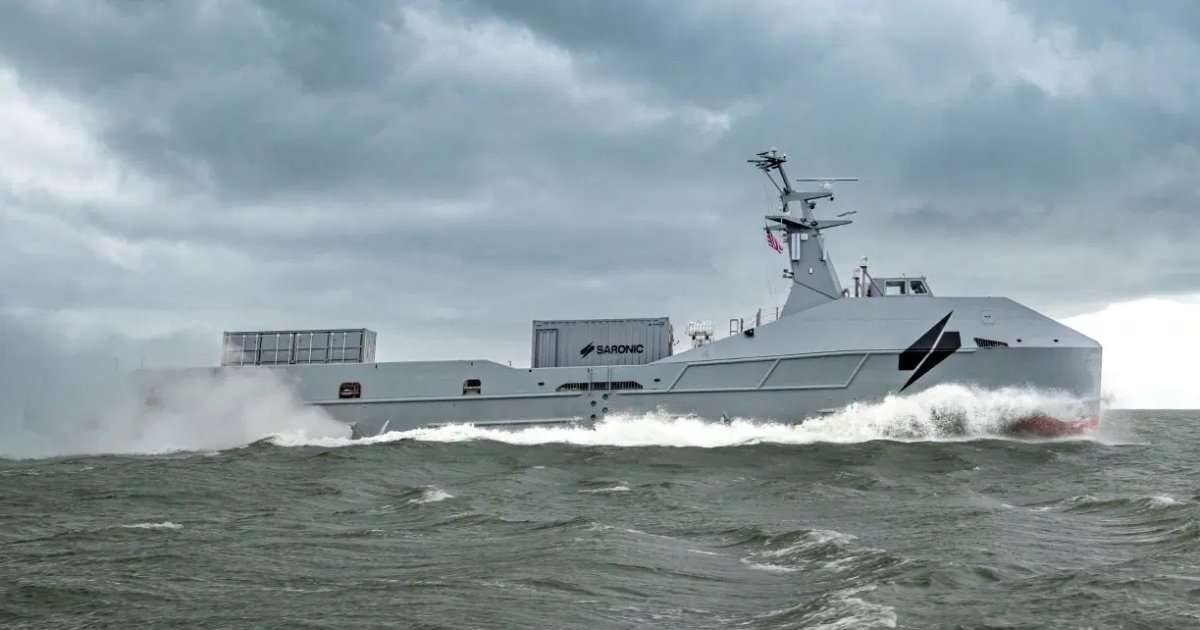 U.S. Navy Awards Production Agreements for 30 Medium Unmanned Surface Vessels, Including 10 Saronic Marauders
-
 Boeing Wins $20 Billion U.S. Navy Contract for F/A-XX Sixth-Generation Fighter
-
 Flydubai Flight to Israel Diverted to Saudi Arabia After Possible Attempted Terror Attack in Cockpit
-
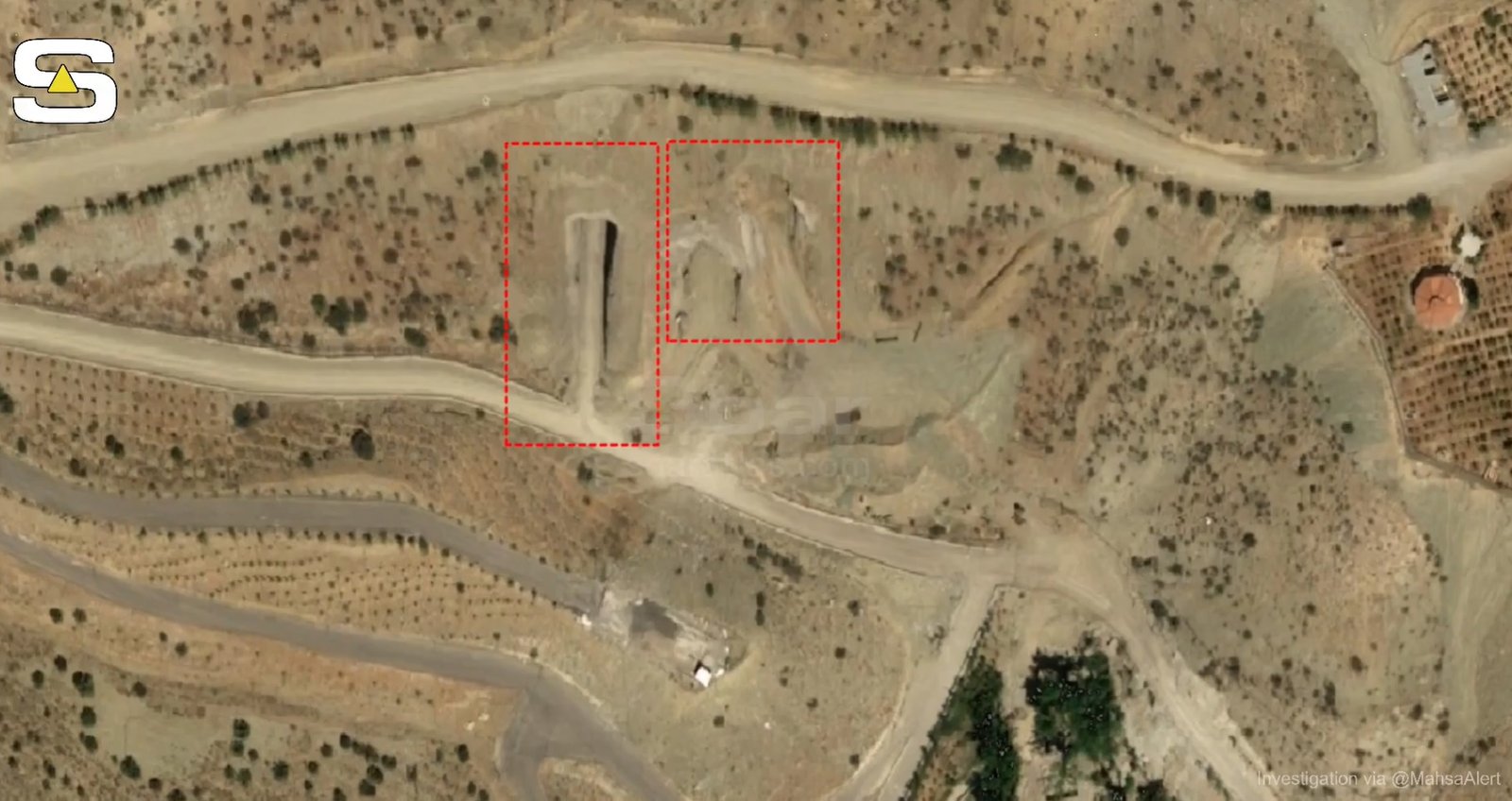 Satellite Imagery Shows Construction Changes at Hillside Site Linked to Iran’s Supreme National Security Council
-
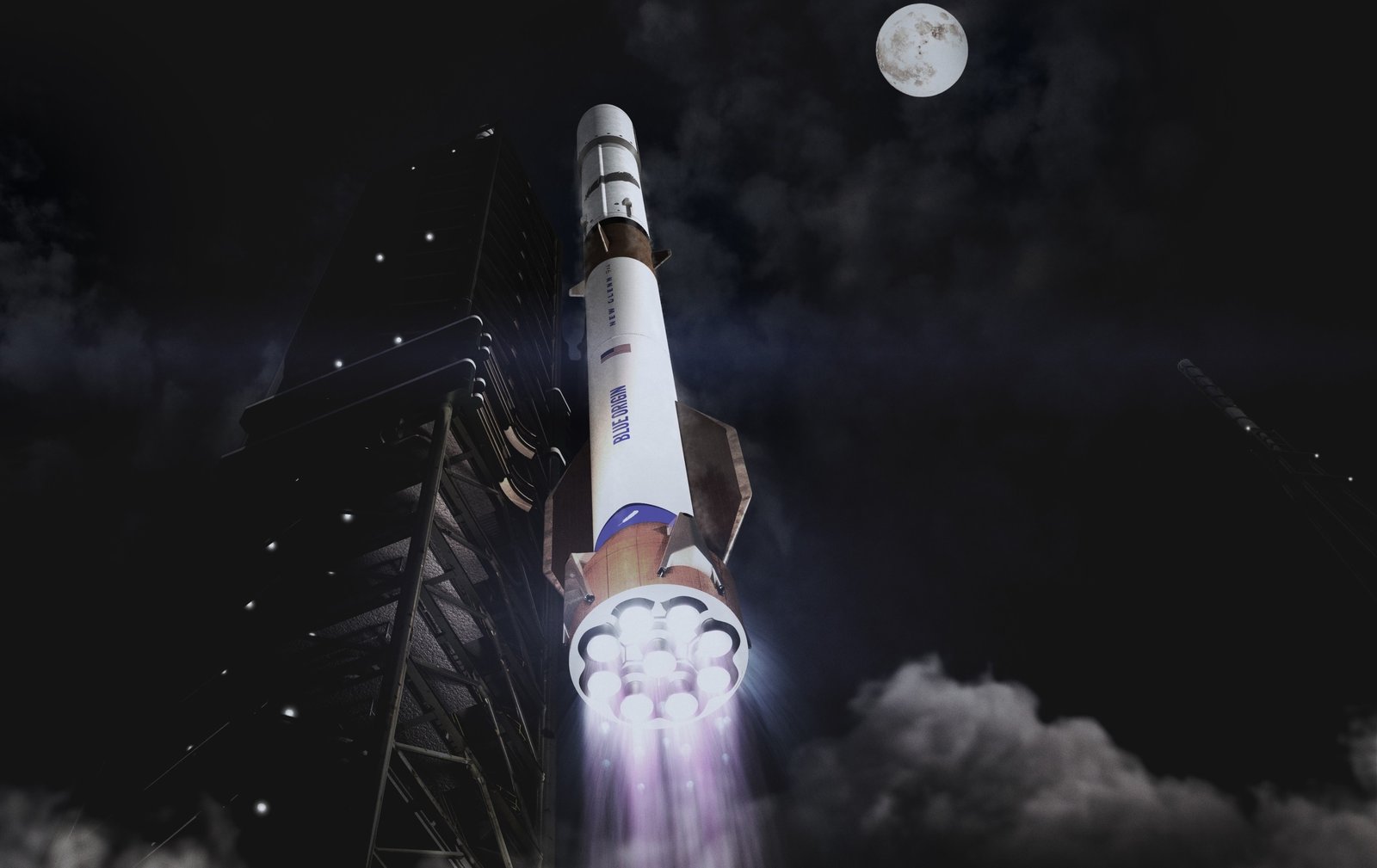 NASA Adds Blue Origin’s Upgraded New Glenn 9×4 to Launch Services Contract
-
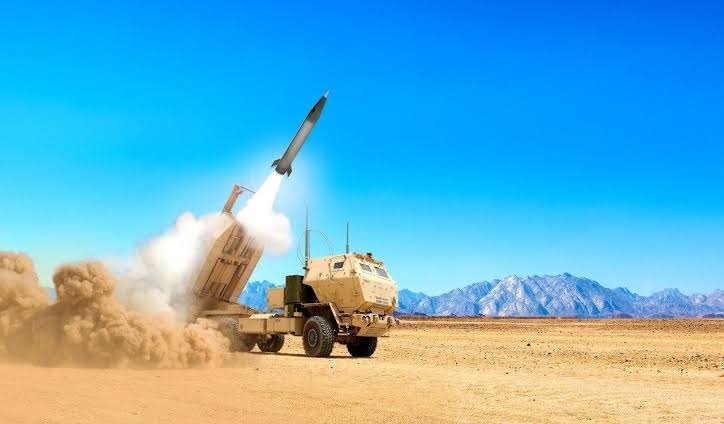 U.S. Army Selects Five Companies to Develop 1,000-Km Precision Strike Missile Prototypes
-
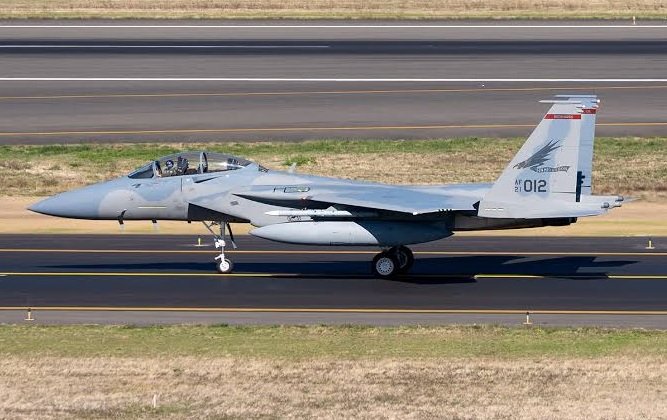 U.S. Air Force Awards Boeing $2.38 Billion Contract for 22 F-15EX Fighter Jets
-
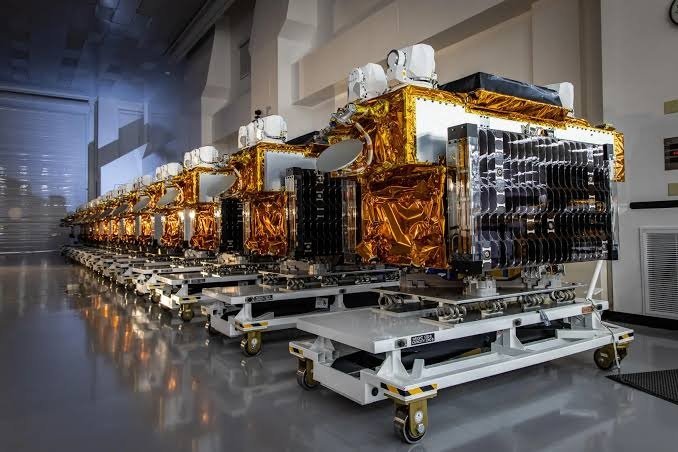 Northrop Grumman Delivers First 21 Satellites for Pentagon’s Next-Generation Military Network
Top Trending in 4 Days
-
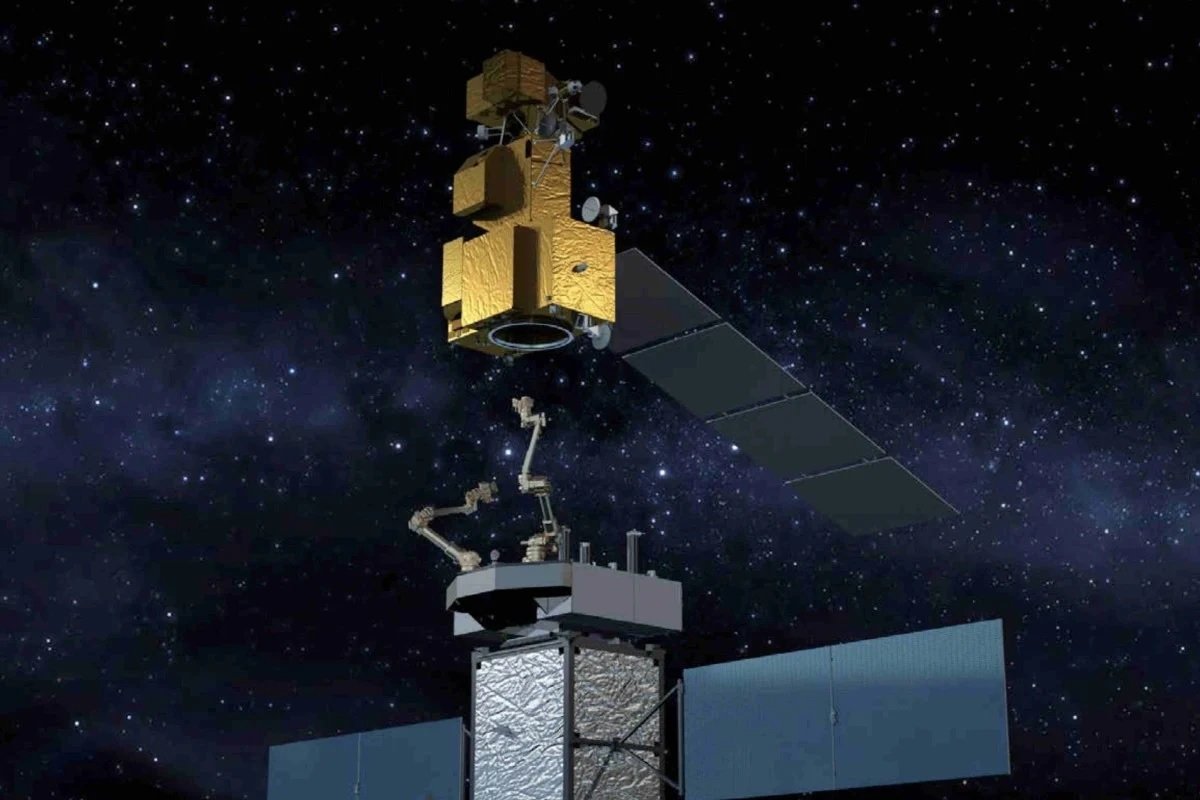 China Reports First High-Orbit Refueling of BeiDou Satellite, but Tracking Data Raise Questions
-
 Russia Says Su-75 Checkmate Could Cost Just $25–30 Million, Flight-Hour Costs 6 Times Lower Than F-35
-
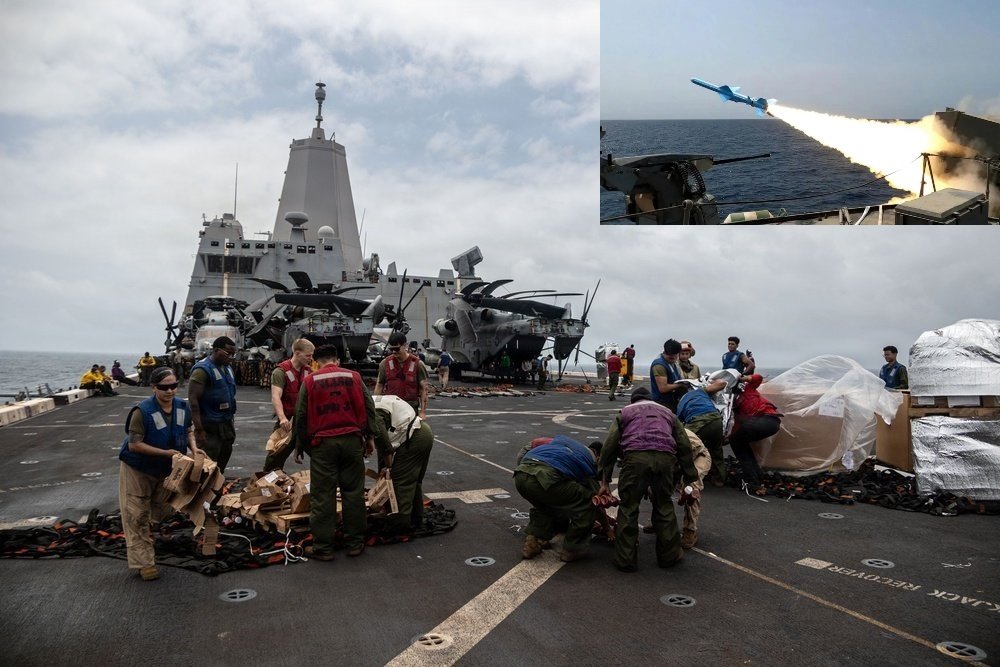 Eight U.S. Marines Injured in Iranian Missile Strike on U.S Vessel in Strait of Hormuz
-
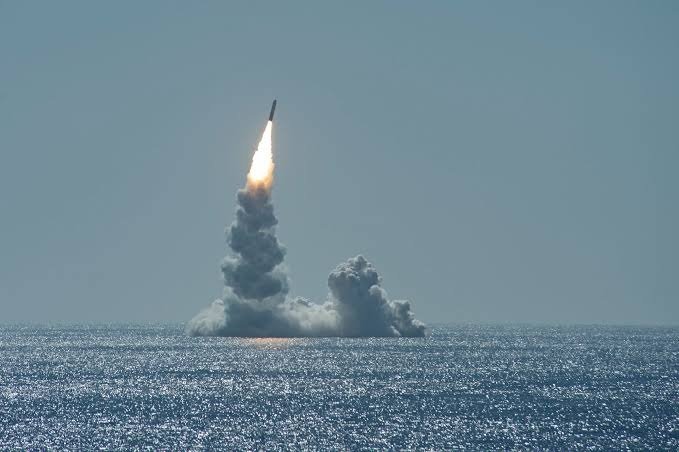 UK Offers Nuclear Deterrence for Its Northern European Defence Partners
-
 U.S. and Russia Remove Human-Review Rules From Draft UN AI Weapons Framework
-
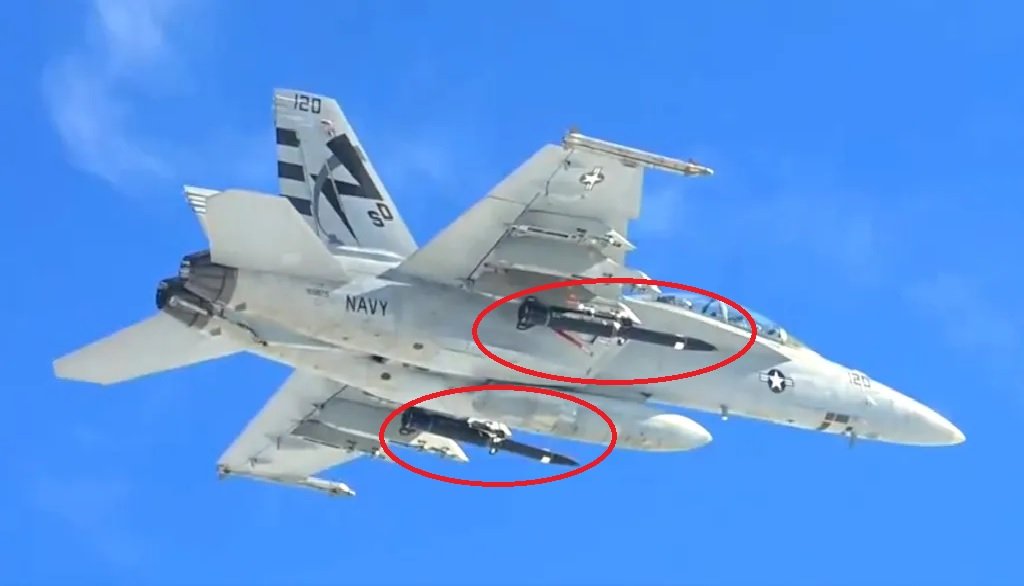 U.S. Navy Begins Flight Testing Blackbeard Hypersonic Missile on F/A-18 Super Hornet
-
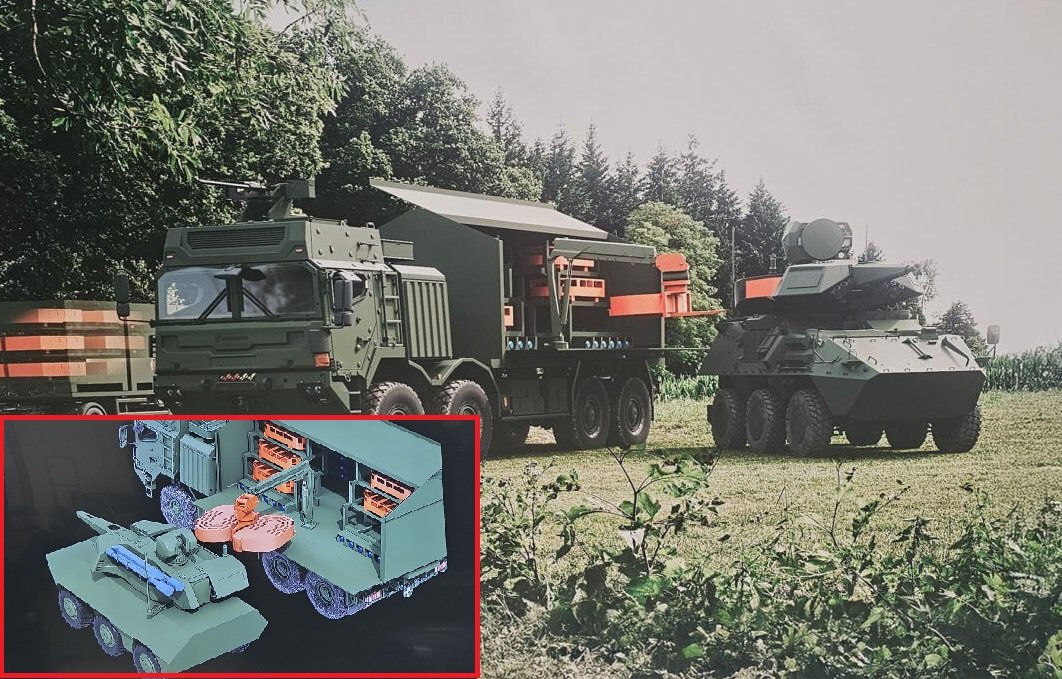 Rheinmetall Develops Automated Reloader for Austrian Skyranger Air Defense System
-
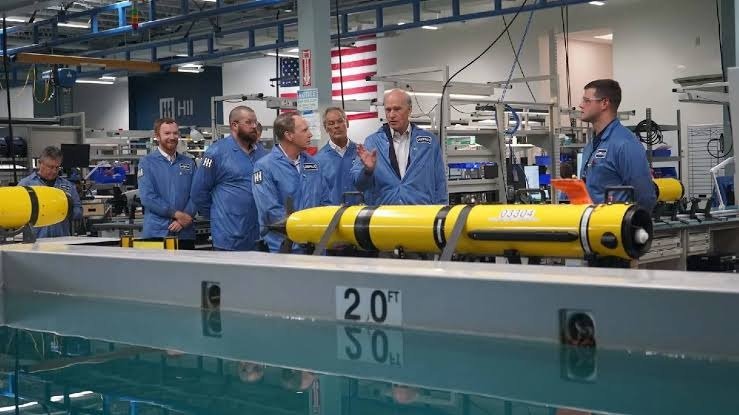 HII Expands Massachusetts Unmanned Systems Facility by 25 Percent to Support U.S. Navy Lionfish Production
