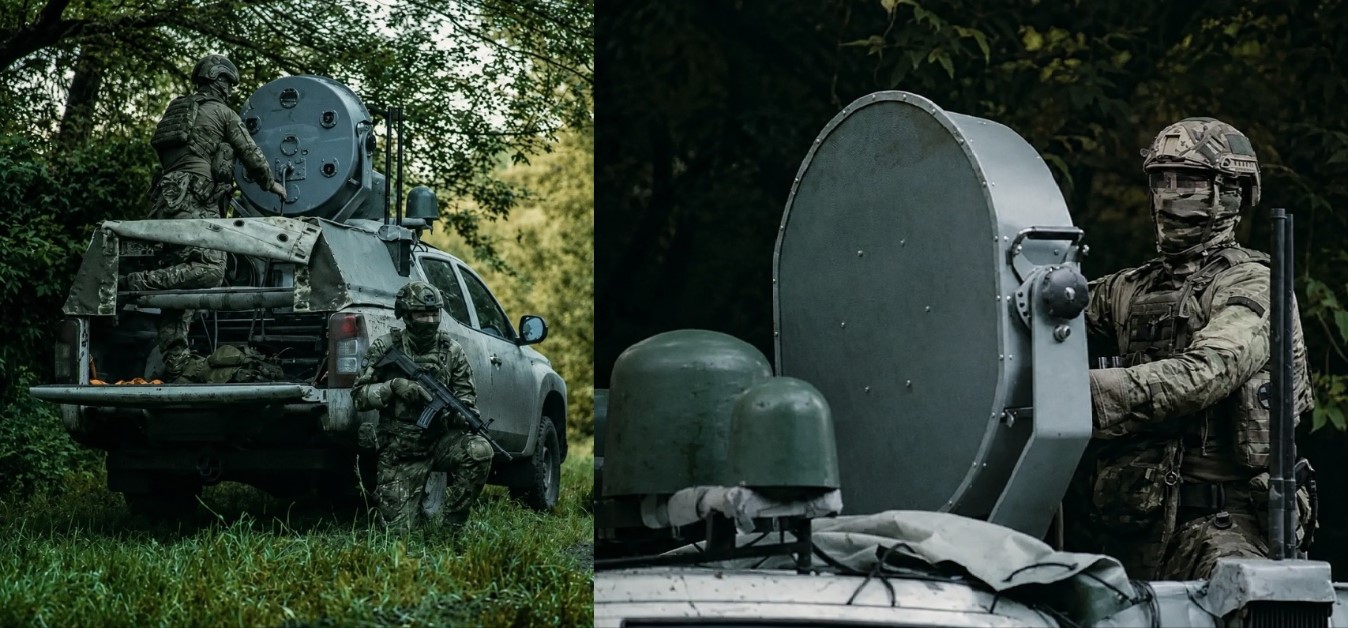
KYIV, Ukraine — June 20, 2026 : Newly released training photographs from a unit of Ukraine's Special Operations Forces (SSO) show a tactical vehicle equipped with a large-format long-range acoustic hailing system, marking the first publicly observed instance of Ukrainian special operators training with this type of equipment.
Defense analysts examining the images, including open-source intelligence observers, have tentatively identified the device as the LRAD 1950XL-RT, a long-range acoustic communication system manufactured by California-based defense technology company Genasys Inc. While the photographs confirm the system's presence in SSO training activities, there is currently no public information indicating whether the equipment has been deployed in active combat operations.
Long-Range Communication Capability
The LRAD 1950XL-RT is the largest and most powerful single-head acoustic hailing system offered by Genasys. Designed for long-distance communication, the system can transmit highly intelligible voice commands, warning messages, and alert tones across substantial ranges.
According to manufacturer specifications, the system can project communications up to 5,000 meters (3.1 miles) under favorable atmospheric conditions. In high-noise environments with background sound levels reaching approximately 88 decibels—comparable to a heavy diesel truck operating nearby—the effective communication range remains up to 1,600 meters (1 mile).
The "RT" designation refers to Genasys' Reach Technology, which integrates an IP Ethernet interface into the system. This feature allows operators to control the device either locally or remotely through a network connection. As a result, personnel can operate the acoustic system from protected positions inside armored vehicles or from distant command centers, reducing exposure to potential threats.
Technical Specifications
The LRAD 1950XL-RT head unit measures approximately 91 cm by 99 cm by 31 cm (36 inches by 39 inches by 12 inches) and weighs 43.1 kilograms (95 pounds). A separate water-resistant electronics housing measures 23 cm by 56 cm by 38 cm (9 inches by 22 inches by 15 inches).
The system generates a peak sound pressure level of 160 decibels at a distance of one meter. Sound is projected through a highly directional beam of plus or minus 15 degrees at 1 kilohertz, enabling operators to focus communications on specific vehicles, individuals, or groups while minimizing noise dispersion outside the target area.
Built for military field operations, the LRAD 1950XL-RT complies with U.S. MIL-STD-810H environmental standards. The system can operate in temperatures ranging from -33°C to +60°C and is designed to withstand harsh conditions including blowing rain, salt fog, vibration, and vehicle shock.
These characteristics make it suitable for deployment across a wide range of operational environments, including those encountered by Ukrainian forces.
Potential Operational Uses
Ukraine's Special Operations Forces (SSO) became an independent branch of the Armed Forces of Ukraine in January 2016. The command is responsible for missions including unconventional warfare, direct action operations, deep reconnaissance, sabotage, special reconnaissance, and influence activities behind enemy lines.
The appearance of the LRAD 1950XL-RT during SSO training suggests that Ukrainian forces are exploring additional non-kinetic capabilities that can be employed before the use of lethal force.
Military organizations worldwide commonly use long-range acoustic devices to bridge the gap between verbal engagement and armed response. Potential applications for Ukrainian forces include:
- Issuing warning messages and stop commands at checkpoints.
- Supporting border security operations.
- Establishing security perimeters around critical infrastructure and military facilities.
- Conducting psychological operations (PSYOPS) through loudspeaker broadcasts.
- Delivering surrender instructions or information messages to opposing forces.
- Managing escalation-of-force procedures during encounters with approaching vehicles or personnel.
The system's ability to transmit clear instructions over long distances may be particularly valuable in environments where conventional communication methods are ineffective due to noise, terrain, or security concerns.
Escalation-of-Force Tool
Genasys markets the LRAD product family primarily as a communication and escalation-of-force solution rather than a weapon system. The company states that the technology is intended to provide clear warnings and encourage compliance before military personnel resort to more forceful measures.
However, the device's maximum acoustic output significantly exceeds the threshold of immediate pain for unprotected human hearing. Prolonged exposure to high-intensity tones at close range can result in hearing damage.
The use of LRAD systems has generated legal and ethical discussions in several countries. In some civilian deployments, including crowd-control situations in the United States, individuals exposed to high-intensity deterrent tones have reported auditory injuries, leading to legal challenges and public debate regarding operational guidelines and safe employment practices.
Origins of LRAD Technology
The development of LRAD technology can be traced to security concerns highlighted by the October 2000 bombing of the USS Cole in Aden, Yemen. During the attack, an explosives-laden small boat approached the U.S. Navy guided-missile destroyer before detonating, killing 17 sailors.
Following the incident, American Technology Corporation—later renamed Genasys—developed the first Long Range Acoustic Device (LRAD) in 2002 to provide military and security personnel with a means of delivering unmistakable warnings at extended distances before resorting to defensive fire.
Since its introduction, LRAD technology has expanded beyond naval security applications. The systems are now used on military vehicles, fixed-site installations, helicopters, maritime platforms, and law enforcement assets in numerous countries.
According to Genasys, its acoustic and protective technologies are currently utilized across all 50 U.S. states and in more than 100 countries worldwide, supporting the safety and security of over 155 million people.
Expanding Non-Kinetic Capabilities
The appearance of the LRAD 1950XL-RT in Ukrainian Special Operations Forces training highlights ongoing efforts to broaden operational capabilities through a combination of lethal and non-lethal systems. While the operational status of the equipment remains unknown, its integration into training activities indicates interest in long-range communication and escalation-of-force tools that can support military operations across a variety of scenarios.
As Ukraine continues to adapt its force structure and equipment requirements, systems such as the LRAD 1950XL-RT may provide additional options for communication, deterrence, checkpoint security, and psychological operations while reducing the need for immediate kinetic engagement.
——— End of Article ———