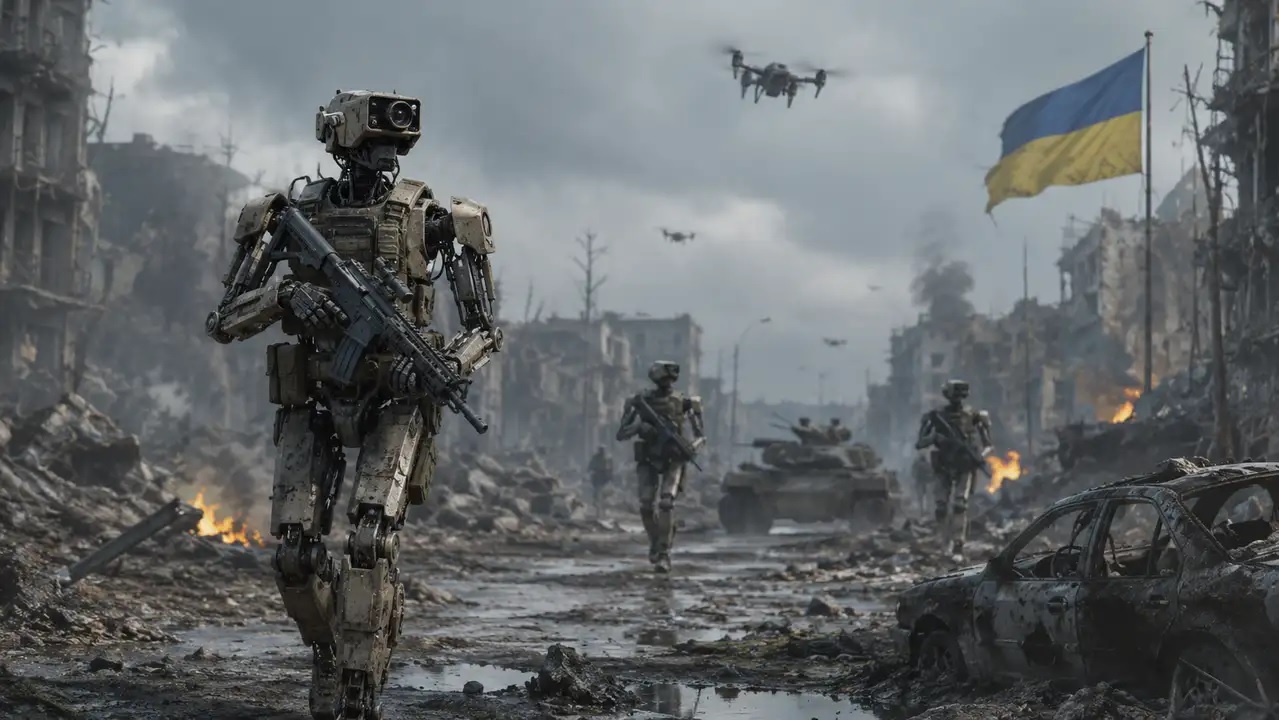
KYIV — Ukraine has launched a new grant program to help local companies develop humanoid robots for military use as it looks to automate more battlefield tasks and reduce the risks faced by frontline soldiers.
The announcement was made by Brave1 CEO Andriy Hrytsenyuk during the recent Brave1 Advantage event in Kyiv, according to a Militarnyi reporter who attended the event.
Brave1 is a government-backed defense technology group created by Ukraine's Ministry of Digital Transformation and other government agencies to speed up the development, testing, and deployment of new military technologies.
The new grant program will support Ukrainian developers building humanoid robots for military operations. Officials said the main goal is to use robots for dangerous frontline missions, reducing the need to expose soldiers to high-risk combat situations.
Hrytsenyuk said the project follows similar efforts in countries such as the United States and China, which are also investing in humanoid robot technology. However, Ukraine plans to take a gradual approach by first developing simpler robots before adding more advanced capabilities. The aim is to improve reliability while expanding what the robots can do over time.
Unlike many humanoid robot projects around the world that are designed for factories and other commercial uses, Ukraine's program is focused entirely on military operations. The robots are expected to support troops, carry out dangerous tasks, and operate in combat areas where sending soldiers would be more risky.
Since the start of the war, Ukraine has become an important testing ground for new defense technologies. Many Western defense companies and startups have used real battlefield conditions to evaluate new equipment. Before the grant program was announced, the Phantom MK-1 humanoid robot, developed by U.S. startup Foundation, was delivered to Ukraine for operational testing to assess how it performs in combat conditions.
Although interest in military humanoid robots is growing, the technology still faces several challenges. Current robots are heavy, expensive to build, require frequent battery charging, and often struggle to move across rough terrain. Reports also say a typical humanoid robot uses around 20 motors to control its movements, meaning the failure of just one motor can affect the robot's performance.
Military experts also believe more work is needed before humanoid robots can be widely used on the battlefield. Issues such as maintenance, logistics, safety, and reliable autonomous operation must be solved before they can become a practical part of future military operations.
——— End of Article ———