KYIV, Ukraine, June 30, 2026 — Ukrainian officials have stated that electronic components manufactured by Japanese companies have been identified in approximately 90% of the ballistic missiles, cruise missiles, and drones used by Russian forces during the ongoing war, according to internal Ukrainian government documents.
The findings were presented by Vladyslav Vlasiuk, Ukrainian President Volodymyr Zelenskyy's Commissioner for Sanctions Policy, who said the components are primarily civilian electronic parts that have been diverted into Russia's defense industry through third-country supply networks rather than direct exports from Japan.
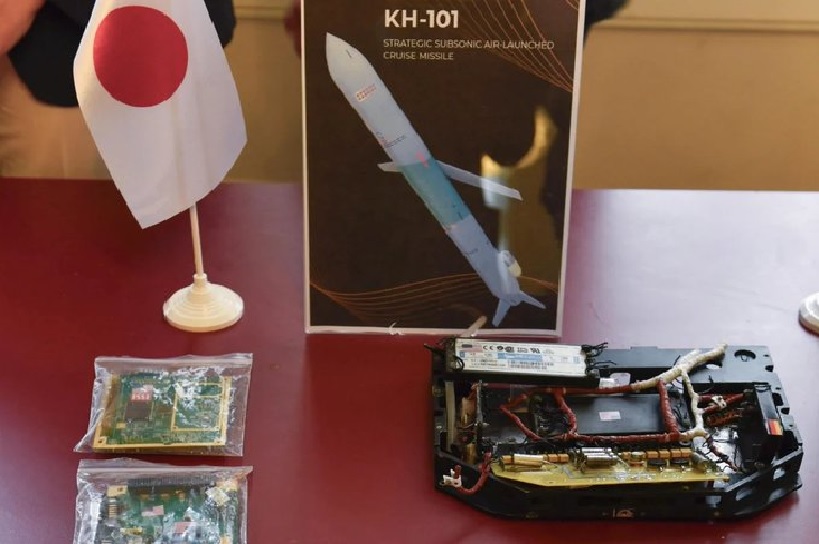
According to the documents, Ukrainian investigators have identified components from 13 Japanese semiconductor and electronics manufacturers in a range of Russian weapon systems recovered from the battlefield. The parts have been traced in the Kh-101 long-range cruise missile, which reportedly contains more than 100 foreign-made components, as well as Lancet loitering munitions, Iranian-designed Shahed attack drones, and Mohajer-6 reconnaissance drones used by Russian forces.
The Ukrainian government said the components involved are standard commercial electronic parts designed for civilian applications rather than military use. Because these products are widely available on the global market, authorities say monitoring their final destination remains a significant challenge for export control agencies.
According to Ukrainian officials, Russia is obtaining these dual-use components through a network of intermediaries that re-export commercially available electronics into the country. Investigations indicate that many of the parts are routed through Central Asian countries and China, allowing Russian defense manufacturers to bypass existing international sanctions and export restrictions.
The findings have renewed Kyiv's calls for tighter international controls on dual-use technologies. Vlasiuk urged the Japanese government to strengthen export oversight, improve end-user verification, and increase monitoring of indirect exports that could ultimately reach Russia's military-industrial sector.
He stated that Russia continues to exploit the complexity of global supply chains and the difficulty of tracking civilian electronic products after export, enabling the country to maintain production of missiles and unmanned aerial systems despite international sanctions.
The issue highlights broader challenges facing governments attempting to restrict the transfer of commercially available microelectronics that can serve both civilian and military purposes. While many advanced weapons rely on specialized components, a significant portion of their electronic systems also use standard semiconductors, processors, sensors, and integrated circuits that are commonly available in international markets.
Japanese news agency Kyodo News contacted the 13 companies identified in the Ukrainian documents for comment. Their responses varied. Five manufacturers said they were unable to confirm whether the identified components originated from their supply chains because of limited visibility into downstream distribution. One company indicated that a product manufactured by one of its subsidiaries may have been repurposed after sale. Another company stated that the component identified in the report was produced by a different manufacturer. The remaining six companies did not respond to requests for comment.
Ukraine has previously documented the presence of foreign-made electronic components from multiple countries in Russian weapons recovered during the conflict. However, Ukrainian officials said the latest assessment indicates that Japanese-made components appear in an estimated 90% of the missiles and drones examined, drawing renewed attention to the role of global commercial supply chains in the production of military equipment.
Japan has remained a consistent supporter of Ukraine since the start of Russia's full-scale invasion, imposing sanctions on Russia while providing financial assistance, humanitarian support, and non-lethal defense aid, including drone detection systems and other security-related equipment.
Ukrainian officials said the latest findings demonstrate that, despite extensive international sanctions, preventing the diversion of widely available civilian electronics into military supply chains continues to be one of the most difficult aspects of sanctions enforcement. They argue that closer international coordination, stronger export controls, and improved monitoring of intermediary trade routes will be necessary to reduce the flow of dual-use components into Russia's weapons manufacturing sector.
Japanese authorities had not issued an immediate public response to Ukraine's latest claims at the time of reporting.
——— End of Article ———