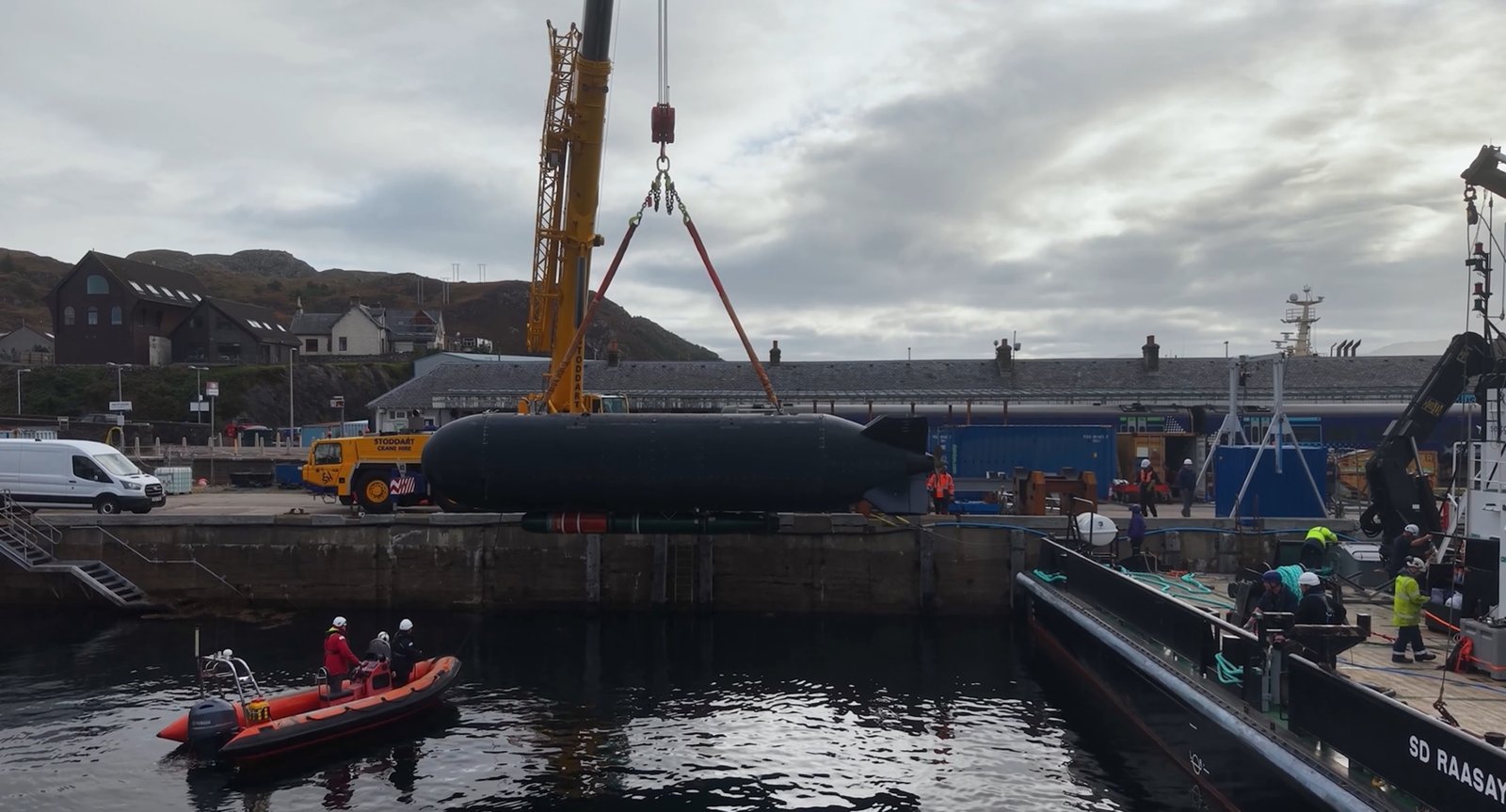
SCOTLAND — The U.S. Navy and Royal Navy have successfully conducted a proof-of-concept launch of a U.S. Mk 48 heavyweight torpedo from the Royal Navy’s XV EXCALIBUR uncrewed underwater vehicle (XLUUV).
The test took place on September 13, 2026, at the British Underwater Test & Evaluation Centre (BUTEC) in Scotland. It was conducted under Project Broadsword and Trial Iron as part of AUKUS Pillar 2, which covers cooperation on advanced military capabilities.
The launch was the first time either the United States or United Kingdom had launched a heavyweight torpedo from an uncrewed underwater vessel rather than a crewed submarine, according to the UK government.
📰 U.S. NAVY UPDATE: U.S. Navy and Royal Navy Successfully Test Fire Torpedo from Unmanned Undersea Vehicle
— Office of the Chief of Naval Operations (@USNavyCNO) September 22, 2026
📍WASHINGTON – On September 13, 2026, the U.S. Navy and the Royal Navy successfully conducted the proof-of-concept launch of an exercise U.S. Mk 48 Heavyweight Torpedo… pic.twitter.com/lVB4wYSwC0
Mk 48 Launched From XV EXCALIBUR
The Mk 48 is the U.S. Navy’s standard heavyweight torpedo and is used as a submarine-launched weapon against surface ships and submarines.
The launch platform, XV EXCALIBUR, is a 12-meter, 19-tonne XLUUV built by Plymouth-based MSubs under the Royal Navy’s Project CETUS. The Royal Navy describes Excalibur as an experimental platform for testing autonomous systems, military payloads and missions.
Excalibur does not have conventional torpedo tubes. During the trial, the Mk 48 was carried externally beneath the vehicle and released from a cradle.
Interoperability Demonstrated
The demonstration validated the mechanical, electrical and software connections needed to operate a U.S. weapon from a British autonomous underwater vehicle.
U.S. Chief of Naval Operations Adm. Daryl Caudle described the test as a historic first for allied undersea warfare and said it demonstrated the potential for greater interchangeability of weapons, payloads and mission architectures between allied platforms.
Vice Adm. Robert Gaucher, Director of Submarine Programs, said the demonstration was an early step toward adding strike capabilities to autonomous undersea systems and highlighted the role of AUKUS Pillar 2 in improving interoperability.
Rapid Development
The project was approved in February 2026 by the Department of the Navy Rapid Capabilities Office (DONRCO), with the demonstration completed in less than seven months.
The effort involved DONRCO, OPNAV N97, the Royal Navy, Defense Innovation Unit, Naval Undersea Warfare Center Keyport and industry partners. DONRCO co-managed the project with the Navy’s Direct Reporting Portfolio Manager for Robotic and Autonomous Systems.
Vice Adm. Seiko Okano, director of DONRCO, said the project uses a modular, software-defined and open-systems approach to combine allied hardware with commercial technology rather than waiting for development of a single bespoke platform.
The Department of the Navy established the Rapid Capabilities Office in August 2025 with a mandate to deliver solutions to operational problems within a zero-to-three-year timeframe.
Next Phase: Project CUTLASS
The next phase will be Project CUTLASS, which will use the Anduril Dive-XL uncrewed underwater vehicle.
CUTLASS will focus on further payload integration, command-and-control data architecture and tactical employment scenarios as the United States and United Kingdom continue developing uncrewed undersea capabilities.
The Excalibur test provides an initial demonstration of integrating a U.S. heavyweight torpedo with an allied uncrewed underwater platform, supporting the wider AUKUS effort to develop interoperable autonomous undersea systems.
——— End of Article ———