WASHINGTON, D.C., June 25, 2026 — The U.S. Department of Energy's National Nuclear Security Administration (DOE/NNSA) has unveiled Aires Tide, a proof-of-concept nuclear flight test vehicle developed using artificial intelligence (AI), high-performance computing (HPC), and advanced 3D-printing technologies. Designed to measure the extreme heat and vibrations experienced during a nuclear weapon's flight, the project demonstrates a faster and more cost-effective approach to developing national security systems.
Developed between October 2025 and March 2026, Aires Tide progressed from initial design to a flight-ready prototype in just five months. By integrating AI-driven engineering, high-performance computing, and additive manufacturing, the NNSA completed the project approximately seven times faster and at nearly one-fifteenth the cost of traditional development methods.
First Milestone of the Genesis Mission
Aires Tide is the first major engineering demonstration under the Genesis Mission, a White House initiative launched by President Donald Trump in November 2025 and led by the Department of Energy. The program seeks to connect AI-enabled national laboratory supercomputers to accelerate scientific research and national security development.
National Laboratory Collaboration
The project brought together multiple organizations across the Nuclear Security Enterprise.
Lawrence Livermore National Laboratory (LLNL) led AI-enabled payload optimization and advanced physics-based modeling. Sandia National Laboratories (SNL) provided system design, integration expertise, and testing infrastructure, while Los Alamos National Laboratory (LANL) contributed systems modeling and design support. Manufacturing was carried out with assistance from the Kansas City National Security Campus (KCNSC).
Engineers used the NNSA's Venado and El Capitan supercomputers to analyze large datasets, evaluate design configurations, and optimize the vehicle before manufacturing.
Advanced Manufacturing Process
The cone-shaped fuselage was produced using laser powder bed fusion, an advanced metal 3D-printing process. The vehicle was manufactured as nested modular sections, reducing production time and cost while allowing rapid assembly and design refinement.
Successful Flight Tests
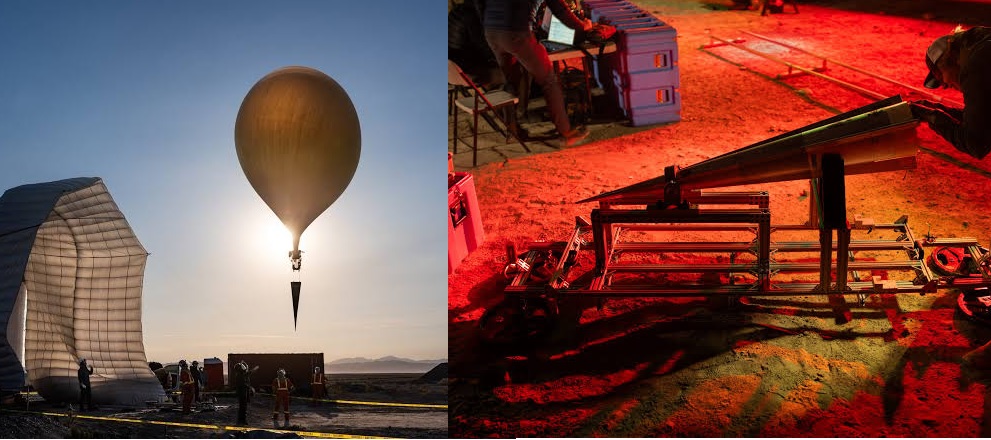
In May 2026, scientists conducted two successful flight tests of a half-scale (1:2) Aires Tide prototype at the U.S. Army's Dugway Proving Ground in Utah.
The vehicle was lifted to an altitude of 32,000 feet by a hydrogen-filled balloon before being released. During the tests, onboard instruments collected data on aerodynamic heating, structural vibrations, and flight performance. The information is being used to validate computer simulations and improve future designs.
Public Display and Future Applications
An 11-foot-tall full-scale prototype of Aires Tide is on display at the National Mall in Washington, D.C., as part of the Great American State Fair during the Freedom 250 celebration.
The NNSA said Aires Tide is a proof-of-concept flight test vehicle rather than a production weapons system. Data collected during the program will support future AI-enabled design, testing, and manufacturing efforts, helping modernize engineering processes used for the U.S. nuclear stockpile and other national security applications.
——— End of Article ———