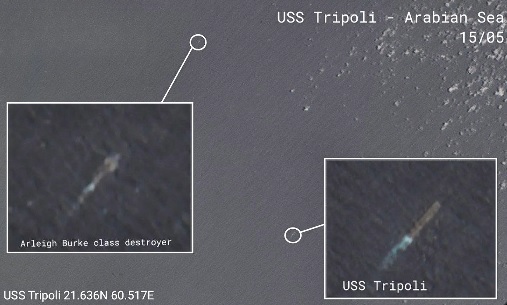
ARABIAN SEA, — June 15, 2026 : The U.S. Navy’s America-class amphibious assault ship USS Tripoli (LHA-7) continues to operate in the Arabian Sea, maintaining a position approximately 100 kilometers east of Oman while accompanied by at least one guided-missile destroyer. The vessel has been observed in the same area multiple times during the ongoing maritime blockade and is expected to remain on station for the foreseeable future.
According to naval planning, USS Tripoli and its escorting warships will continue operating from their current location even if the blockade of Iranian ports is formally lifted or modified. The decision highlights the strategic importance of maintaining a sustained U.S. naval presence near key maritime routes linking the Gulf of Oman, the Strait of Hormuz, and the wider Arabian Sea.
Deployed as Flagship of Amphibious Ready Group
USS Tripoli is currently serving as the flagship of the Tripoli Amphibious Ready Group (ARG) in the U.S. 5th Fleet area of operations. The formation, which includes up to 5,000 personnel, was deployed to the Middle East earlier this year in support of Operation Epic Fury.
Since arriving in the region, the Amphibious Ready Group has participated in a range of missions, including maritime security operations, flight activities, replenishment-at-sea operations, and support for maritime interdiction efforts. The group operates alongside guided-missile destroyers, including vessels that have previously included the Arleigh Burke-class destroyer USS Spruance (DDG-111).
The naval force has been tasked with enforcing maritime restrictions on commercial shipping attempting to enter or leave ports affected by the current blockade.
Blockade Enforcement Operations Continue
According to U.S. Central Command (CENTCOM), forces enforcing the blockade have redirected more than 129 commercial vessels to ensure compliance with maritime restrictions. Naval units have also conducted boarding operations against vessels that failed to respond to warnings, while some ships were reportedly disabled after refusing to comply with instructions.
The mission places significant emphasis on maritime surveillance, vessel tracking, and rapid-response capabilities across key shipping lanes in the region. The Arabian Sea and Strait of Hormuz remain among the world's most strategically important waterways, carrying a substantial share of global energy exports and commercial shipping traffic.
Air Wing Supports Surveillance and Boarding Missions
A key component of USS Tripoli’s operational capability is the embarked 31st Marine Expeditionary Unit (MEU), which provides expeditionary and maritime security forces for the deployment.
The ship’s aviation combat element includes F-35B Lightning II fighter aircraft from Marine Fighter Attack Squadron 121 (VMFA-121), alongside MV-22B Osprey tiltrotor aircraft and MH-60S Seahawk helicopters. These assets enable continuous monitoring of regional airspace and maritime traffic while supporting rapid-response and vessel-boarding operations.
Marine teams supported by these aircraft are capable of conducting interdiction missions throughout the Gulf of Oman and the Strait of Hormuz, allowing U.S. forces to quickly investigate or secure vessels when required.
America-Class Warship Built for Aviation Operations
Commissioned in July 2020, USS Tripoli is the second vessel in the America-class of amphibious assault ships. The warship measures approximately 844 feet (257 meters) in length, has a 106-foot beam, and displaces around 45,000 tons at full load.
Powered by two marine gas turbines, the vessel can achieve speeds exceeding 22 knots and is capable of carrying approximately 1,687 Marines in addition to a crew of more than 1,000 sailors.
Unlike earlier amphibious assault ships that featured traditional well decks for landing craft operations, USS Tripoli was designed with a greater emphasis on aviation capabilities. Its large flight deck supports operations involving F-35B fighters, MV-22 Ospreys, helicopters, and other aircraft, making it one of the U.S. Navy’s primary air-centric expeditionary platforms.
Continued Presence in the Region
USS Tripoli arrived in the U.S. Central Command area of responsibility in late March 2026 and has remained actively involved in regional operations since then. In April, Marines embarked aboard the ship participated in the boarding and search of the Iranian-flagged vessel M/V Touska in coordination with USS Spruance after the vessel reportedly failed to comply with coalition warnings.
By maintaining the Amphibious Ready Group approximately 100 kilometers off the Omani coast, U.S. commanders retain a permanent staging point for air and surface operations. The deployment ensures that surveillance, interdiction, and rapid-response capabilities remain available regardless of changes to the current blockade.
While U.S. officials have not disclosed how long the deployment will continue, USS Tripoli remains engaged in routine operations in the Arabian Sea as part of broader U.S. 5th Fleet efforts to support maritime security, freedom of navigation, and regional contingency response missions.
——— End of Article ———