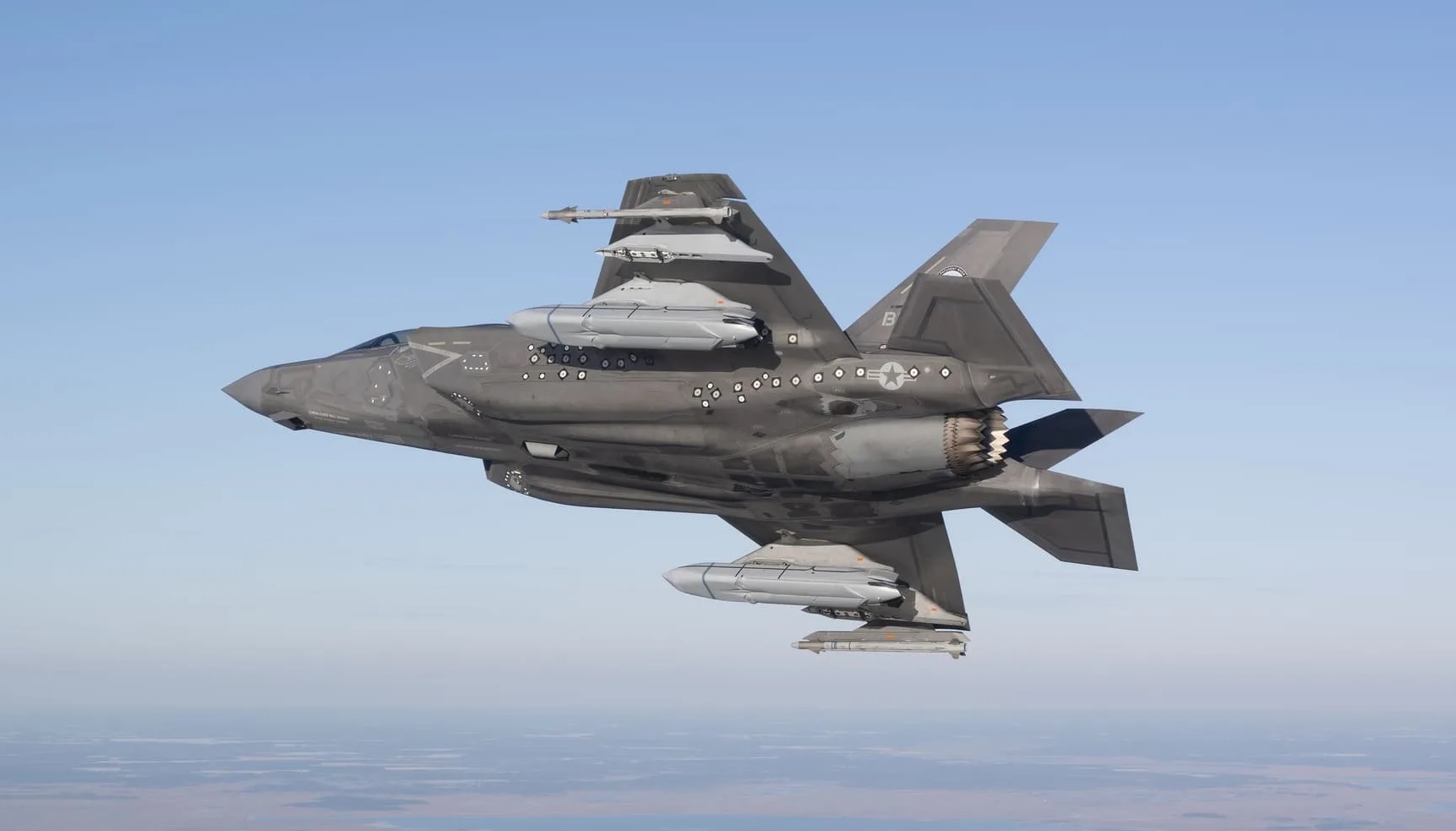
PATUXENT RIVER, Maryland — June 11, 2026 : The U.S. Navy, in partnership with Lockheed Martin, has successfully completed the first phase of the F-35C LRASM Flight Sciences Test Program, marking a significant step toward integrating the AGM-158C Long-Range Anti-Ship Missile (LRASM) with the carrier-based F-35C Lightning II fighter aircraft.
Lockheed Martin announced on June 10, 2026, that the initial phase of testing concluded following a series of integration flight trials conducted between September 2024 and April 2026 at Naval Air Station Patuxent River, Maryland. The milestone allows the program to move forward with the next stages of the missile integration effort.
The AGM-158C LRASM, due to its size, is carried externally on the F-35C’s wing stations rather than inside the aircraft’s internal weapons bays. The U.S. Navy released the first images of the external carriage configuration in September 2024 shortly after testing began.
Captive Carriage Testing Validates Aircraft and Missile Integration
The first phase of the program focused on captive carriage flight testing, a critical step in evaluating how the aircraft performs while carrying a large external weapon. During these flights, engineers assessed aerodynamic characteristics, structural loads, flutter behavior, handling qualities, and overall flight performance across various operating conditions.
According to Lockheed Martin, the tests successfully validated the structural integrity of both the aircraft and missile integration system throughout the planned flight envelope. The data collected confirmed that the F-35C can safely operate with the LRASM attached under a range of flight profiles.
A notable event during the campaign occurred on November 6, 2025, when a U.S. Marine Corps pilot participated in a rate-capture test as part of the broader flight sciences evaluation. Testing was conducted by the Pax River F-35 Integrated Test Force (ITF), which coordinated efforts among Navy, Marine Corps, and industry teams.
To streamline the program and maximize efficiency, the test team utilized assets from both the LRASM and AGM-158 Joint Air-to-Surface Standoff Missile (JASSM) programs. Because the two weapons share a common external airframe design, data gathered from both missile families contributed to the integration effort.
Next Phase to Include Separation and Weapon Testing
With captive carriage trials completed, the program will proceed to the next stages of testing. Upcoming evaluations will include separation tests, which will examine the missile's behavior immediately after release from the aircraft, followed by comprehensive weapon testing to assess the missile’s full engagement profile.
Neither the U.S. Navy nor Lockheed Martin has announced a timeline for future live-fire demonstrations or operational testing activities.
Expanding Long-Range Strike Capability for Carrier Air Wings
The integration of LRASM is expected to significantly enhance the F-35C’s ability to engage enemy surface vessels from long distances while operating in contested environments. Once fully integrated, the aircraft will gain a dedicated long-range anti-ship strike capability similar to that already fielded on the B-1B Lancer strategic bomber and the F/A-18E/F Super Hornet.
“By integrating LRASM onto the F-35, we’re giving our warfighters a powerful capability that enhances mission flexibility and expands their operational options,” said Jon Hill, Vice President and General Manager of Lockheed Martin Air Dominance and Strike Weapons.
Sean Jackson, Vice President of F-35 Development, stated that integrating LRASM onto the fifth-generation fighter reflects continued investment by the United States and allied partners in expanding the aircraft’s mission capabilities, particularly for long-range maritime and land-attack operations.
The U.S. Marine Corps has also conducted similar AGM-158 integration activities on the F-35B short takeoff and vertical landing variant, supporting broader efforts to field the missile family across multiple F-35 versions.
About the AGM-158C LRASM
The AGM-158C LRASM is a low-observable, long-range anti-ship cruise missile derived from the AGM-158B JASSM-ER (Extended Range). Originally developed through a program led by the Defense Advanced Research Projects Agency (DARPA) for the U.S. Air Force and Navy, the missile was designed to address the military’s Offensive Anti-Surface Warfare (OASuW) capability requirements.
The weapon is specifically engineered to operate in heavily contested environments where electronic warfare, jamming, and degraded communications may limit traditional targeting methods.
After navigating toward a designated area using GPS guidance, the missile employs onboard sensors and advanced processing systems to locate, identify, and track targets before executing terminal guidance. Its semi-autonomous targeting capability reduces dependence on external Intelligence, Surveillance, and Reconnaissance (ISR) assets and network connections.
Current LRASM Variants and Future Development
The Navy’s OASuW Increment 1 program currently includes three LRASM variants.
LRASM 1.0, which achieved early operational capability in 2019, is operational on the B-1B Lancer and F/A-18E/F Super Hornet fleets.
LRASM 1.1, fielded in 2023, is undergoing Initial Operational Test and Evaluation (IOT&E) and is also being integrated onto the P-8A Poseidon maritime patrol aircraft.
The next version, LRASM C-3, focuses on extending the missile’s anti-surface warfare range and updating its target threat library. The U.S. Navy plans to achieve early operational capability in the fourth quarter of Fiscal Year 2026.
The LRASM C-3 program is intended to serve as a bridge capability until the Department of Defense launches the OASuW Increment 2 program. The future competition-based Increment 2 effort is expected to reach early operational capability in Fiscal Year 2029 and initial operational capability in Fiscal Year 2031.
Production Expansion to Meet Growing Demand
As integration activities continue across multiple platforms, Lockheed Martin has expanded manufacturing capacity for both the LRASM and JASSM missile families. The company has invested in production facilities, including its operations in Pike County, Alabama, to support increasing demand from U.S. military services and international customers.
The completion of the first phase of the F-35C LRASM Flight Sciences Test Program represents an important milestone in bringing long-range maritime strike capability to the Navy’s carrier-based fifth-generation fighter fleet. Future testing will determine the timeline for full operational integration and fleet deployment of the missile system.
——— End of Article ———