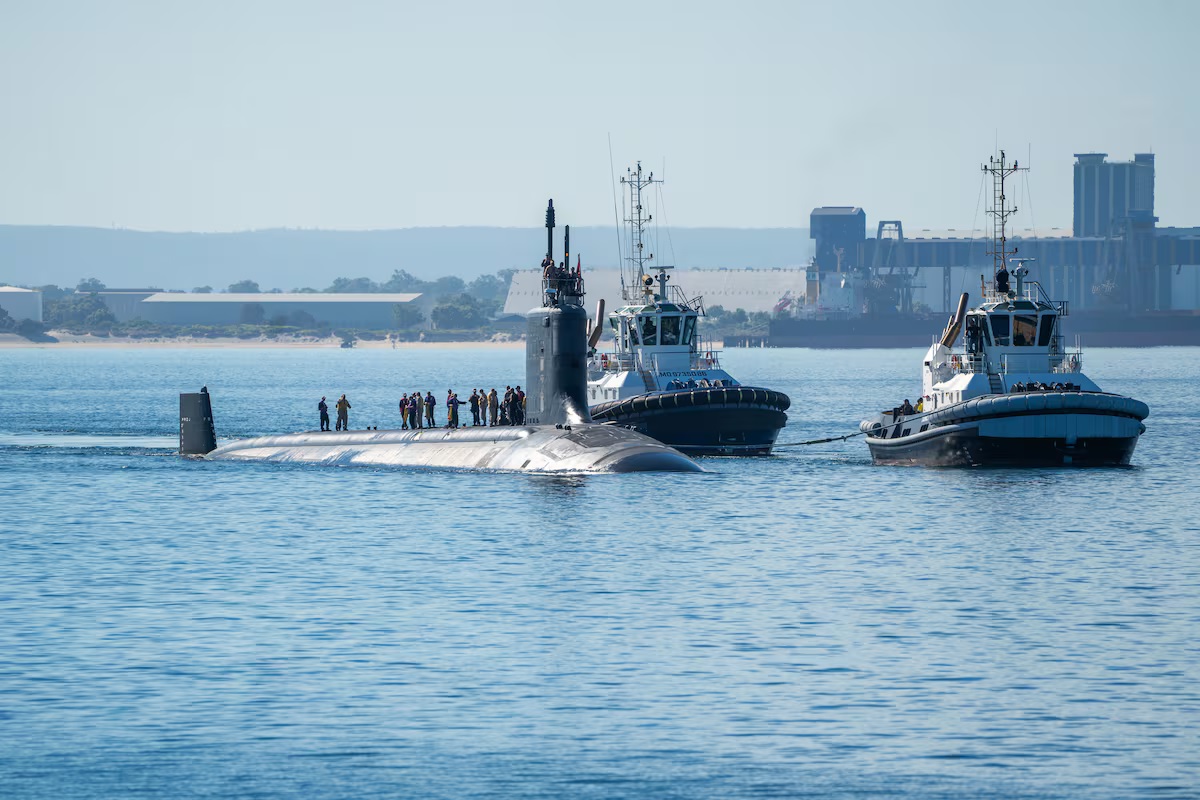
PERTH, Australia, — June 14, 2026 : The U.S. Navy has officially reactivated Submarine Squadron 3 (CSS-3) and relocated its headquarters to HMAS Stirling in Western Australia, marking a major milestone in the implementation of the AUKUS security partnership between Australia, the United Kingdom, and the United States. The squadron, which was decommissioned in 2012, will play a central role in supporting future rotational deployments of U.S. and British nuclear-powered submarines in Australia.
The move is part of broader efforts under AUKUS Pillar 1 to strengthen allied undersea capabilities in the Indo-Pacific region while helping Australia develop the infrastructure, workforce, and operational expertise required to operate nuclear-powered submarines.
CSS-3 Reactivated After 14 Years
The reestablishment of CSS-3 was formally announced on June 10, 2026, by Rear Adm. Chris Cavanaugh, Commander of the U.S. Pacific Submarine Force. Originally based at Pearl Harbor, Hawaii, the squadron was disbanded in February 2012 as part of a restructuring of U.S. submarine forces.
Now headquartered at HMAS Stirling near Perth, CSS-3 will serve as the primary U.S. Navy command element supporting submarine operations in Western Australia. Its personnel will work closely with the Royal Australian Navy (RAN) to develop maintenance, logistics, training, and operational support systems required for allied submarine deployments.
According to the U.S. Navy, the squadron's mission is to establish the foundations necessary for long-term submarine operations in Australia while assisting the country in building sovereign capabilities to support and sustain nuclear-powered vessels.
Supporting Submarine Rotational Force-West
The revival of CSS-3 is directly linked to the creation of Submarine Rotational Force-West (SRF-West), one of the most significant initiatives under the AUKUS agreement.
Beginning in 2027, U.S. and U.K. nuclear-powered fast-attack submarines are scheduled to conduct rotational deployments from HMAS Stirling. The rotational force will enhance allied presence and operational readiness across the Indo-Pacific while providing Australian personnel with practical experience alongside experienced submarine operators.
CSS-3 will be responsible for coordinating many of the operational and support activities associated with SRF-West. The squadron will help establish procedures, maintenance capabilities, logistics networks, and infrastructure necessary to sustain visiting submarines and their crews.
Expansion of U.S. Support Infrastructure in Australia
To support the growing U.S. naval presence in Western Australia, the U.S. Navy has also established Naval Support Activity (NSA) Stirling through its Japan Regional Command.
NSA Stirling will provide administrative, logistical, and community support services for U.S. military personnel, civilian employees, contractors, and family members stationed in Australia as part of the AUKUS program.
In addition, the Pearl Harbor Naval Shipyard and Intermediate Maintenance Facility (PHNSY & IMF) is expected to establish a dedicated maintenance detachment in Western Australia by mid-2026. The unit will conduct intermediate-level repairs and maintenance for U.S. submarines assigned to SRF-West and continue practical training programs for Australian maintenance specialists.
These developments are intended to ensure that Western Australia has the necessary infrastructure and skilled workforce to support a sustained rotational submarine presence.
AUKUS Plan Shifts to In-Service Virginia-Class Submarines
The reactivation of CSS-3 comes shortly after a significant adjustment to Australia's submarine acquisition plans under AUKUS.
At the Shangri-La Dialogue in Singapore on May 30, 2026, officials from the partner nations confirmed that Australia will now acquire three in-service Block IV Virginia-class submarines from the U.S. Navy's existing fleet.
The decision represents a change from the original 2023 AUKUS "Optimal Pathway," which envisioned Australia receiving a combination of used and newly built Virginia-class submarines. Under the revised arrangement, all three submarines transferred to Australia will be operational vessels already serving in the U.S. Navy.
Australian Deputy Prime Minister and Defence Minister Richard Marles described the change as a cost-effective approach that simplifies acquisition, training, maintenance, and supply-chain management.
Streamlining Australia's Transition to Nuclear-Powered Submarines
The revised plan is expected to reduce complexity during Australia's transition from conventional to nuclear-powered submarines.
Rather than managing multiple submarine variants, Australia will transition through three primary classes: the existing Collins-class submarines, the transferred Block IV Virginia-class submarines, and the future SSN-AUKUS submarines scheduled to enter service in the early 2040s.
Defense officials believe this streamlined approach will make workforce training and fleet management more efficient while keeping the broader AUKUS timeline on track.
The Virginia-class submarines expected to be transferred were built between 2020 and 2028 and feature reactors designed for approximately 33 years of service life. Because the vessels will already have spent several years in U.S. Navy service before transfer, they are expected to provide Australia with roughly 23 years of operational availability after delivery during the 2030s.
The updated arrangement may also help relieve pressure on U.S. shipyards, which are currently focused on meeting production targets for newer Block V and future Block VI Virginia-class submarines.
Strategic Importance of HMAS Stirling
Located near Perth on Australia's west coast, HMAS Stirling is strategically positioned along key maritime routes in the Indian Ocean and serves as Australia's principal submarine base.
The rotational deployment model under SRF-West will allow the United States and United Kingdom to maintain a regular submarine presence in the region without establishing a permanent foreign base in Australia. At the same time, it provides Australia with access to operational experience and technical expertise necessary for the future operation of its own nuclear-powered submarine fleet.
Officials from all three AUKUS partners have stated that the reactivation of CSS-3, the establishment of SRF-West, and the revised Virginia-class acquisition plan are designed to keep AUKUS Pillar 1 on schedule while strengthening interoperability and reducing logistical challenges.
As preparations continue ahead of the first planned submarine rotations in 2027, HMAS Stirling is expected to become a central hub for allied undersea operations and cooperation across the Indo-Pacific region
——— End of Article ———