WASHINGTON — The U.S. Navy has officially reclassified 19 future Virginia-class submarines equipped with the Virginia Payload Module (VPM) as guided-missile submarines (SSGNs), recognizing their expanded long-range strike capability as the service prepares to retire its Ohio-class guided-missile submarine fleet.
The redesignation applies to Block V and Block VI Virginia-class submarines fitted with the Virginia Payload Module. Previously classified as nuclear-powered fast attack submarines (SSNs), the vessels will now carry the SSGN designation to reflect their significantly increased conventional strike capacity.
Chief of Naval Operations Adm. Daryl Caudle said the new designation accurately represents the strike capability, operational flexibility and global reach of VPM-equipped submarines. He added that the change comes as the Navy begins retiring its Ohio-class SSGNs and positions the Virginia-class fleet to continue that mission with greater survivability and adaptability.
Virginia Payload Module Expands Strike Capability
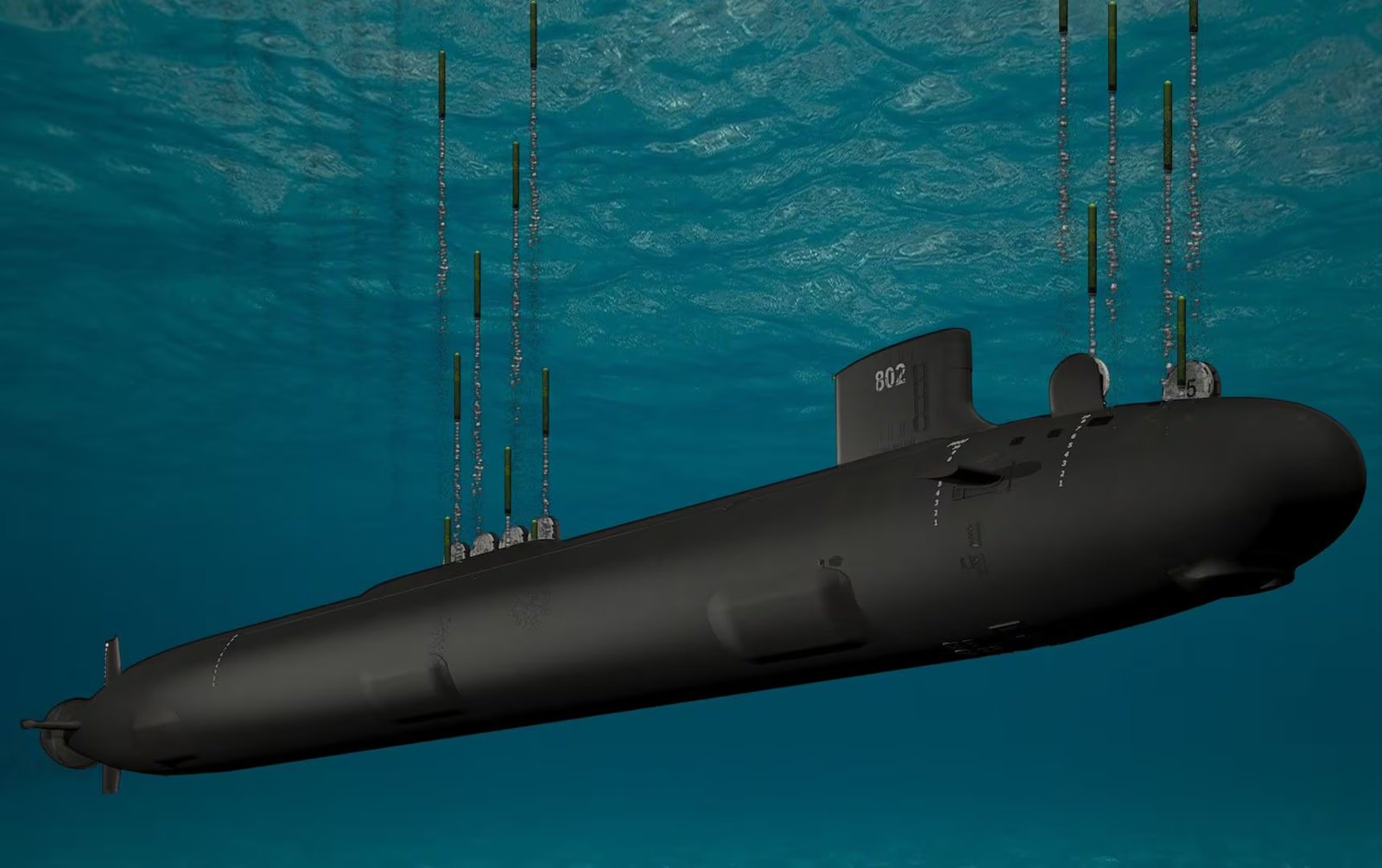
The Virginia Payload Module is a hull extension inserted into the middle section of the submarine. According to the Navy, the module measures about 70 to 84 feet in length and contains four large vertical payload tubes.
Each tube can carry seven Tomahawk land-attack cruise missiles, adding 28 missiles to the submarine's vertical-launch capacity. Combined with the submarine's two existing Virginia Payload Tubes, which each hold six Tomahawk missiles, a VPM-equipped Virginia-class submarine can carry 40 vertically launched Tomahawk missiles.
Earlier Virginia-class submarines carried 12 Tomahawk missiles in their vertical launch systems or payload tubes.
The larger payload tubes are also designed to accommodate future payloads, including the Intermediate-Range Conventional Prompt Strike (IRCPS) hypersonic missile. The Navy has also identified the potential to deploy unmanned underwater vehicles (UUVs), specialized seabed warfare systems, and future surface-to-air missiles using the same payload spaces.
In addition to the new payload module, the submarines will continue to carry four 21-inch torpedo tubes, capable of launching Mk 48 heavyweight torpedoes, Tomahawk cruise missiles, and Harpoon anti-ship missiles. They also retain the ability to deploy and recover unmanned underwater vehicles, while selected boats can support special operations forces through Dry Deck Shelters.
USS Arizona to Be First Virginia-Class SSGN
The future USS Arizona (SSGN 803), the second Block V submarine currently under construction, will become the first Virginia-class submarine equipped with the Virginia Payload Module. The Navy expects the submarine to be delivered in fiscal year 2029.
The lead Block V submarine, the future USS Oklahoma, is being built without the payload module and will retain its SSN configuration.
Under current acquisition plans, the Navy will field 11 Block V submarines and nine Block VI submarines. Excluding USS Oklahoma, the remaining 19 submarines equipped with the Virginia Payload Module will receive the new SSGN designation.
Ohio-Class Retirement Drives Transition
The redesignation comes as the Navy begins retiring its four Ohio-class guided-missile submarines, which have served as the fleet's primary conventional strike platforms for more than two decades.
USS Georgia completed its final patrol in late July 2026 and is scheduled to begin formal inactivation in 2027. The remaining three submarines—USS Ohio, USS Florida, and USS Michigan—are scheduled to retire by the end of fiscal year 2029.
An Ohio-class SSGN can carry up to 154 Tomahawk cruise missiles, although typical operational loads are lower. By comparison, a Virginia-class submarine equipped with the Virginia Payload Module carries 40 vertically launched Tomahawk missiles. Based on missile capacity, approximately four VPM-equipped Virginia-class submarines provide a strike volume comparable to one Ohio-class SSGN.
Fleet Transition Extends Into 2038
The Navy does not expect all 19 Virginia-class SSGNs to enter service until fiscal year 2038, creating a transition period after the retirement of the Ohio-class fleet.
Virginia-class submarine production also remains below the Navy's objective of building two boats per year, with officials expecting that production rate to be achieved sometime during the 2030s. Construction demand is further affected by U.S. commitments under the AUKUS partnership to provide Virginia-class submarines to Australia.
Last week, the Navy awarded a $76.6 billion contract covering the construction of nine Block VI Virginia-class submarines and five Columbia-class ballistic missile submarines, supporting long-term modernization of the U.S. undersea fleet.
Navy Highlights Expanded Operational Role
Vice Adm. Rob Gaucher, Director of Submarine Programs, said the redesignation recognizes the increased lethality provided by the Virginia Payload Module and will allow the Navy to surge additional strike power when required.
The Navy said VPM-equipped Virginia-class submarines will continue performing their existing missions, including anti-submarine warfare, anti-surface warfare, intelligence collection, mine warfare, and support for special operations forces. The additional payload capacity is intended to strengthen Distributed Maritime Operations by providing fleet commanders with greater long-range precision strike capability from a stealth platform.
The redesignation formally marks the Navy's transition from the Ohio-class guided-missile submarine fleet to a new generation of Virginia-class submarines with expanded conventional strike capabilities while maintaining their broad undersea warfare mission.
——— End of Article ———