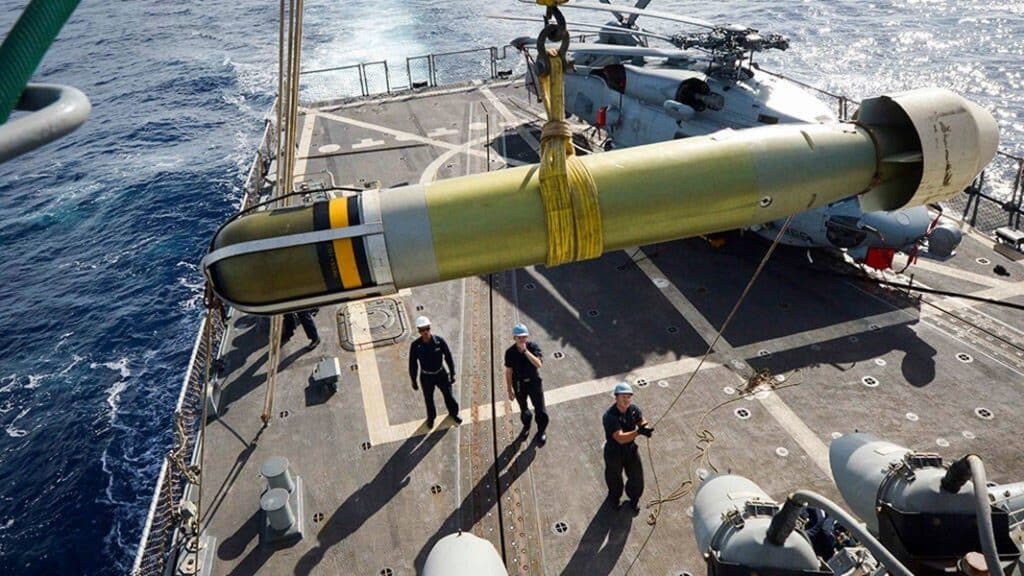
WASHINGTON, — June 18, 2026 : The U.S. Navy has awarded General Dynamics Mission Systems (GDMS) a $116.6 million contract modification to continue the production of sonar assembly kits and associated equipment for the MK 54 lightweight torpedo, the Navy’s primary anti-submarine warfare (ASW) weapon.
The contract, announced on June 17, exercises options under an existing agreement and will support production of sonar assemblies, test equipment, and instrumentation subsystems through April 2029. Funding for the effort is being provided through Navy weapons procurement accounts across multiple fiscal years.
Work under the contract will be carried out at several facilities across the United States. The majority of production, approximately 62 percent, will take place in Canonsburg, Pennsylvania, while additional manufacturing and support activities will be conducted in Salt Lake City, Utah; Andover, Massachusetts; Bloomington, Indiana; Manassas, Virginia; and Port Orchard, Washington.
Supporting the Navy’s Primary Anti-Submarine Weapon
The MK 54 lightweight torpedo serves as the U.S. Navy’s standard lightweight torpedo and is deployed from a range of platforms, including surface combatants, helicopters, and maritime patrol aircraft such as the P-8A Poseidon. It is designed to engage submarines operating in both deep-water and shallow-water environments.
The latest contract focuses on the sonar section of the MK 54 Mod 1 variant, which is responsible for detecting, classifying, and tracking underwater targets. The sonar system plays a critical role in distinguishing submarine contacts from ocean background noise, clutter, and countermeasures such as decoys.
The Mod 1 upgrade incorporates a higher-resolution sonar array and an advanced processor group that improves target detection and tracking performance. The upgraded processing architecture utilizes Advanced Processor Build (APB) software, sharing computing algorithms with the Navy’s larger MK 48 heavyweight torpedo, which is launched from submarines.
According to Navy program information, these enhancements are intended to improve performance against quieter and more sophisticated submarine threats operating in increasingly complex underwater environments.
Evolution of the MK 54 Mod 1 Program
Development of the MK 54 Mod 1 began in 2007 as part of a long-term modernization effort aimed at maintaining the torpedo’s effectiveness against evolving undersea threats.
The program was structured into multiple increments. Increment 1 introduced Advanced Processor Build 5 software along with hardware upgrades designed to improve target detection, classification, and tracking capabilities. The Navy achieved initial operational capability (IOC) for the Mod 1 configuration in 2023, and full-rate production began in April 2023.
The earlier MK 54 Mod 0 variant entered service in 2004 and remained in production until 2020.
Operational assessments conducted by the Pentagon’s Director of Operational Test and Evaluation (DOT&E) concluded that the MK 54 Mod 1 Increment 1 is operationally effective. Earlier evaluations also identified reliability and availability factors that continue to be addressed through ongoing refinements and modernization efforts.
Strategic Importance in an Evolving Undersea Environment
The contract comes as the U.S. Navy continues to invest in anti-submarine warfare capabilities amid changes in the global undersea security environment.
Recent assessments by the U.S. Office of Naval Intelligence (ONI) indicate that China currently operates approximately 60 submarines, with projections suggesting the fleet could expand to around 70 submarines by 2027 and approximately 80 vessels by 2035.
Naval intelligence officials have also highlighted a gradual transition within the People’s Liberation Army Navy (PLAN) toward a larger number of quieter, nuclear-powered submarines. By 2035, analysts project that as many as half of China’s submarine fleet could be nuclear-powered.
Rear Adm. Michael Brookes, commander of the Office of Naval Intelligence, has previously stated that China's expanding undersea force could present a credible challenge to U.S. maritime operations in the Indo-Pacific region over the coming decades. In response, the Navy continues to prioritize investments in undersea surveillance systems, submarine readiness, and advanced anti-submarine weapons such as the MK 54.
Widely Used by Allied Navies
The MK 54 torpedo is also used by numerous U.S. allies and partners, making it an important element of NATO and allied anti-submarine warfare operations.
Several countries have acquired the weapon directly or invested in conversion programs to upgrade existing torpedo inventories. Australia has procured additional MK 54 torpedoes through previous acquisition programs, while Canada has pursued conversion kits and conducted testing aboard vessels such as HMCS Regina.
India has also integrated the MK 54 into its anti-submarine warfare inventory for use aboard P-8I maritime patrol aircraft and MH-60R Seahawk helicopters. Other operators include Norway, New Zealand, and several NATO member nations through Foreign Military Sales (FMS) programs.
The widespread adoption of the MK 54 supports interoperability between allied forces and enables partner navies to operate common anti-submarine warfare systems alongside U.S. forces.
Continued Modernization Effort
The latest contract modification ensures the continued supply of updated sonar components and associated equipment for the U.S. Navy and allied operators. By sustaining production of the Mod 1 sonar assemblies, the Navy aims to maintain the effectiveness of a proven weapon system while incrementally improving its ability to counter increasingly capable submarine threats.
With production scheduled to continue through 2029, the contract represents part of the Navy’s broader strategy of modernizing existing anti-submarine warfare capabilities while leveraging advancements in sonar technology, signal processing, and open-architecture software to meet future operational requirements.
——— End of Article ———