QUANTICO, Virginia, June 30, 2026 — The U.S. Marine Corps has awarded Seattle-based Overland AI a production contract worth approximately $20 million to accelerate the fielding of fully autonomous ground vehicles (AGVs) in support of Marine air defense operations. The agreement marks the first time a ground autonomy company has served as the prime contractor for a production contract involving autonomous ground vehicles with the U.S. military.
The contract, valued at $19.74 million, was awarded through the Accelerate the Procurement and Fielding of Innovative Technologies (APFIT) program under an Other Transaction Authority (OTA) agreement. The effort is managed by the Office of the Under Secretary of Defense for Research and Engineering in partnership with the Marine Corps' Program Manager for Ground Based Air Defense (PM GBAD).
The production contract includes procurement of more than a dozen autonomous military ground vehicles, Overland AI's OverDrive autonomous driving software, OverWatch command-and-control system, spare parts, training, and support services. Initial deliveries are scheduled to begin in early 2027, approximately nine months after the contract award.
The award represents an important step in the Department of Defense's broader effort to transition autonomous ground systems from experimental programs into operational military service.
Supporting Marine Air Defense Operations
The autonomous vehicles will be integrated into the Marine Air Defense Integrated System (MADIS), the Marine Corps' mobile short-range air defense platform designed to counter drones, helicopters, and other low-flying aerial threats.
MADIS is currently mounted on Joint Light Tactical Vehicles (JLTVs) and combines surveillance sensors, electronic warfare equipment, 30mm cannons, and Stinger missiles to provide mobile air defense capabilities for Marine units.
Rather than replacing the manned JLTV-based systems, the autonomous vehicles will initially serve as force multipliers by providing logistics support, resupply missions, and intelligence, surveillance, and reconnaissance (ISR) capabilities. Future operational roles may expand as the technology is further integrated into Marine Corps air defense formations.
The integration of autonomous resupply vehicles is expected to extend the operational reach of Marine air defense units while reducing personnel exposure during support missions.
ULTRA Vehicle and Autonomous Technology
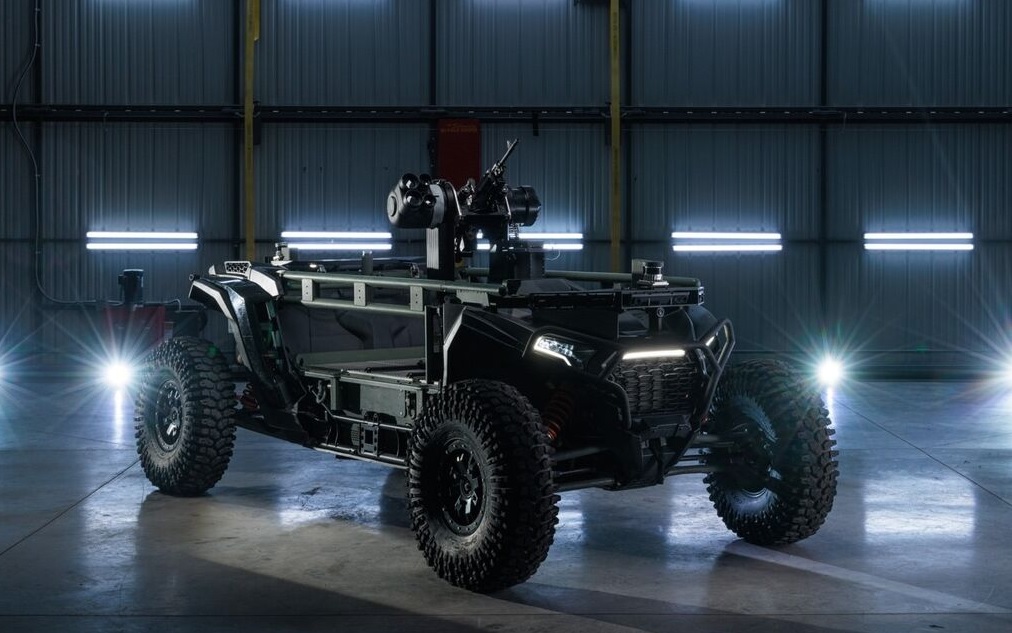
For the contract, Overland AI will provide its ULTRA unmanned ground vehicle, an attritable off-road tactical platform designed for military operations in challenging environments.
The vehicle weighs approximately 2,500 pounds and can carry payloads of up to 1,000 pounds. It features large off-road tires, long-travel suspension, and an open-architecture payload deck that allows different mission equipment to be installed depending on operational requirements.
The ULTRA operates using Overland AI's OverDrive autonomy software, which enables the vehicle to navigate difficult terrain without continuous human control. The system uses onboard sensors to perceive its surroundings, plan routes, avoid obstacles, and make real-time driving decisions while a remote operator can supervise missions through the OverWatch command-and-control system.
According to the company, the platform is designed to operate across diverse environments and is not limited to any specific geographic region or theater of operations.
Military Transition to Operational Deployment
The production award reflects the U.S. military's transition from testing autonomous ground vehicles to fielding operational systems for frontline units. The contract demonstrates growing confidence in autonomous technologies for logistics, reconnaissance, and support missions.
Uncrewed ground vehicles are intended to reduce the need for personnel to operate close to potential threats while increasing operational flexibility across different mission environments.
Demand for autonomous ground systems has grown as the U.S. military continues integrating unmanned technologies into its future operational concepts. The increasing use of uncrewed ground vehicles in recent conflicts has also highlighted their value for logistics, reconnaissance, and force protection missions.
Experience Across Multiple Military Programs
Overland AI has previously supported several U.S. military modernization programs and field exercises. The company's autonomy software is already integrated into platforms including General Dynamics' Small Multipurpose Equipment Transport (S-MET), Textron's Ripsaw M5, and systems evaluated by the Defense Advanced Research Projects Agency (DARPA).
The company has also participated in the Marine Corps' ROGUE Fires program, which focuses on autonomous missile-launching capabilities.
During recent multinational exercises, including Agile Spirit and African Lion 2026, Overland AI supplied autonomous vehicles to the U.S. Army's 173rd Airborne Brigade and 7th Engineer Brigade for missions involving coordinated breaching operations, fire support, logistics, and defensive obstacle emplacement.
Additionally, the 82nd Airborne Division employed the company's autonomous vehicles for intelligence, surveillance, and reconnaissance (ISR) missions during a six-month training rotation at Fort Polk, Louisiana.
Expanding Autonomous Capability
The Marine Corps continues to expand its use of autonomous and unmanned systems as part of its modernization strategy for distributed operations, particularly in contested environments such as the Indo-Pacific region. Integrating autonomous ground vehicles into air defense units is expected to improve logistics support, extend operational range, reduce personnel exposure to threats, and enhance overall mission effectiveness.
With deliveries beginning in early 2027, the Overland AI contract marks the Marine Corps' transition from evaluating autonomous ground vehicle technology to fielding production systems intended for operational military use.
——— End of Article ———