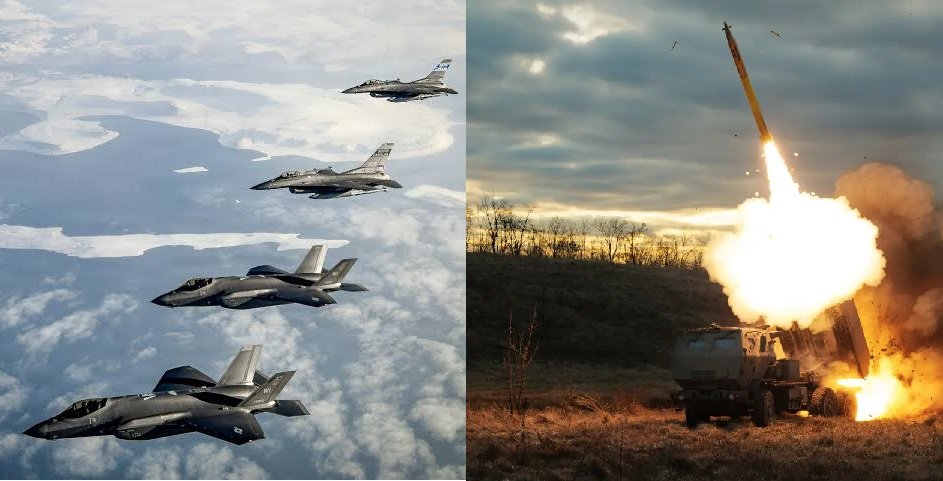
NOME, Alaska — U.S. joint military forces carried out a multi-domain homeland defense exercise near Nome, Alaska, on August 4 and 6, 2026, integrating fifth-generation fighter aircraft with long-range ground artillery to test their ability to detect, track and engage simulated threats approaching North America through the Arctic.
The exercise was conducted under Operation TUNDRA MERLIN, a long-planned homeland defense operation led by U.S. Northern Command and Alaskan Command. The mission focused on improving coordination between air and land forces, validating rapid deployment capabilities, and strengthening joint operations in the Arctic environment.
Air and Ground Forces Conduct Integrated Mission
The exercise brought together a range of U.S. military assets from the Air Force and Army.
Air Force units from Eielson Air Force Base, Alaska, deployed two F-35 Lightning II fighter aircraft, two F-16 Fighting Falcons, and a KC-135 Stratotanker for aerial refueling.
On the ground, the U.S. Army fielded an M142 High Mobility Artillery Rocket System (HIMARS) from Joint Base Lewis-McChord, Washington, supported by an AN/TPQ-53 radar system and soldiers from the 1st Battalion, 5th Infantry Regiment, 1st Mobile Brigade Combat Team (Air Assault), 11th Airborne Division.
The entire operation was conducted under the command and control of U.S. Northern Command and Alaskan Command.
HIMARS Rapidly Deployed to Nome
As part of the exercise, the HIMARS launcher was deployed to Nome on July 31, 2026, demonstrating the military's ability to rapidly move combat systems into remote Arctic locations.
The 17th Field Artillery Brigade, I Corps, transported the HIMARS aboard a Royal Canadian Air Force C-17 Globemaster III from Joint Base Lewis-McChord. During the flight, the aircraft also stopped at Fort Wainwright, Alaska, to transport soldiers from the 11th Airborne Division, who later operated alongside the HIMARS and AN/TPQ-53 radar during the mission.
F-35s and HIMARS Conduct Long-Range Precision Strike
The main objective of the exercise was to integrate airpower with long-range precision fires in a single coordinated mission.
After receiving aerial refueling from the KC-135, the F-35s and F-16s flew toward the vicinity of Saint Lawrence Island in the Bering Sea.
The F-35s then digitally synchronized with the HIMARS unit on the ground to detect and engage a simulated target approximately 135 miles away, demonstrating coordination between airborne sensors and ground-based precision fires.
F-16s Practice Defensive Counterair Operations
Alongside the strike mission, the exercise also included defensive counterair training.
The F-16 Fighting Falcons were assigned to defend the airspace by intercepting the F-35s, which temporarily acted as simulated inbound threats. This scenario allowed aircrews to practice defensive tactics while operating alongside other joint-force elements.
Military Leaders Highlight Joint Force Integration
Lt. Gen. Robert Davis, commander of Alaskan Command, the Alaskan North American Aerospace Defense Command Region, and the Eleventh Air Force, said the exercise demonstrated the value of integrating air and land capabilities for homeland defense.
"This operation demonstrated the power of an integrated joint force capable of layering effects across the air and land domains to strengthen homeland defense," Davis said.
"By synchronizing command and control, airpower and long-range precision fires, we strengthened our ability to posture combat-ready forces, eliminate operational seams and demonstrate the credible combat capability required to deter aggression across the Arctic."
Maj. Gen. John Cogbill, commander of the 11th Airborne Division, said the deployment showed the Army's ability to rapidly move forces into the Arctic and integrate them with other military capabilities.
"This deployment under Operation TUNDRA MERLIN demonstrates our ability to rapidly deploy forces and seamlessly integrate joint capabilities across the Arctic," Cogbill said.
"By deploying alongside the HIMARS, we are proving our readiness to deter adversaries by demonstrating lethal, long-range precision capabilities that can hold their assets at risk."
Operation TUNDRA MERLIN Supports Arctic Homeland Defense
Operation TUNDRA MERLIN is a long-planned and ongoing homeland defense operation conducted by Alaskan Command with U.S. and Canadian partners.
The operation integrates joint and multinational forces across the Alaskan theater to strengthen command and control, improve force integration, and maintain combat-ready forces capable of defending the northern approaches to North America.
Earlier phases of the operation included a five-day, 800-mile combined maritime patrol conducted from July 20 to 24 in the Bering Sea and Bering Strait. The patrol involved the U.S. Coast Guard Cutters Munro and Storis and the Royal Canadian Navy ship HMCS Max Bernays.
Before the August exercise, residents of Nome were notified about increased military activity and planned low-flying aircraft operations. Military officials said all activities were coordinated to minimize disruption to local communities while maintaining readiness for homeland defense missions in the Arctic.
——— End of Article ———