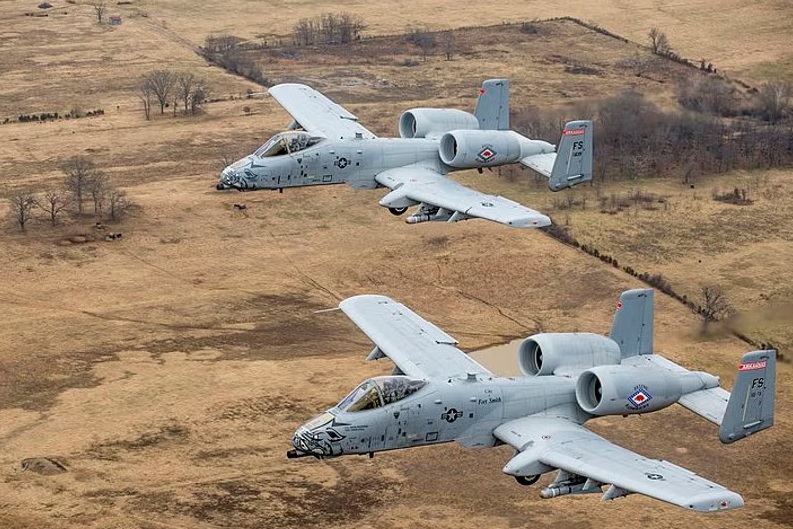
RAF LAKENHEATH, United Kingdom — April 1, 2026 : Twelve United States Air Force A-10C Thunderbolt II aircraft have arrived at Royal Air Force (RAF) Lakenheath in Suffolk, England, as part of an ongoing deployment to the Middle East under the U.S. military campaign designated Operation Epic Fury. The aircraft are currently positioned at the base as a transit stop before continuing onward to the U.S. Central Command (CENTCOM) area of responsibility.
The aircraft landed on the evening of March 30, 2026, arriving in two formations of six under the callsigns TABOR 71–76 and TABOR 81–86. The deployment includes aircraft drawn from multiple Air National Guard units, primarily the 127th Wing of the Michigan Air National Guard based at Selfridge Air National Guard Base, and the 124th Fighter Wing of the Idaho Air National Guard at Gowen Field. Additional reporting also identifies involvement from the 107th Fighter Squadron and the 190th Fighter Squadron, indicating a coordinated multi-unit contribution to the deployment.
Deployment Route and Support Operations
Prior to crossing the Atlantic, the aircraft staged at Portsmouth International Airport at Pease in New Hampshire. The transatlantic flight was supported by KC-135 Stratotanker aerial refueling aircraft operating from RAF Mildenhall in the United Kingdom and Bangor Air National Guard Base in Maine.
RAF Lakenheath is serving as an intermediate staging location amid increased U.S. Air Force activity in the United Kingdom in recent weeks. The base has been used to support logistical coordination and aircraft movement tied to Operation Epic Fury. U.S. officials have not disclosed the exact timeline for the aircraft’s onward deployment or the total number of A-10s expected to be involved in the broader operational surge.
Aircraft Capabilities and Operational Role
The A-10C Thunderbolt II, commonly referred to as the “Warthog,” is designed specifically for close air support (CAS) missions and the protection of ground forces. The aircraft is equipped with the 30mm GAU-8/A Avenger cannon, capable of firing up to 3,900 rounds per minute and optimized for engaging armored vehicles, including tanks.
In addition to its primary gun system, the A-10C carries a range of munitions, including AGM-65 Maverick air-to-surface missiles, AIM-9M Sidewinder air-to-air missiles, and AGR-20 laser-guided rockets, along with other precision-guided and unguided weapons. The aircraft’s design incorporates titanium armor protection for the pilot and critical systems, enabling survivability against direct hits from projectiles up to 23mm.
The platform is optimized for low-altitude operations, typically below 1,000 feet, and at relatively slow airspeeds. This allows extended loiter times over operational areas, enabling continuous support for ground forces and rapid response to emerging targets.
Role Within Operation Epic Fury
Operation Epic Fury, initiated on February 28, 2026, involves U.S. Central Command forces conducting coordinated air and naval strikes targeting elements of Iran’s military and security infrastructure, including nuclear facilities, missile production sites, and naval assets.
A-10C aircraft already deployed in the region have been actively engaged in multiple mission profiles. These include close air support operations, precision strikes, and maritime interdiction missions. According to U.S. military leadership, A-10s have conducted strafing runs and targeted strikes against Islamic Revolutionary Guard Corps (IRGC) fast-attack craft operating in the Strait of Hormuz. The aircraft have also been used to engage positions held by Iranian-backed Popular Mobilization Forces (PMF) in Iraq.
Indicators of Expanded Operational Scope
The movement of an additional 12 A-10C aircraft through Europe, combined with reports of EA-37B Compass Call electronic warfare aircraft transiting the United Kingdom, reflects a continued buildup of U.S. airpower supporting Operation Epic Fury.
Given the A-10’s primary mission of providing close air support to ground units, defense analysts assess that the increased deployment may be intended to support potential ground-based operations or specialized missions. These could include providing air cover for special operations forces, securing strategic infrastructure such as Kharg Island, or supporting operations targeting fortified or underground facilities.
The broader regional posture also includes the presence of U.S. special operations units, including Army Rangers, Navy SEALs, and Marine forces, consistent with the logistical requirements for sustained ground or joint-force operations.
Current Status
The 12 A-10C aircraft remain at RAF Lakenheath as part of a transit phase. No official confirmation has been provided regarding their final destination within the CENTCOM area or the timeline for redeployment. The U.S. Department of Defense has also not released details on the total scale of A-10 deployments associated with Operation Epic Fury.
The arrival of these aircraft forms part of a wider pattern of U.S. force movement and operational reinforcement linked to ongoing military activities in the Middle East.
——— End of Article ———