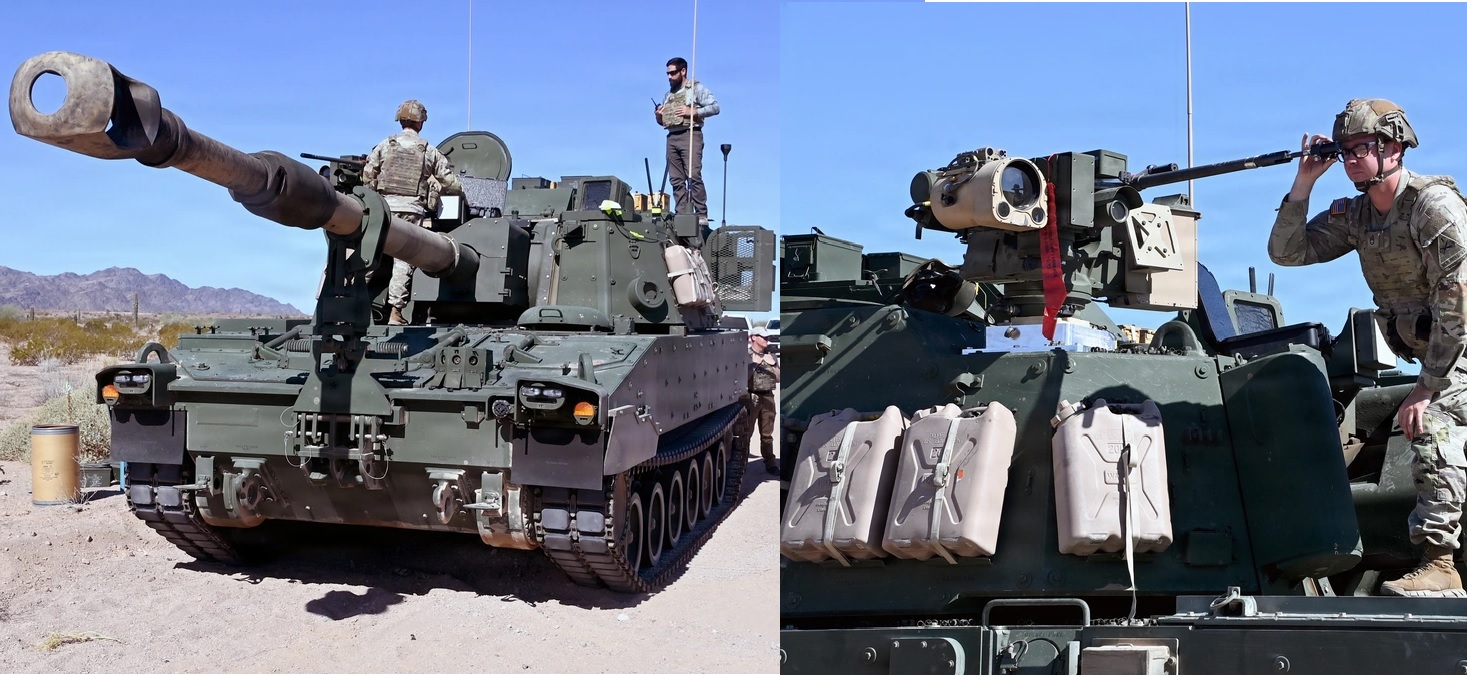
YUMA PROVING GROUND, Arizona, June 25, 2026 — The U.S. Army is conducting developmental testing of the Low-Profile Common Remotely Operated Weapons Station (LP-CROWS) at Yuma Proving Ground (YPG), evaluating its integration on the M109A7 Paladin self-propelled howitzer and the M992A3 Carrier Ammunition Tracked vehicle. The new system is designed to allow crews to operate secondary mounted weapons and counter small unmanned aerial systems (UAS) while remaining inside the protection of the vehicle's armored hull.
The testing is part of the Army's broader effort to improve crew survivability and adapt artillery platforms to the changing requirements of modern combat, where drones, precision strikes, and indirect fire have increased the risks associated with exposed operations.
Manufactured by BAE Systems, the M109A7 Paladin is the U.S. Army's latest 155 mm self-propelled howitzer. Operated by a four-person crew and powered by a modernized 600-volt electric drive system, the vehicle can fire conventional artillery rounds to ranges of approximately 22 kilometers and precision-guided Excalibur projectiles to distances of up to 40 kilometers. While the vehicle provides significant firepower, crews have traditionally needed to open the roof hatch to operate secondary weapons, exposing soldiers to enemy fire, shrapnel, and improvised explosive devices (IEDs).
The LP-CROWS incorporates a gyro-stabilized weapon mount, a fully integrated fire control system, and high-resolution day and thermal cameras, enabling accurate target engagement while the vehicle is moving across rough terrain. The stabilization system is designed to maintain weapon accuracy even when the 84,000-pound Paladin is operating over uneven ground, providing a high probability of first-burst hits against ground and aerial threats.
Development of the low-profile system addressed several limitations found in earlier versions of CROWS. Previous variants could not be installed on the Paladin because their taller profile exceeded transportation height requirements. In addition, repeated firing of the Paladin's 155 mm main gun, which is capable of firing up to four rounds per minute, generated blast overpressure and recoil forces that damaged components on older weapon stations. The redesigned LP-CROWS features a reduced external profile and reinforced mechanical components capable of withstanding the harsh operating environment created by repeated artillery firing.
Unlike many military development programs, LP-CROWS was developed internally through partnerships across the U.S. Army DEVCOM community rather than through a traditional original equipment manufacturer. Army officials said this collaborative approach significantly shortened development timelines, allowing the program to progress from concept to production-representative live testing in just over one year.
A major focus of the current evaluation is the integration of counter-small unmanned aircraft system (C-sUAS) capabilities. The Army is testing the installation of radar directly onto the LP-CROWS mount, enabling the system to detect and engage hostile drones while crews remain under closed-hatch protection. The effort is being carried out in cooperation with the Project Manager Crew Served Weapons office and other Army organizations.
The testing is being conducted at Yuma Test Center, which was designated as the Army's primary dedicated interagency counter-UAS test and training range following the establishment of Joint Interagency Task Force 401 by Secretary of War Pete Hegseth in August 2025. YPG also supports testing through its Threat Systems Target Branch, which maintains one of the largest collections of foreign threat systems in the continental United States and develops realistic battlefield scenarios for evaluation.
Operational assessments have included several weeks of testing by soldiers from the 4th Battalion, 1st Field Artillery Regiment based at Fort Bliss, Texas, and the Transformation Integration Directorate at Fort Sill, Oklahoma. Their feedback is helping engineers refine system operation, controls, and overall performance.
Current developmental testing includes evaluating the upgraded camera systems, weapon loading procedures, firing performance, and overall integration under realistic combat conditions. Engineers are also assessing how the system performs during vehicle movement and repeated artillery firing.
Following completion of the current developmental phase, the Army plans to conduct extensive durability testing, including long-distance operational mileage, to verify the reliability of LP-CROWS on both the M109A7 Paladin and the M992A3 Carrier Ammunition Tracked vehicle before moving toward broader fielding.
The LP-CROWS program is intended to enhance the survivability of artillery crews while improving their ability to respond to evolving battlefield threats, including the growing use of small unmanned aerial systems, without exposing soldiers outside their armored vehicles.
——— End of Article ———