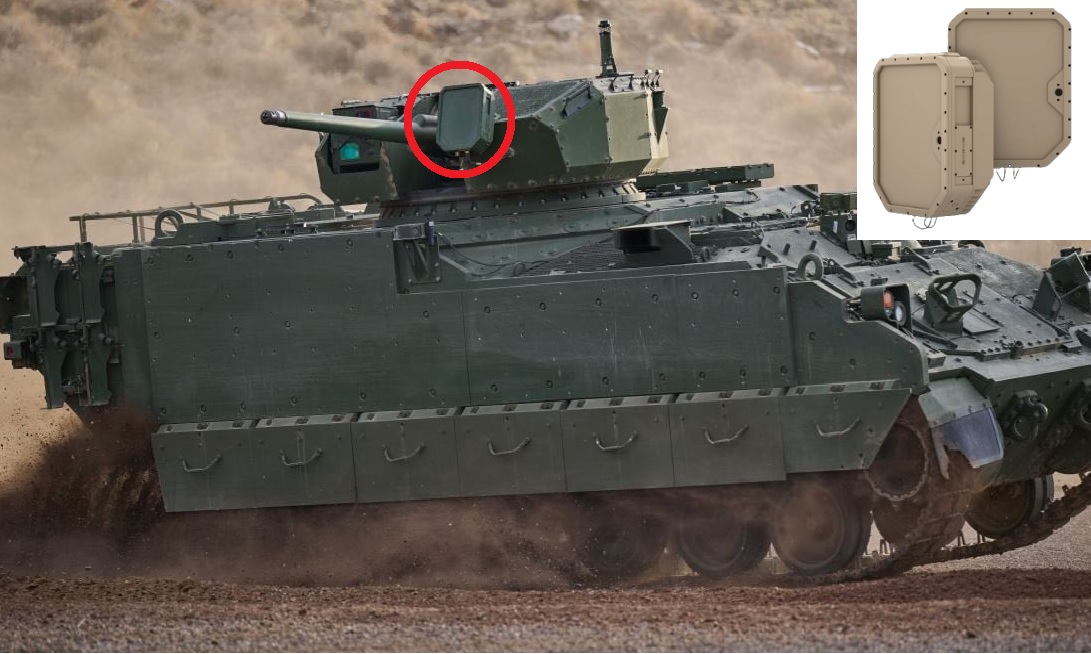
FORT CAVAZOS, Texas — May 21, 2026 : The U.S. Army’s 1st Cavalry Division is evaluating two prototype Armored Multi-Purpose Vehicle 30mm variants (AMPV-30) equipped with EchoShield radar systems for counter-unmanned aerial system (C-UAS) operations.
The vehicles were developed and supplied by BAE Systems as company-funded prototypes and delivered to the Army in April 2026 under the service’s “Transformation in Contact” (TiC) 2.0 initiative. The program is intended to accelerate the field testing of emerging technologies by placing new systems directly into operational units for soldier evaluation.
AMPV-30 Configuration
The AMPV platform was originally developed by BAE Systems to replace the U.S. Army’s legacy M113 armored vehicle family, providing improved survivability, mobility, and onboard power generation for Armored Brigade Combat Teams (ABCTs).
The AMPV-30 configuration transforms the standard support vehicle into a mobile counter-drone platform designed to provide localized air defense protection for armored formations operating in contested environments.
The prototypes are equipped with the Kongsberg Gruppen MCT-30 remotely operated turret, derived from the RT-20 design. The turret is armed with a Mk 44 Bushmaster II 30mm autocannon capable of firing programmable airburst munitions (PABM), which are designed to engage aerial targets by creating fragmentation patterns along the drone’s projected flight path.
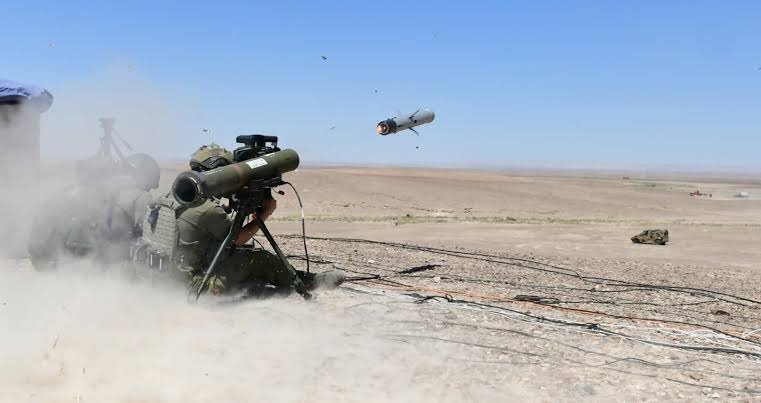
The turret also includes a coaxial 7.62mm machine gun and can be configured to carry additional weapons such as FGM-148 Javelin anti-tank guided missiles or laser-guided 70mm rockets depending on mission requirements.
EchoShield Radar Integration
To provide aerial target detection and tracking capability, the AMPV-30 integrates the EchoShield radar system developed by U.S.-based radar manufacturer Echodyne.
The radar is externally mounted on the vehicle and provides continuous low-altitude airspace surveillance for detecting and tracking small unmanned aerial systems operating near the ground.
EchoShield is a software-defined cognitive 4D pulse-Doppler radar utilizing Echodyne’s proprietary Metamaterials Electronically Steered Array (MESA) architecture. The system operates in the Ku-band frequency range between 15.4 and 16.6 GHz and is specifically optimized to detect low-flying, slow-moving, and small radar cross-section targets in cluttered battlefield environments.
The radar dynamically adjusts waveforms and beam scheduling through software to improve target detection and tracking performance without requiring physical hardware modifications.
Radar Specifications
According to published technical specifications, the EchoShield radar provides high-fidelity tracking data, including range, azimuth, elevation, and velocity information.
Key specifications include:
- Tracking capacity for more than 1,000 objects simultaneously
- Angular tracking accuracy of less than 0.5 degrees in both azimuth and elevation
- Field of view of 130 degrees in azimuth and 90 degrees in elevation
- Track update rates of up to 10 Hz
- Detection range of approximately 3 kilometers for Group 1 drones
- Detection range of up to 11.4 kilometers for larger Group 3 UAVs
- Maximum instrumented range of 30 kilometers depending on mission configuration
The radar panel measures approximately 42.5 × 33 × 18 centimeters, weighs 17.8 kilograms, and consumes less than 250 watts during operation, allowing integration onto mobile armored platforms with limited impact on vehicle power requirements.
EchoShield also incorporates native target classification capability using Doppler signatures to distinguish drones from environmental clutter and other airborne objects, including hovering UAVs operating close to the ground.
Operational Evaluation
The AMPV-30 prototypes are being evaluated as part of the Army’s broader modernization effort to improve protection against emerging drone threats on the battlefield.
The integration of mobile radar surveillance, programmable airburst munitions, and armored mobility reflects a shift in Army doctrine toward providing armored and cavalry formations with organic short-range air defense capabilities rather than relying solely on dedicated air defense artillery units.
The Army has stated that the AMPV-30 vehicles remain prototype systems developed for testing and capability assessment purposes. At present, there is no formal procurement requirement or funded acquisition program for the configuration.
The ongoing evaluation is intended to assess the operational effectiveness of combining counter-drone detection and engagement systems onto the AMPV platform to support future battlefield requirements.
——— End of Article ———