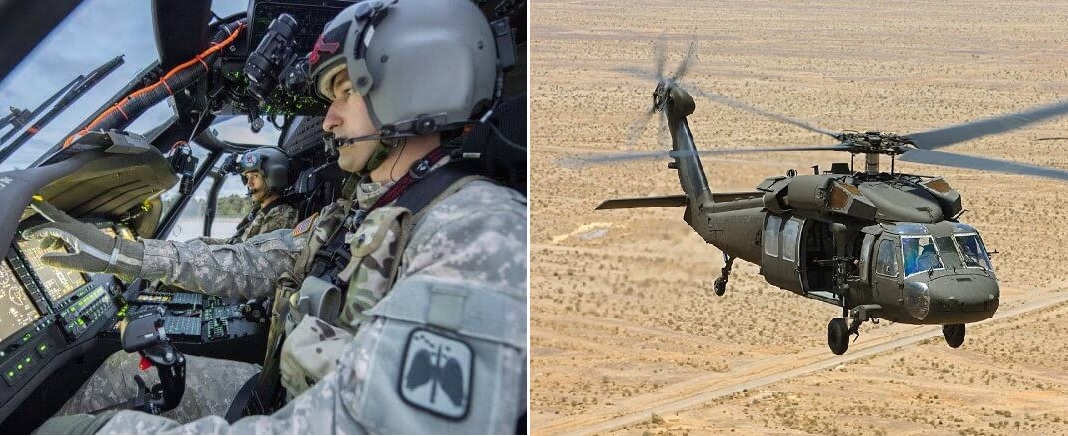
FORT NOVOSEL, Ala., — June 14, 2026 : The U.S. Army is testing 3D spatial audio technology on UH-60 Black Hawk helicopters to improve pilot situational awareness, reduce cognitive workload, and enhance communication during flight operations.
The U.S. Army Aeromedical Research Laboratory (USAARL) recently installed the system on two Black Hawks operated by the U.S. Army Aviation Center of Excellence (AVCOE) at Fort Novosel. The aircraft are currently supporting operational assessments with the 1st Battalion, 212th Aviation Regiment, 110th Aviation Brigade’s Aviation Tactics Instructor Course.
Military helicopter pilots often manage multiple radio channels, intercom communications, navigation information, and system alerts while flying at low altitudes and making tactical decisions. Traditional aviation headsets deliver all audio through a single channel, requiring pilots to separate overlapping voices and alerts mentally.
The 3D spatial audio system recreates natural directional hearing by assigning different radio channels and audio sources to distinct positions around the pilot. Instead of multiple conversations blending together, pilots can hear each transmission as coming from a different direction, making communications easier to identify and understand.
Capt. Brandon Allen, a USAARL research pilot who evaluated the technology alongside Capt. William Bradley, said the system helps pilots distinguish multiple radio conversations more effectively.
“When you are up on four radios, 3D spatial audio splits up all those radios in your head and you can distinguish who is talking to you,” Allen said.
Both pilots reported improved speech intelligibility, better situational awareness, and reduced mental strain during flight evaluations.
The technology was first tested aboard USAARL’s MEDEVAC research helicopter, Forge 612, making it the first U.S. Army aircraft equipped with 3D spatial audio. Feedback from those tests helped guide installation on the two operational Black Hawks.
The upgrade process at Lowe Army Heliport required more than 231 man-hours of installation work and included two days of flight evaluations.
According to Col. Thomas Summers, commander of USAARL, the Army wants pilots to use the system extensively and provide feedback to help refine the technology for future aviation operations.
The program involves several Army organizations, including the Combat Capabilities Development Command Aviation and Missile Center, the Utility Helicopters Project Office, and Project Manager Air Warrior, along with industry partners CATI Training Systems and TTM Technologies.
Data gathered from the Black Hawk evaluations will support development of the MV-75 Cheyenne II, the Army’s Future Long-Range Assault Aircraft (FLRAA). Developed by Bell Textron and based on the V-280 Valor tiltrotor design, the aircraft is scheduled to enter service in 2031.
Army officials say testing 3D spatial audio on current aircraft will help ensure future aircrews have improved tools for managing communications and operating effectively in increasingly complex flight environments.
——— End of Article ———