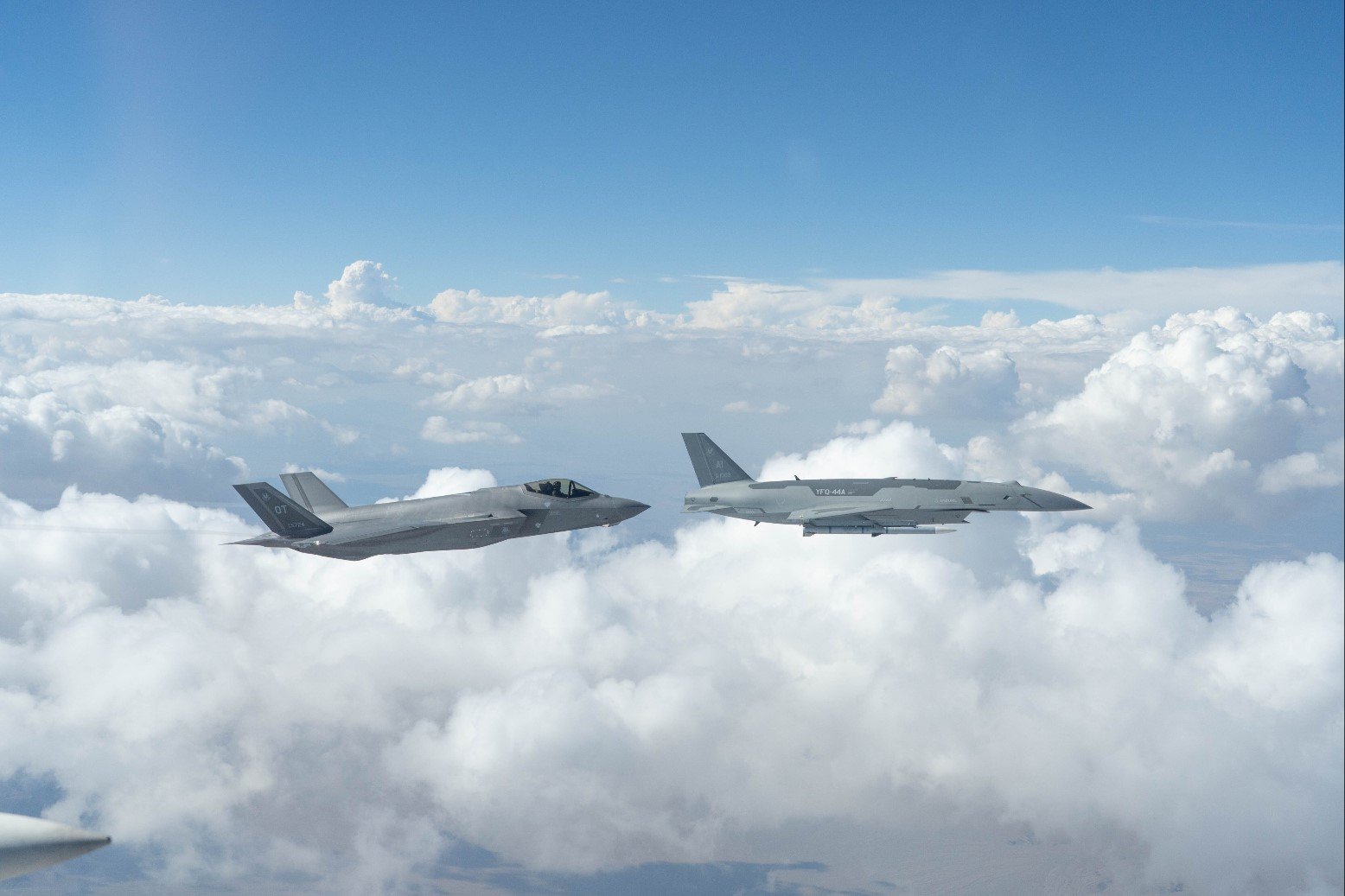
CREECH AIR FORCE BASE, Nev. — The U.S. Air Force has received its first two Collaborative Combat Aircraft (CCA) at Creech Air Force Base, Nevada, marking a new phase in the service’s effort to integrate uncrewed, semi-autonomous aircraft into future combat operations.
Anduril delivered its YFQ-44A Fury to the Air Force’s Experimental Operations Unit in August, while General Atomics delivered the YFQ-42A Vengeance last week. Both aircraft will support operational experimentation led by Air Combat Command to determine how CCAs can operate alongside crewed aircraft in contested environments.
The Air Force has moved the aircraft into the hands of operators at an early stage so Airmen can help develop tactics, operating procedures and requirements for the new aircraft.
“Putting CCA in the hands of Airmen is how we build the operational future of this program,” said Secretary of the Air Force Troy Meink. He added that the Fury and Vengeance deliveries demonstrate the service’s focus on speed, competition and cost-effective combat capability.
Air Force Chief of Staff Gen. Ken Wilsbach also welcomed the aircraft to the Experimental Operations Unit, saying Airmen are looking forward to evaluating their capabilities.
Operational testing at Creech
The Experimental Operations Unit is evaluating how small teams can operate CCAs from distributed and austere locations. The testing includes examining aircraft operations, sortie generation and the support requirements needed to operate the platforms away from traditional air bases.
This work is being conducted as part of the Air Force’s Agile Combat Employment approach. A July exercise at Creech examined how the aircraft could be serviced and relaunched in a realistic operational environment, including refueling and weapons-handling activities.
The Air Force is also using the operational experimentation to identify future requirements for training, sustainment, manpower and infrastructure as the CCA program moves toward larger-scale fielding.
Recent weapons test
The arrival of the two aircraft follows several recent CCA milestones. In July, the Air Force conducted a live-fire test involving the YFQ-44A, which fired an AIM-120 at a digital target over the Mojave Desert. The test followed earlier evaluations of weapons carriage and data-link integration.
The Air Force also conducted a second Agile Combat Employment exercise involving CCAs in July, further examining how the aircraft could be operated in distributed conditions.
Production of Fury and Vengeance
The Air Force selected Anduril and General Atomics in 2024 to develop the first CCA Increment 1 prototypes. On June 17, 2026, the Department of the Air Force awarded contracts for the first-generation CCA aircraft and mission-autonomy software.
The aircraft were initially designated YFQ-44A and YFQ-42A during development. In September, the Air Force officially named the aircraft FQ-44 Fury and FQ-42 Vengeance. The service has entered production for both designs rather than selecting only one aircraft.
The Air Force has said it plans to field 500 combat-ready semi-autonomous systems by 2032, with a longer-term objective of approximately 1,000 CCAs across multiple increments.
For now, the focus at Creech is on learning how the aircraft can be operated, supported and integrated with crewed combat aircraft. The results from this operational experimentation will help shape how future CCA units are organized, trained, equipped and employed for air superiority and other combat missions.
——— End of Article ———