DAYTON, Ohio, June 28, 2026 — The U.S. Air Force is seeking industry solutions to modernize the Infrared Search and Track (IRST) capability across its F-15 fighter fleet, aiming to improve passive target detection and tracking in contested electronic warfare environments.
On June 26, 2026, the Air Force Life Cycle Management Center (AFLCMC) WAQK F-15 Program Office, based in Dayton, Ohio, issued a sources sought notice on SAM.gov requesting industry input for the F-15 IRST modernization program. Issued under NAICS code 334511 for aeronautical system manufacturing, the notice seeks companies capable of developing, producing, or integrating advanced IRST systems. Responses are due by July 27, 2026.
An IRST system detects aircraft by sensing the infrared heat signatures produced by engines and airframes rather than emitting radio waves like conventional radar. Because it operates passively, it allows pilots to detect, track, and engage targets without revealing their position through radar emissions. This capability is particularly valuable in environments where electronic warfare systems and radar jamming reduce the effectiveness of traditional radar.
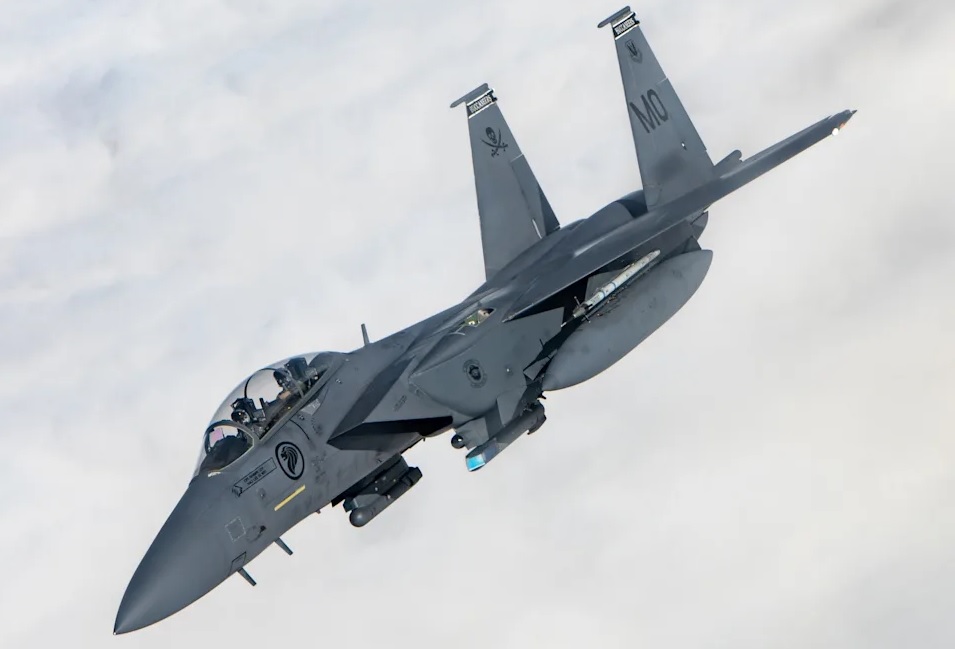
The Air Force's current IRST capability is based on the Eagle Integrated IRST (EI-IRST) program, which uses Lockheed Martin's Legion Pod housing the AN/ASG-34 infrared sensor derived from the F-14D Tomcat. The Air Force procured 38 Legion Pods for the F-15C fleet, and the system reached Initial Operational Capability (IOC) in February 2022.
Operational testing, however, identified several limitations. Mounting the Legion Pod on the aircraft's centerline station restricts the F-15's maneuvering envelope during high-angle-of-attack flight, while funding constraints prevented completion of the full flight test program needed to remove those restrictions. The centerline installation also occupies a hardpoint that could otherwise carry an external fuel tank or additional weapons, reducing operational flexibility.
The modernization effort comes as potential adversaries continue fielding more advanced passive sensing capabilities. China's J-20 stealth fighter incorporates an integrated IRST with a 360-degree distributed aperture system, while Russia's Su-35S uses the OLS-35 IRST, reportedly capable of detecting non-afterburning aircraft beyond 50 kilometers from the front and more than 90 kilometers from the rear. The Eurofighter Typhoon is equipped with the PIRATE IRST, providing comparable long-range passive detection capability.
The Air Force believes the F-15EX Eagle II offers the best opportunity to integrate a next-generation IRST system. As of March 2026, the service expanded its planned F-15EX fleet from 80 to 267 aircraft, strengthening the platform's role alongside the F-35 in future air superiority operations.
The F-15EX features a modern digital architecture built around the Advanced Display Core Processor II (ADCP II) mission computer and the AN/APG-82(V)1 Active Electronically Scanned Array (AESA) radar. This open architecture can support a fully integrated IRST as part of the aircraft's sensor fusion and fire-control system instead of relying on an externally mounted pod.
Boeing has already demonstrated this concept by installing a nose-mounted IRST sensor ahead of the cockpit on an F-15 Advanced Eagle test aircraft in early 2025. Compared with the current centerline pod, a nose-mounted sensor would provide a wider field of regard while eliminating aerodynamic penalties and preserving the aircraft's centerline station for fuel or weapons.
The Air Force said the sources sought notice is intended to identify industry capabilities and potential technical solutions before defining formal program requirements. Feedback received by the July 27 deadline will help shape future acquisition plans as the service works to improve the F-15's passive sensing capabilities and maintain its effectiveness in increasingly contested air combat environments.
——— End of Article ———