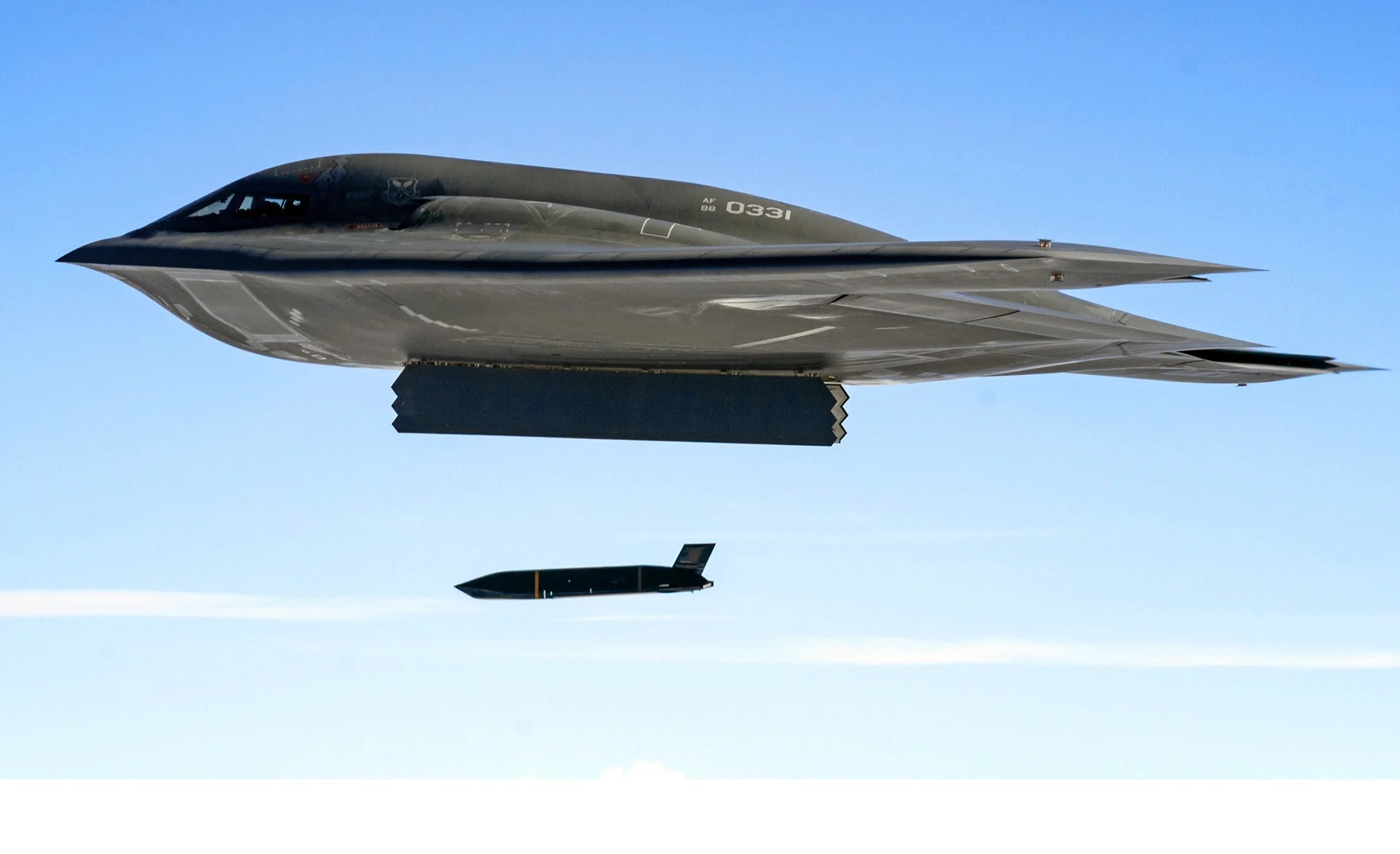
ANDERSEN AIR FORCE BASE, Guam, June 30, 2026 — The U.S. Air Force has publicly revealed a new maritime strike capability for the B-2 Spirit stealth bomber following a successful live-fire sinking exercise (SINKEX) conducted during Exercise Valiant Shield 2026. The exercise marked the first publicly disclosed deployment of the AGM-158C Long Range Anti-Ship Missile (LRASM) from the B-2, expanding the bomber's role in long-range counter-maritime operations.
The live-fire event took place on June 27 in the Mariana Island Range Complex over the Philippine Sea, approximately 200 nautical miles north of Guam. Organized by U.S. Pacific Air Forces (PACAF), the exercise demonstrated the integration of the stealthy LRASM with the B-2 Spirit, providing the U.S. military with a new long-range precision strike capability against maritime targets.
B-2 Conducts LRASM Strike
The mission was carried out by a B-2 Spirit assigned to the 509th Bomb Wing at Whiteman Air Force Base, Missouri. The aircraft was loaded with a live AGM-158C LRASM on June 22 before deploying to Andersen Air Force Base, Guam, to participate in Valiant Shield 2026.
During the exercise, the B-2 launched the LRASM against the ex-USS Juneau (LPD-10), a decommissioned Austin-class amphibious transport dock that served as the target vessel. The successful strike demonstrated the bomber's ability to employ the advanced anti-ship missile in an operational maritime scenario.
The sinking exercise was conducted as a joint and multinational operation involving U.S. and allied forces. Before the vessel sank, it was engaged by multiple weapon systems. A Japan Maritime Self-Defense Force (JMSDF) submarine fired a heavy torpedo that also contributed to the sinking of the ex-USS Juneau, while the aircraft carrier USS George Washington (CVN-73) and other allied naval assets operated in the exercise area.
LRASM Expands Long-Range Maritime Strike Capability
The AGM-158C Long Range Anti-Ship Missile (LRASM) is a precision-guided, stealthy anti-ship cruise missile developed to detect, track, and engage enemy surface vessels at extended ranges while operating from stand-off distances.
The missile uses a GPS-assisted Inertial Navigation System (INS) combined with an onboard infrared seeker to navigate toward its target area and identify enemy warships without relying on active radar emissions, reducing the likelihood of detection by opposing forces. Designed to strike high-value maritime targets in contested environments, LRASM provides autonomous target identification and precision engagement capabilities over ranges extending hundreds of miles.
Before this demonstration, the LRASM had only been publicly certified for use on the U.S. Air Force's B-1B Lancer and the U.S. Navy's F/A-18E/F Super Hornet. Its integration with the B-2 Spirit introduces a new combination of stealth, long-range penetration, and precision maritime strike capability, enabling the bomber to operate more effectively in heavily defended areas.
Supporting Indo-Pacific Operations
Pacific Air Forces said the live-fire event forms part of broader efforts to strengthen long-range counter-maritime capabilities and improve readiness across the Indo-Pacific region. The exercise demonstrated the ability of U.S. and allied forces to conduct coordinated, multi-domain operations while employing advanced precision weapons against maritime targets.
"The B-2's impressive performance underscores the U.S. military's commitment to adaptability and flexibility in the face of emerging security challenges," said General Kevin B. Schneider, Commander of Pacific Air Forces. "By prioritizing counter-maritime strike operations, we can maintain a decisive edge over adversaries, protect our national interests and ensure the free and open Pacific that underpin our global security."
Valiant Shield 2026
Exercise Valiant Shield 2026 is a joint and multinational military exercise focused on high-end warfighting and integrated operations across the Indo-Pacific. The drills involve U.S. military services working alongside allied and partner nations to enhance interoperability, long-range precision strike capabilities, maritime security, and multi-domain coordination.
According to Pacific Air Forces, the successful B-2 LRASM employment highlights the continued evolution of U.S. long-range strike capabilities. By combining the B-2 Spirit's stealth and global reach with the LRASM's autonomous anti-ship capabilities, the U.S. military has added a new penetrating maritime strike option designed to support operations in contested environments and reinforce regional security objectives across the Indo-Pacific.
——— End of Article ———