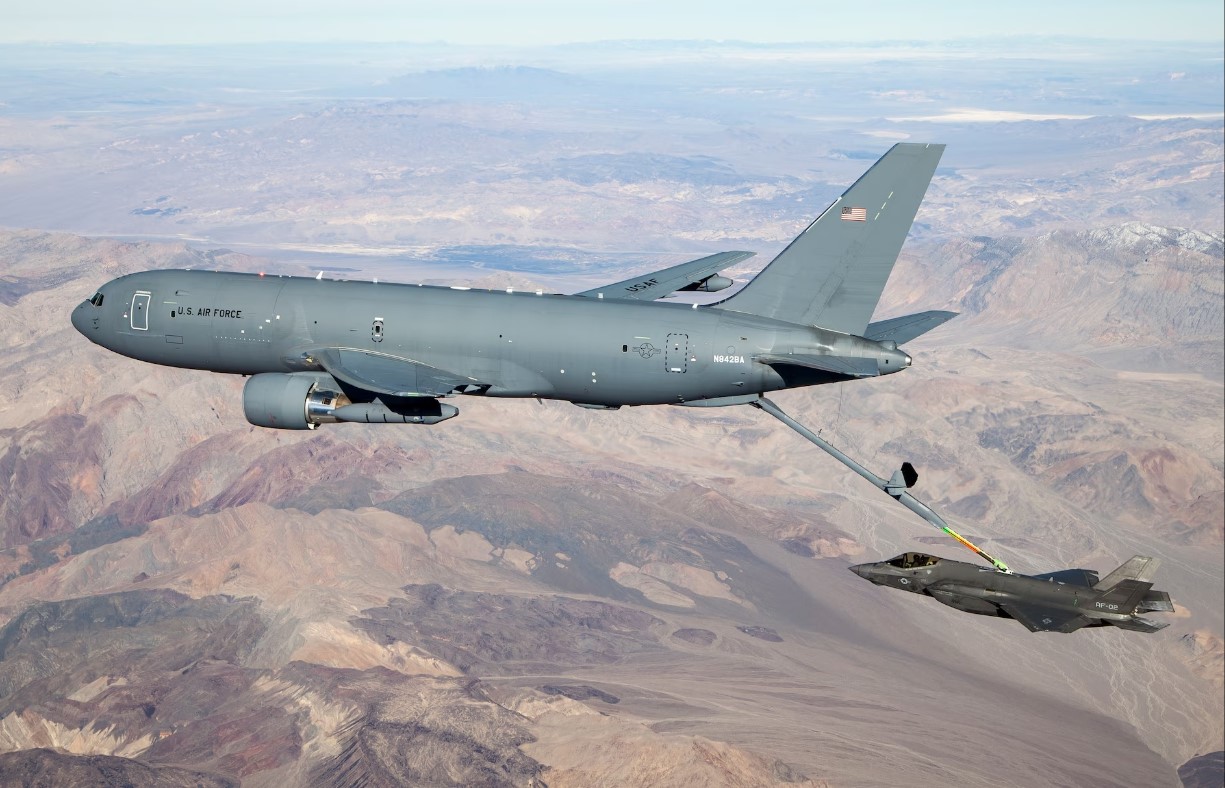
WASHINGTON, D.C., June 30, 2026 — The U.S. Air Force has awarded a combined $471 million through 28 separate indefinite-delivery, indefinite-quantity (IDIQ) contracts to strengthen the repair and exchange of aircraft parts for the KC-46 Pegasus aerial refueling fleet. Awarded on June 24, 2026 by the Air Force Sustainment Center at Tinker Air Force Base, Oklahoma, the contracts are intended to improve aircraft availability by addressing persistent shortages of replacement components.
Work will be carried out at facilities across more than a dozen U.S. states and Israel through May 2031. The awards followed a competitive procurement process that received 28 offers and cover both commercial and non-commercial aircraft parts.
The contracts are intended to strengthen the KC-46 supply chain by expanding the number of qualified repair providers, reducing maintenance delays, shortening repair turnaround times, and limiting the impact of disruptions affecting individual suppliers.
Parts Shortages Continue to Affect Fleet Readiness
Replacement part shortages remain one of the main factors affecting KC-46 readiness. While many aircraft remain technically serviceable, limited availability of components—including hydraulic actuators, landing gear assemblies, avionics modules, and other critical systems—has delayed maintenance and kept aircraft out of service.
By distributing repair work among multiple companies, the Air Force aims to build a more resilient logistics network capable of supporting the expanding tanker fleet while reducing dependence on single suppliers.
KC-46 Pegasus and Its Operational Role
The KC-46 Pegasus, developed from the Boeing 767 commercial airliner, is the U.S. Air Force's primary replacement for the KC-135 Stratotanker.
The aircraft can carry up to 212,000 pounds (96,160 kilograms) of fuel for aerial refueling using both boom and hose-and-drogue systems. It can also transport 65,000 pounds (29,484 kilograms) of cargo across 18 pallet positions and be configured for aeromedical evacuation of up to 58 patients.
The Air Force has accepted more than 105 aircraft from a planned fleet of 263 KC-46s, with operations currently based at seven locations and additional bases planned through 2031.
Technical and Maintenance Challenges
According to a 2026 Government Accountability Office (GAO) report, the KC-46 achieved a 62 percent mission-capable rate during fiscal year 2024, compared with 68 percent for the KC-135.
The Pentagon's Director of Operational Test and Evaluation identified two major technical issues that continue to affect full operational capability: the Remote Vision System (RVS), which assists boom operators during aerial refueling, and the Boom Telescope Actuator, which controls extension of the refueling boom.
The GAO also reported that approximately 75 percent of maintenance personnel at some dual-aircraft bases lack sufficient experience maintaining the more advanced KC-46, further affecting fleet readiness.
Supplier Network Expansion
The contracts were awarded to a broad range of aerospace manufacturers, avionics suppliers, repair specialists, and international partners.
Recipients include Boeing in Tukwila, Washington; Honeywell International in Tempe, Arizona; Collins Aerospace in Windsor Locks, Connecticut; Crane Aerospace and Electronics; and Eaton Corporation, which received five contract awards across four states.
Additional awards went to Davenport Aviation, S&K Aerospace, and TAT Technologies in Kiryat Gat, Israel, expanding repair capacity across multiple facilities.
Part of a Broader Readiness Initiative
The contracts support a wider readiness initiative announced jointly by the Air Force and Boeing on May 12, 2026.
The effort includes installation of the Remote Vision System 2.0 beginning during scheduled depot maintenance in 2028, redistribution of engines, landing gear, and other major components from five early-production aircraft to operational tankers, and a five-year performance-based logistics agreement that makes Boeing responsible for improving support for the aerial refueling subsystem.
Air Force officials estimate these combined measures will improve fleet availability by approximately 6 percent in the near term, with overall readiness expected to increase by more than 20 percent by 2030.
Expanding Fleet and Operational Role
The Air Force's fiscal year 2027 budget request includes funding for 15 additional KC-46 aircraft, with procurement projected to increase to 18 aircraft annually between 2028 and 2031.
The KC-46 has become increasingly important for long-range operations, particularly in the Indo-Pacific, where aerial refueling extends the range and endurance of fighters, bombers, and transport aircraft operating over vast distances.
The aircraft also demonstrated its operational value during Operation Epic Fury on February 28, 2026, when KC-46 and KC-135 tankers supported a joint U.S.-Israeli operation by providing aerial refueling and transporting personnel and cargo throughout the U.S. Central Command area.
With the expanded repair network and ongoing modernization efforts, the Air Force aims to improve the long-term availability and sustainment of the KC-46 fleet while supporting future global operations.
——— End of Article ———