LONDON, July 1, 2026 — The UK Ministry of Defence (MoD) has announced plans to gradually end procurement of the Storm Shadow cruise missile under its newly published Defence Investment Plan, shifting its long-range strike strategy toward a combination of advanced complex weapons and lower-cost, mass-produced precision strike systems.
The new approach is based on lessons from the war in Ukraine, where large numbers of expensive long-range missiles have been expended at a rapid pace. The strategy aims to increase the UK's stockpile of long-range strike weapons while reducing procurement costs and improving production capacity.
To support the transition, the Ministry of Defence has allocated an initial £300 million to develop and procure affordable long-range strike systems. Each new low-cost effector is expected to cost around £400,000 per unit, excluding the warhead, nearly half the cost of a Storm Shadow missile. The systems are also designed for faster production, enabling the UK to replenish inventories more quickly during future conflicts.
Project Brakestop Advances with Three British Prototypes
A key element of the strategy is Project Brakestop, a rapid-development programme to field an affordable ground-launched long-range strike weapon.
Three British companies have completed flight testing of their prototypes in Scotland and have each been awarded £15 million follow-on contracts to continue development.
The Ministry of Defence requires candidate systems to strike targets beyond 500 kilometres, carry a minimum 225-kilogram warhead, exceed 600 km/h in speed, and be capable of producing at least 20 missiles per month shortly after a production contract is awarded.
The competing designs include:
-
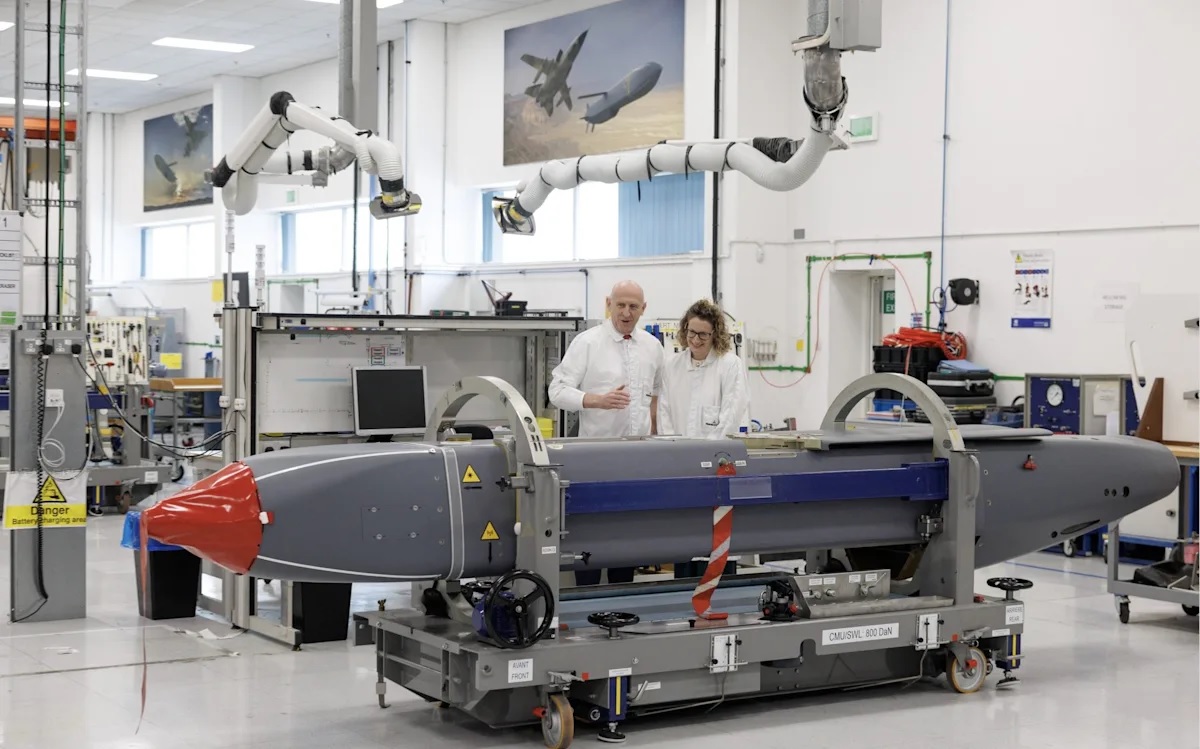
MBDA UK's Crossbow, a modular vehicle-launched missile using commercially available components with a planned range exceeding 800 kilometres.
-
MGI Engineering's TigerShark, which incorporates advanced composite materials and 3D-printed components inspired by the company's Formula 1 engineering experience. It is designed to reach speeds of approximately 750 km/h, strike targets up to 1,000 kilometres away, and carry a payload of up to 300 kilograms.
-
Rotron Aerospace's SkyLance, powered by a Wankel rotary engine driving a propeller. Although slower than jet-powered designs, it offers an operational range of approximately 1,200 kilometres.
The Ministry of Defence plans to select the winning Project Brakestop design before the end of 2026.
ITAR-Free Design for Greater Export Flexibility
Project Brakestop requires the exclusive use of British or other non-U.S. components. By avoiding American parts and navigation technologies, the missiles will not fall under the United States' International Traffic in Arms Regulations (ITAR).
This gives the UK full control over production and export decisions, allowing potential transfers to allied countries, including Ukraine, without requiring prior U.S. approval.
Stratus to Succeed Storm Shadow
Alongside Project Brakestop, the Ministry of Defence is continuing development of the Stratus programme as the long-term replacement for Storm Shadow.
Stratus is being designed in multiple variants, including land-attack versions for both aircraft and surface platforms, as well as a dedicated anti-ship variant for the Royal Navy. The programme is intended to provide a next-generation long-range precision strike capability for operations against heavily defended targets while complementing the UK's expanding inventory of lower-cost weapons.
Ukraine Seeks SCALP Production Licence
As the UK reduces future Storm Shadow procurement, Ukraine is pursuing domestic production of similar long-range cruise missiles.
According to recent reports, Kyiv is negotiating with France to obtain a licence to manufacture the SCALP cruise missile—the French equivalent of Storm Shadow—within Ukraine to support its long-term strike capability.
——— End of Article ———