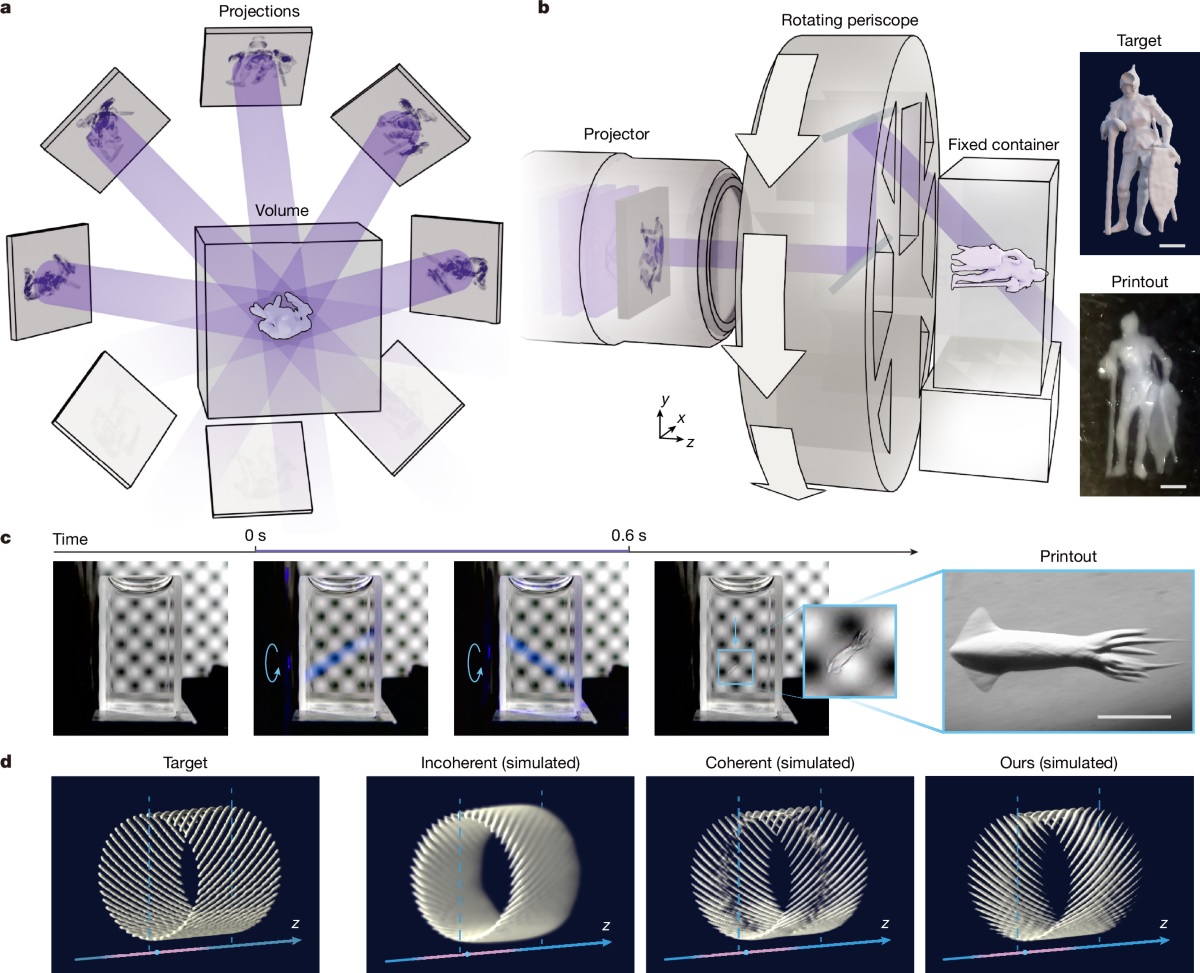
BEIJING, — June 22, 2026 : Researchers at Tsinghua University have developed a new volumetric 3D printing technology capable of fabricating complex millimeter-scale objects in just 0.6 seconds. The system, known as Digital Incoherent Synthesis of Holographic Light Fields (DISH), uses holographic light projections to create entire three-dimensional structures simultaneously within a stationary vat of liquid resin, eliminating the need for traditional layer-by-layer manufacturing.
The research, published in the journal Nature, was led by Academician Dai Qionghai of the Chinese Academy of Engineering, alongside Associate Professor Wu Jiamin and Professor Fang Lu. The project represents more than five years of work in computational optics and additive manufacturing.
New Approach to Volumetric Manufacturing
Conventional high-resolution 3D printers build objects point by point or layer by layer, often requiring several minutes or hours to complete small components. While previous volumetric printing technologies attempted to produce entire objects at once, many relied on rotating resin containers, creating mechanical instability and limiting the range of usable materials.
The DISH system removes these constraints by keeping the resin completely stationary during the printing process. Instead of moving the material or print head, the technology manipulates light through a combination of advanced optics and computational algorithms.
At the core of the system is a high-speed rotating periscope capable of revolving around the resin container up to ten times per second. Simultaneously, a Digital Micromirror Device (DMD) projects optimized binary holographic laser patterns at speeds of up to 17,000 times per second. As multiple light fields intersect within the photosensitive resin, specific regions reach the required exposure threshold and solidify almost instantly into a three-dimensional structure.
Advanced Optical Modeling Improves Accuracy
To maintain image quality and printing precision, the research team developed a wave-optics computational model that compensates for light refraction as it passes from air into liquid resin. This correction prevents distortion and maintains sharp focus throughout the printing volume.
According to the researchers, the system achieves a consistent printing resolution of approximately 19 micrometers across a depth range of one centimeter. Independent positive features as small as 12 micrometers were successfully produced, making them thinner than a typical human hair.
Record Printing Speed
Published performance data show that DISH currently delivers the highest volumetric printing speed reported for this type of manufacturing technology.
Key specifications include:
- Fabrication of millimeter-scale objects in approximately 0.6 seconds.
- Volumetric printing speed of 333 cubic millimeters per second.
- Processing capability of roughly 125 million voxels per second.
- Uniform 19-micrometer resolution throughout a one-centimeter printing depth.
- Minimum feature sizes reaching 12 micrometers.
Broader Material Compatibility
One of the major advantages of the technology is its ability to work with low-viscosity materials. Because the resin remains stationary, there are no centrifugal forces acting on the liquid during fabrication. As a result, DISH can utilize watery resins with viscosities as low as 4.7 centipoise, materials that are difficult or impossible to use in many previous volumetric printing systems.
The researchers successfully demonstrated printing with multiple acrylate-based resins and biocompatible hydrogel materials.
Applications in Bioprinting and Micro-Manufacturing
During testing, the team fabricated a variety of detailed structures, including gear-like components, hollow bifurcated tubes resembling vascular networks, and miniature sculptural models. The ability to process biocompatible hydrogels opens opportunities for tissue engineering and biomedical research, particularly in the production of three-dimensional scaffolds for cell growth.
The technology also demonstrated potential for continuous manufacturing. Researchers integrated the printer with a fluid channel and pump system that continuously supplied fresh resin while removing completed parts from the exposure region. This setup enables sequential production without stopping the machine or replacing molds.
Potential applications include:
- Bioprinting and tissue engineering
- Microfluidic devices
- Customized medical components
- Photonic computing devices
- Micro-robotics systems
- Smartphone camera modules
- Rapid prototyping and precision manufacturing
Current Challenges
Despite its performance, the technology remains focused on millimeter-scale objects. Expanding the process to larger parts while maintaining high speed and resolution remains a key challenge for future development.
The system also requires significant computational resources to generate and optimize the holographic light-field patterns used during printing. However, researchers noted that calibration procedures can be completed within minutes without modifying the hardware.
——— End of Article ———