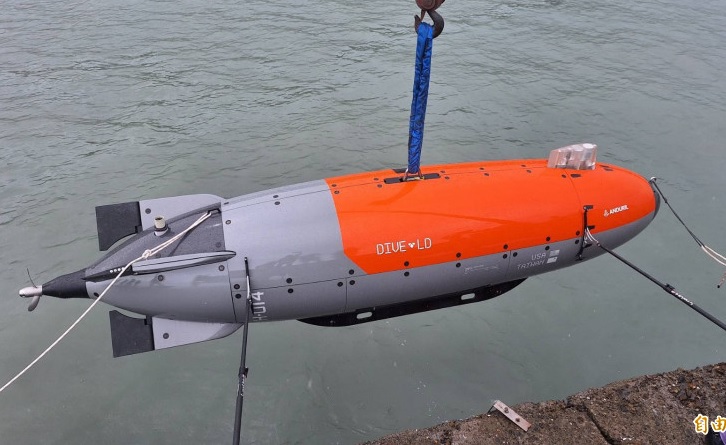
TAIPEI, Taiwan, June 25, 2026 — Taiwan's National Chung-Shan Institute of Science and Technology (NCSIST) has begun onboarding and operational training for personnel on the Dive-LD large autonomous underwater vehicle (AUV) developed by U.S. defense technology company Anduril Industries. The institute is scheduled to officially receive the system in August 2026, marking an important milestone in Taiwan's efforts to expand its long-endurance autonomous underwater capabilities.
According to NCSIST, the Dive-LD will initially be used for submarine cable inspection demonstrations and validation before being evaluated for additional missions, including underwater search and rescue, maritime accident evidence collection, seabed mapping, hydrographic surveys, and marine infrastructure inspection.
Strengthening Underwater Infrastructure Protection
The acquisition comes as governments around the world place greater emphasis on protecting critical underwater infrastructure, particularly submarine communication cables that carry most global internet and telecommunications traffic.
To support this effort, NCSIST is working with Chunghwa Telecom to deploy the Dive-LD for autonomous submarine cable inspections. Unlike conventional inspection methods that depend on divers or surface vessels, the AUV follows pre-programmed routes to accurately locate underwater cables and identify potential damage. This autonomous capability is expected to reduce inspection time and accelerate maintenance and repair operations.
Due to U.S. military export control regulations and agreements with Anduril Industries, Taiwan's Dive-LD is designated for commercial and civilian applications. Approved missions include marine surveys, infrastructure maintenance, environmental monitoring, and search and rescue operations.
Designed for Long-Endurance Deep-Sea Operations
The Dive-LD is designed for extended underwater missions in deep-ocean environments. The vehicle measures approximately 5.8 meters in length and 1.2 meters in diameter, with a dry weight of approximately 2,700–2,720 kilograms. It is capable of operating at depths of up to 6,000 meters while functioning in Sea State 3 conditions.
According to NCSIST, more than 90 percent of the world's ocean depths fall within the vehicle's operational range, making it well suited for operations in the deep waters surrounding Taiwan.
Long-endurance performance is one of the platform's key features. Operating at a cruising speed of 2.5 knots without payload, the Dive-LD can remain submerged continuously for approximately 10 days. During survey missions equipped with Synthetic Aperture Sonar (SAS) and operating at 4 knots, it can conduct missions lasting approximately four days. The vehicle's normal operating speed ranges from 2 to 8 knots.
Additional design features include direct-drive electric propulsion, which improves efficiency while reducing acoustic signature, a single-point lift and tow system for simplified logistics, and a 3D-printed exterior structure that allows easier customization and maintenance.
AI Navigation Enables Precise Underwater Operations
Since GPS signals cannot penetrate deep underwater, the Dive-LD relies on Anduril's proprietary artificial intelligence-based navigation system combined with multiple sensor fusion technologies.
Its navigation system integrates Inertial Navigation Systems (INS), Doppler Velocity Logs (DVL), and seabed tracking to maintain precise positioning throughout long-duration missions. According to NCSIST, navigation error remains within 0.02 percent of the total distance traveled, providing highly accurate localization of underwater infrastructure during autonomous operations.
This level of navigation precision is particularly important for inspecting submarine cables, underwater pipelines, and other critical seabed assets.
Modular Payload Supports Multiple Mission Profiles
The Dive-LD features a modular, free-flooded payload interface with more than one cubic meter of payload capacity and an open software architecture, allowing operators to rapidly reconfigure the vehicle for different missions.
NCSIST said new payloads and sensors, including equipment not originally installed by the manufacturer, can be integrated through software, mechanical, and electrical interfaces in approximately two weeks.
Taiwan's configuration includes several advanced underwater sensors:
-
Synthetic Aperture Sonar (SAS): Produces high-resolution seabed imagery for detailed inspection of submarine cables, pipelines, and underwater infrastructure.
-
Multi-Beam Echo Sounder: Generates accurate three-dimensional topographic maps of the seabed using fan-shaped acoustic beams.
-
Magnetometer: Detects metallic objects such as shipwrecks, anchors, and submerged debris.
-
High-Resolution Cameras: Provide visual confirmation of underwater targets and support evidence collection during inspection and recovery missions.
Expanding Search and Rescue Capabilities
Beyond infrastructure inspection, NCSIST plans to evaluate the Dive-LD for underwater search and rescue missions.
Its combination of high-resolution sonar, advanced imaging systems, and autonomous navigation can improve the efficiency of locating downed aircraft, shipwrecks, missing persons, and submerged evidence while reducing reliance on divers and multiple support vessels.
NCSIST officials noted that during the search for an Air Force F-16V that disappeared off the coast of Hualien earlier this year, authorities had considered employing the Dive-LD's underwater reconnaissance capabilities. The institute believes the system can significantly improve future maritime recovery operations.
Supporting Taiwan's Autonomous Maritime Capabilities
Over the past decade, autonomous underwater vehicles have become increasingly important for marine scientific research, offshore resource exploration, hydrographic surveys, environmental monitoring, and critical infrastructure maintenance.
The Dive-LD's introduction represents another step in Taiwan's efforts to develop indigenous underwater detection capabilities while expanding cooperation with Anduril Industries on autonomous systems. The platform was previously displayed during the 2025 Taipei Aerospace & Defense Technology Exhibition (TADTE) as part of Taiwan's plans to strengthen autonomous maritime technologies.
According to NCSIST, operational experience gained through the Dive-LD will help improve Taiwan's ability to inspect underwater infrastructure, respond to maritime emergencies, support scientific research, and enhance long-term underwater situational awareness across its surrounding waters.
——— End of Article ———