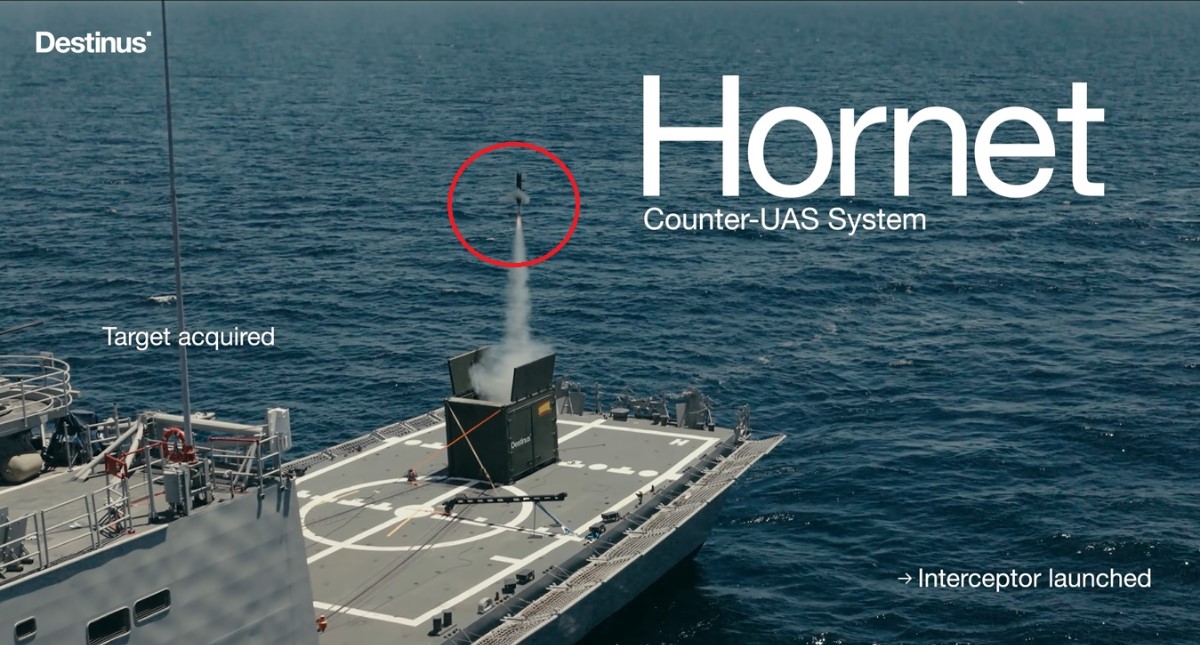
Madrid, — June 19, 2026 : The Spanish Navy and European defense company Destinus conducted a live test launch of the Hornet Block 1 interceptor from the F-81 Santa María frigate on June 18, 2026, marking a step in evaluating modular air defense solutions for naval platforms.
The trial involved a single interceptor launched from a containerised system installed on the deck of the Santa María, a frigate based on the Oliver Hazard Perry-class design. The objective was to assess whether interceptor systems can be rapidly integrated onto existing warships without major structural modifications or the installation of dedicated vertical launch systems.
The containerised launcher uses standard shipping-container architecture, allowing naval vessels to carry additional interceptors through a flexible and comparatively low-cost deployment method. The concept is being explored as navies seek effective ways to counter the increasing use of drones, loitering munitions, and coordinated unmanned aerial threats in maritime environments.
Developed by Destinus, the Hornet Block 1 is a canister-launched interceptor designed to engage subsonic aerial targets, including Group 3 UAVs and drone swarms. The system can operate in GNSS-denied environments and uses host-ship radar guidance during the initial phase of flight before transitioning to autonomous target engagement using electro-optical/infrared and radar seekers.
According to company specifications, the interceptor has a range of more than 75 kilometers and carries a 1.5-kilogram payload. Its design aims to provide a dedicated counter-UAS capability while reducing reliance on more expensive air defense missiles for engaging smaller threats.
The naval demonstration follows earlier development activities conducted in Spain, where Destinus worked with Shield AI to integrate the Hivemind autonomous software suite into the Hornet platform. Those tests demonstrated collaborative autonomous operations and adaptive responses against multiple unmanned targets.
Destinus is also developing the Hornet Block 2, an enhanced variant intended for both air-defense missions and precision strikes against maritime and ground targets. The future system is expected to feature a range exceeding 150 kilometers, a 3-kilogram payload, and advanced AI-enabled swarm coordination capabilities.
The Spanish Navy has not released details regarding the threat scenario, engagement parameters, or the outcome of the June 18 firing. However, the demonstration provided an opportunity to evaluate the operational suitability of containerised interceptor technology aboard frontline naval vessels.
The test reflects growing interest in modular defense systems that can strengthen ship survivability and expand defensive capacity without extensive platform modifications, particularly as unmanned threats continue to evolve across the maritime domain.
——— End of Article ———