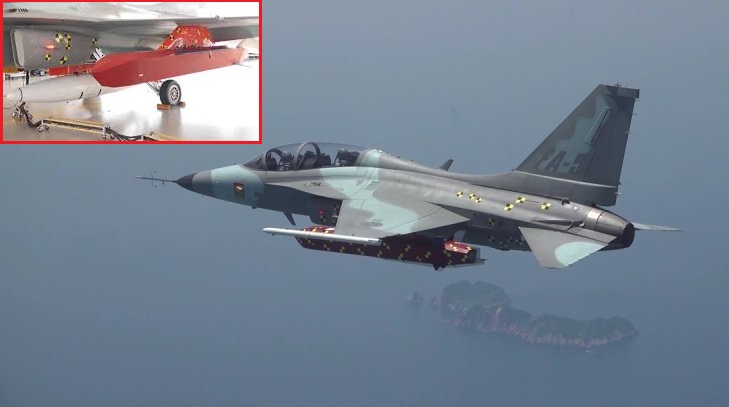
SEOUL, June 29, 2026 — South Korea has successfully completed a technical flight test of its domestically developed Cheonryong long-range air-to-ground missile, marking a major milestone in the country's effort to strengthen its long-range precision strike capability.
According to the Defense Acquisition Program Administration (DAPA), the missile safely separated from a modified FA-50 light attack aircraft, successfully ignited its engine after release, and maintained a stable powered flight trajectory during the test conducted on June 23 at the Republic of Korea Air Force's 3rd Training and Combat Wing. The flight also confirmed safe separation from the aircraft without interference from the airframe.
The successful test follows two unsuccessful attempts in January and March, when the missile failed to ignite its engine after separation. Engineers remotely terminated both flights and safely ditched the prototypes into the Yellow Sea (West Sea). No casualties or property damage were reported.
Designed for Hardened Underground Targets
Cheonryong, meaning "Heavenly Dragon," is designed to destroy heavily fortified underground military infrastructure, including ballistic missile storage sites, command centers, leadership bunkers, and other strategic facilities built into granite mountains. The missile carries a specialized bunker-busting warhead capable of penetrating up to 6 meters (20 feet) of reinforced concrete before detonation.
According to the Seoul Economic Daily, the missile has a range exceeding 600 kilometers (373 miles) and uses a multi-mode guidance system combining terrain contour matching, inertial navigation, and image-based terminal guidance. The guidance package enables a reported circular error probable (CEP) of 1 to 2 meters, even in GPS-denied or jammed environments.
Cheonryong also incorporates a stealth-optimized airframe, radar-absorbent materials, and a low-altitude flight profile to reduce its radar signature during penetration missions.
Reducing Dependence on Imported Missiles
South Korea currently operates around 260 German-built Taurus KEPD 350 cruise missiles, but the Republic of Korea Air Force estimates it requires approximately 600 long-range air-to-ground guided munitions for the initial phase of a potential conflict.
The domestically developed Cheonryong is intended to fill this gap while reducing reliance on imported weapons. Compared with the Taurus, the missile is expected to retain about 90 percent of its bunker penetration capability while extending operational range by approximately 20 percent.
Another operational advantage is its internal propellant storage system. Unlike the Taurus, which requires fueling before deployment, Cheonryong can remain fully fueled for five to ten years, allowing aircraft to remain on alert and reducing launch preparation time.
Integration Across South Korea's Fighter Fleet
Cheonryong has been designed for integration with the KF-21 Boramae, FA-50, KF-16, and F-15K, allowing long-range strike capability to be distributed across multiple aircraft types. Its reduced dimensions and weight also support compatibility with the KF-21's carriage requirements.
The missile forms part of South Korea's Korean Three-Axis System, supporting the Kill Chain pre-emptive strike capability and the Korea Massive Punishment and Retaliation (KMPR) framework.
Developed by the Agency for Defense Development (ADD) in partnership with LIG Nex1 and Hanwha Aerospace, the Cheonryong program is scheduled to complete development by 2028, begin mass production in 2029, and enter operational service aboard the KF-21 Boramae and other Republic of Korea Air Force aircraft in the early 2030s.
——— End of Article ———