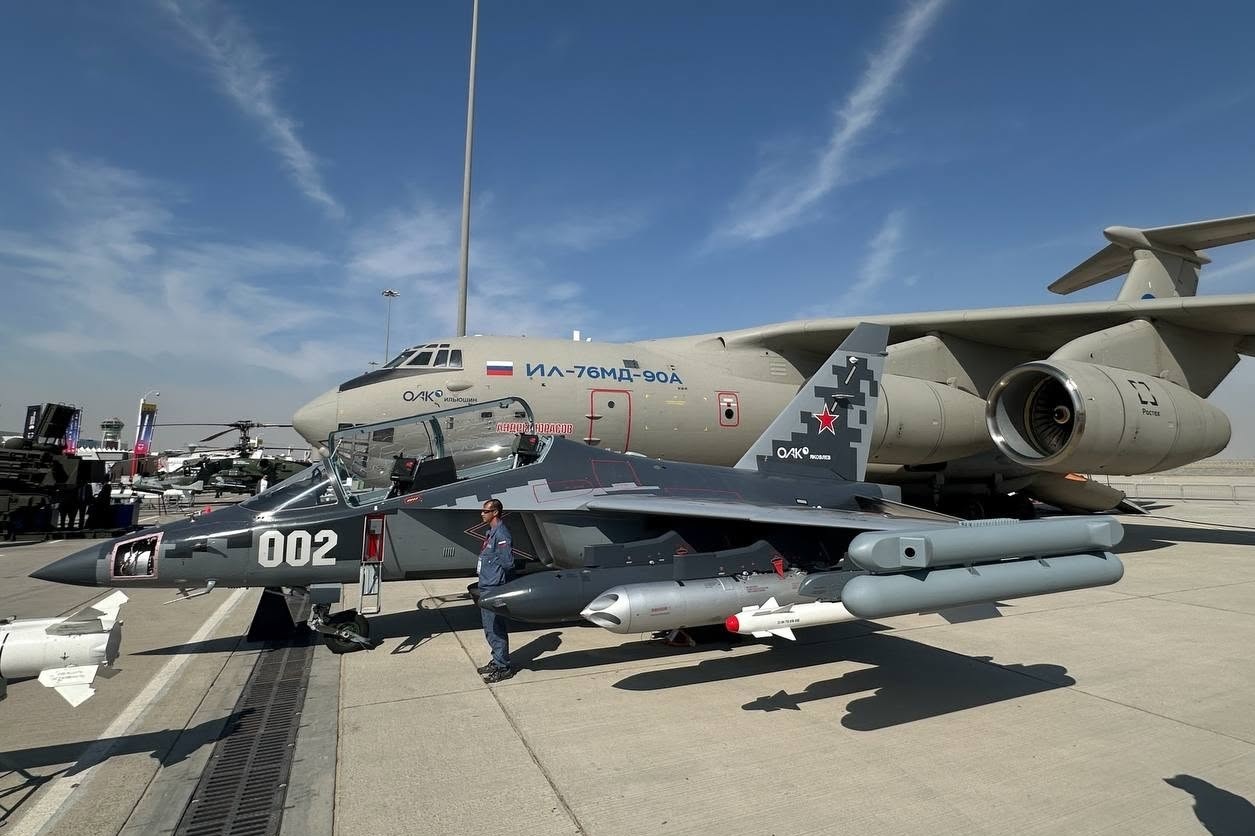
MOSCOW, June 26, 2026 — Russia has successfully completed the maiden flight of the modernized Yak-130M combat trainer aircraft, marking a major milestone in the development of its next-generation lightweight fighter-trainer platform. The flight took place on June 25 at the Irkutsk Aviation Plant, a branch of PJSC Yakovlev under the United Aircraft Corporation (UAC), part of the Rostec State Corporation.
The prototype remained airborne for approximately 50 minutes, reaching an altitude of 2,000 meters and a maximum speed of 600 km/h. The aircraft was flown by 1st Class Test Pilot Alexander Guskov and Distinguished Test Pilot Andrey Voropayev, who reported that all planned flight objectives were completed successfully without any technical issues.
The maiden flight marks the beginning of a broader flight test program that will evaluate the aircraft's upgraded avionics, sensors, flight characteristics, and weapons integration before it progresses toward operational service.
Evolution into a Multi-Role Combat Platform
The Yak-130M is an extensively modernized version of the baseline Yak-130 advanced trainer, which has served the Russian Aerospace Forces and several export customers for pilot training.
Unlike the original aircraft, the Yak-130M has been developed with a stronger emphasis on combat operations while retaining its training role. It is designed to conduct air-to-air combat, precision strike missions, counter-drone operations, close air support, and battlefield reconnaissance, allowing operators to use a single platform for both pilot training and frontline missions.
Improved Performance and Powerplant
The aircraft is powered by two AI-222-25 turbofan engines produced by Rostec's United Engine Corporation (UEC). Each engine delivers 2,500 kgf of thrust through a bypass, non-afterburning design that improves fuel efficiency while maintaining reliable performance.
The Yak-130M has a maximum speed of approximately Mach 0.9, a service ceiling of 12,500 meters, and can carry up to 3,000 kilograms of weapons on nine external hardpoints, enabling it to perform a broad range of combat missions.
Advanced Avionics and Sensor Systems
A key enhancement is the integration of the BRLS-130R Active Electronically Scanned Array (AESA) radar, which significantly improves the aircraft's ability to detect, track, and engage both airborne and ground targets, including beyond-visual-range engagements.
The radar is paired with the SOLT-130K electro-optical and laser targeting system, providing accurate target identification and supporting precision-guided weapons during day and night operations.
To improve survivability, the aircraft is equipped with the President-S130 self-protection suite, while the KSS-130 communications and data link system enhances information sharing and coordination during network-centric operations.
Together, these systems substantially increase the Yak-130M's situational awareness and combat capability compared with the original Yak-130.
Expanded Weapons Capability
The Yak-130M supports a wider range of modern weapons than previous variants. It is expected to integrate the R-77-1 beyond-visual-range air-to-air missile, with potential future compatibility for the R-77M. The aircraft can also employ precision-guided air-to-surface weapons, conventional bombs, rockets, cannon pods, and other mission-specific payloads.
These upgrades significantly improve its effectiveness in air-to-air combat, precision strike, and counter-drone missions compared with earlier Yak-130 variants, including those currently equipped with R-73 short-range air-to-air missiles.
Position in the Global Light Fighter Market
The Yak-130M enters a competitive market for lightweight multi-role combat aircraft, where advanced sensors, modern avionics, and beyond-visual-range weapons have become increasingly important.
Competing platforms include China's JF-17 Block 3 equipped with the PL-15, China's JL-10 with the PL-12, South Korea's FA-50 integrated with the AIM-120 AMRAAM, and Sweden's Gripen E/F equipped with the Meteor missile.
With its AESA radar and planned R-77 series missile integration, the Yak-130M offers significantly greater combat capability than previous Yak-130 variants while providing a cost-effective alternative for operators seeking modern air combat capabilities.
Domestic and Export Potential
Lightweight combat aircraft continue to attract interest because of their relatively low procurement, operating, and maintenance costs compared with heavier fighter platforms. These advantages enable air forces to maintain larger fleets with higher operational availability.
For the Russian Aerospace Forces, the Yak-130M could support fleet expansion while gradually replacing aging, unmodernized MiG-29A fighters, reducing sustainment costs and improving operational capability.
In the export market, the aircraft is positioned to compete with the JF-17 Block 3, JL-10, FA-50, and Gripen E/F. Its combination of advanced training capability, modern combat systems, and comparatively low operating costs is expected to appeal to countries seeking affordable frontline aircraft, including strategic partners in Asia and Africa such as Laos and Burkina Faso.
Flight Testing Continues
United Aircraft Corporation officials said the Yak-130M has been developed to perform a broader range of missions while incorporating technologies that improve both operational capability and export competitiveness.
Following its successful maiden flight, the aircraft will continue an extensive flight test program to validate its avionics, sensors, weapons integration, and overall performance before future production and operational service.
Building on the proven Yak-130 platform, the Yak-130M combines advanced pilot training capabilities with significantly enhanced combat performance, positioning it as Russia's most capable variant of the aircraft to date.
——— End of Article ———