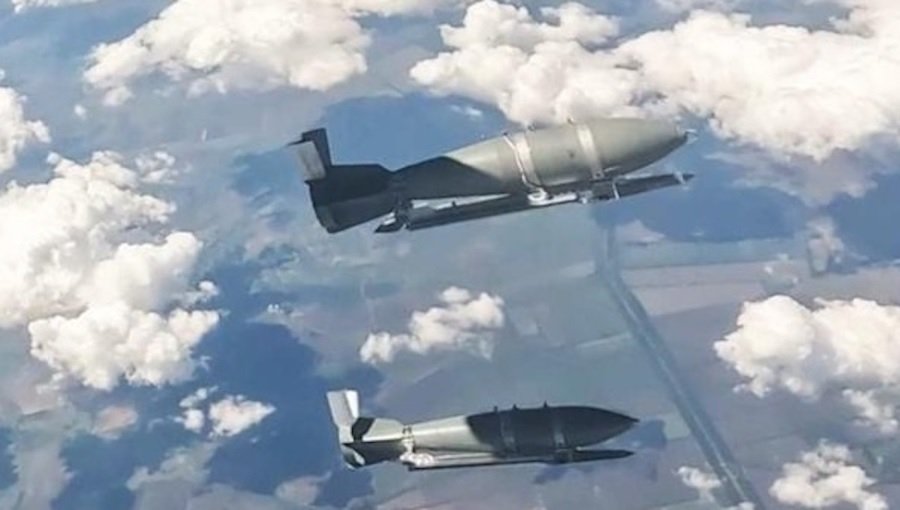
KYIV — Russian Aerospace Forces used a record 8,766 FAB bombs fitted with UMPK glide-and-correction kits against targets in Ukraine during August 2026, according to Ukrainian military data compiled by the OSINT group Oko Gora.
The figure equals an average of about 283 bombs per day during the 31-day month. It was the highest monthly total recorded since Russia's full-scale invasion began in February 2022. Ukrainian monitoring recorded about 8,266 uses in June and approximately 8,300–8,385 in July, showing a continued increase in Russian use of glide bombs.
The August rate was also higher than the estimated U.S. daily rate during Operation Epic Fury, the U.S.-led air campaign against Iran earlier in 2026. Estimates based on available data put U.S. guided aerial bomb use during the first 38 days of the operation at about 8,000–9,000, or roughly 211–237 bombs per day.
However, Russia's current rate remains below the level recorded during the 2003 U.S.-led invasion of Iraq, when coalition forces used approximately 500 air-dropped bombs per day during the intensive combat phase.
UMPK allows older bombs to become glide weapons
The UMPK (Unified Gliding and Correction Module) is a bolt-on system that adds folding wings, control surfaces and satellite-guidance equipment to Soviet-era FAB free-fall bombs.
The system can be fitted to bombs including the FAB-250, FAB-500, FAB-1500 and FAB-3000, as well as some thermobaric and cluster variants. The Su-34 is the primary launch aircraft, while Su-35 and Su-30 aircraft have also been reported using the weapons.
According to Ukrainian sources, the basic UMPK-equipped FAB has a range of about 60–65 kilometers, while the UMPK-PD extended-range version can reach up to 95 kilometers. Later variants with larger wings and other modifications have been reported with ranges exceeding 100 kilometers, while jet-powered versions have been assessed at still greater distances.
The system uses inertial navigation with satellite correction, including the Kometa-M receiver system. By allowing the aircraft to release the weapon from a distance, UMPK-equipped bombs can reduce the aircraft's exposure to Ukrainian short-range air defenses.
Russia rapidly expands production
Western defense assessments indicate that Russia ordered about 40,000 UMPK kits in 2024 and more than 70,000 in 2025. The use of more than 8,000 kits in August alone suggests that Russian production or availability during 2026 could reach 100,000 or more kits, although some weapons may have come from earlier stocks.
The U.S. approach has relied heavily on large precision-weapon inventories accumulated over decades. By 2020, the Pentagon had received approximately 371,000 JDAM conversion kits in the referenced total. Including SDB I and SDB II, annual procurement reached as high as 50,000 kits, while the average over 28 years was about 17,000 JDAM non-extended-range and SDB kits per year. Public figures for the U.S. inventory of JDAM-ER kits remain unavailable.
Russia's UMPK program instead combines rapidly expanding kit production with large stocks of older Soviet-era bombs. The result has been a sustained increase in the number of guided glide bombs used against Ukrainian positions during 2025 and 2026.
——— End of Article ———