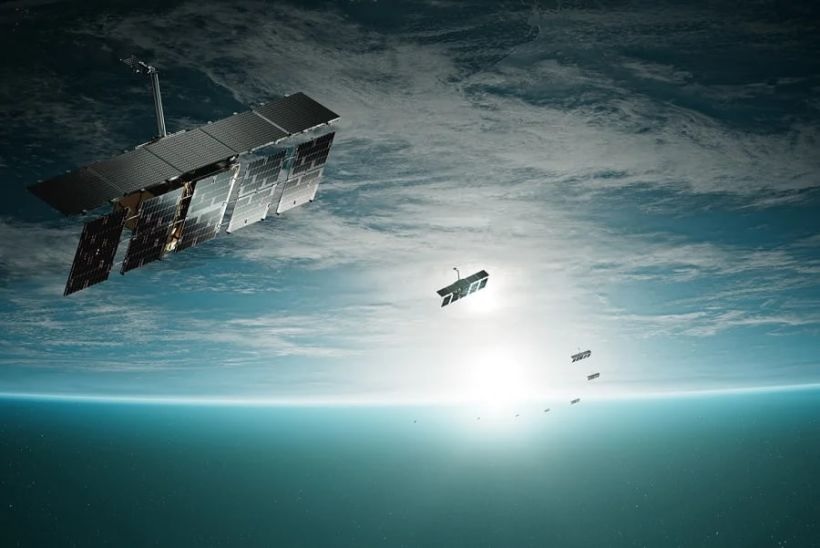
June 25, 2026 — Four Russian military satellites have carried out a series of orbital maneuvers that brought them into close proximity with ICEYE-X36, a commercial synthetic aperture radar (SAR) satellite operated by Finnish-American space company ICEYE, which has provided Earth observation data supporting Ukraine since 2022.
According to space tracking analysts, Kosmos-2610, Kosmos-2611, Kosmos-2612, and Kosmos-2613 adjusted their orbits during May 2026 to align with the orbital plane of ICEYE-X36. The maneuver enabled repeated close approaches, with the closest recorded separation estimated at approximately 13 kilometers in low Earth orbit.
Russian Satellites Changed Orbit to Match ICEYE-X36
The four satellites were launched on April 16, 2026, aboard a Soyuz-2.1b rocket from the Plesetsk Cosmodrome as part of a mission that deployed six military satellites, including Kosmos-2609 and Kosmos-2614.
Between May 14 and May 20, the four spacecraft performed an orbital plane change, increasing their inclination from approximately 97.0 degrees to 97.8 degrees to match the orbit of ICEYE-X36. The maneuver also corrected a small right ascension of the ascending node (RAAN) offset, placing the satellites in the same orbital plane.
Such orbital plane changes are uncommon because they require a significant amount of propellant. Aerospace analysts estimate the maneuver required approximately 105 to 106 meters per second of delta-v, indicating the repositioning was a deliberate operation rather than a routine orbital adjustment.
Close Approaches Tracked in Late May
Following the orbital adjustment, space situational awareness firms, including Integrity ISR, COMSPOC, and Saber Astronautics, observed multiple close approaches between the Russian satellites and ICEYE-X36.
On May 29, the satellites passed within approximately 13 kilometers of the commercial spacecraft. Cross-track separations ranged from around 500 meters to approximately 22 kilometers during various encounters, while several other passes occurred at distances between 16 and 18 kilometers.
The satellites remain positioned in the same orbital plane, allowing additional close approaches with relatively minor orbital adjustments.
ICEYE Satellite Provides All-Weather Intelligence
ICEYE-X36 is part of ICEYE's constellation of synthetic aperture radar satellites. Launched on March 4, 2024, aboard a SpaceX Falcon 9 rideshare mission, the approximately 90-kilogram satellite uses microwave radar to capture high-resolution images regardless of daylight, cloud cover, or weather conditions.
Since 2022, ICEYE has provided satellite imagery to Ukraine under an agreement granting dedicated access to its SAR data. The imagery has supported battlefield reconnaissance by helping identify military equipment, monitor troop movements, and locate logistics facilities, fuel depots, and air defense positions.
Analysts View Maneuvers as Rendezvous and Proximity Operations
Space and defense analysts assess that the maneuvers are consistent with Rendezvous and Proximity Operations (RPO), a capability used for satellite inspection, servicing, technology demonstrations, and military missions.
Although there is no evidence of physical interference with ICEYE-X36, analysts say operating in close proximity could enable electronic intelligence collection, testing of non-kinetic electronic warfare techniques such as localized jamming, or demonstrations of close-orbit maneuvering capabilities.
The operation is also viewed by some experts as a signal that commercial satellites supporting military operations can be closely monitored in orbit.
No Official Response
ICEYE has not publicly commented on the reported orbital activity, while Russia has not issued an official statement regarding the maneuvers.
The satellites continue to be tracked by the U.S. Space Force and independent space situational awareness organizations. No physical contact or confirmed interference with ICEYE-X36 has been reported, and the satellite remains fully operational.
——— End of Article ———