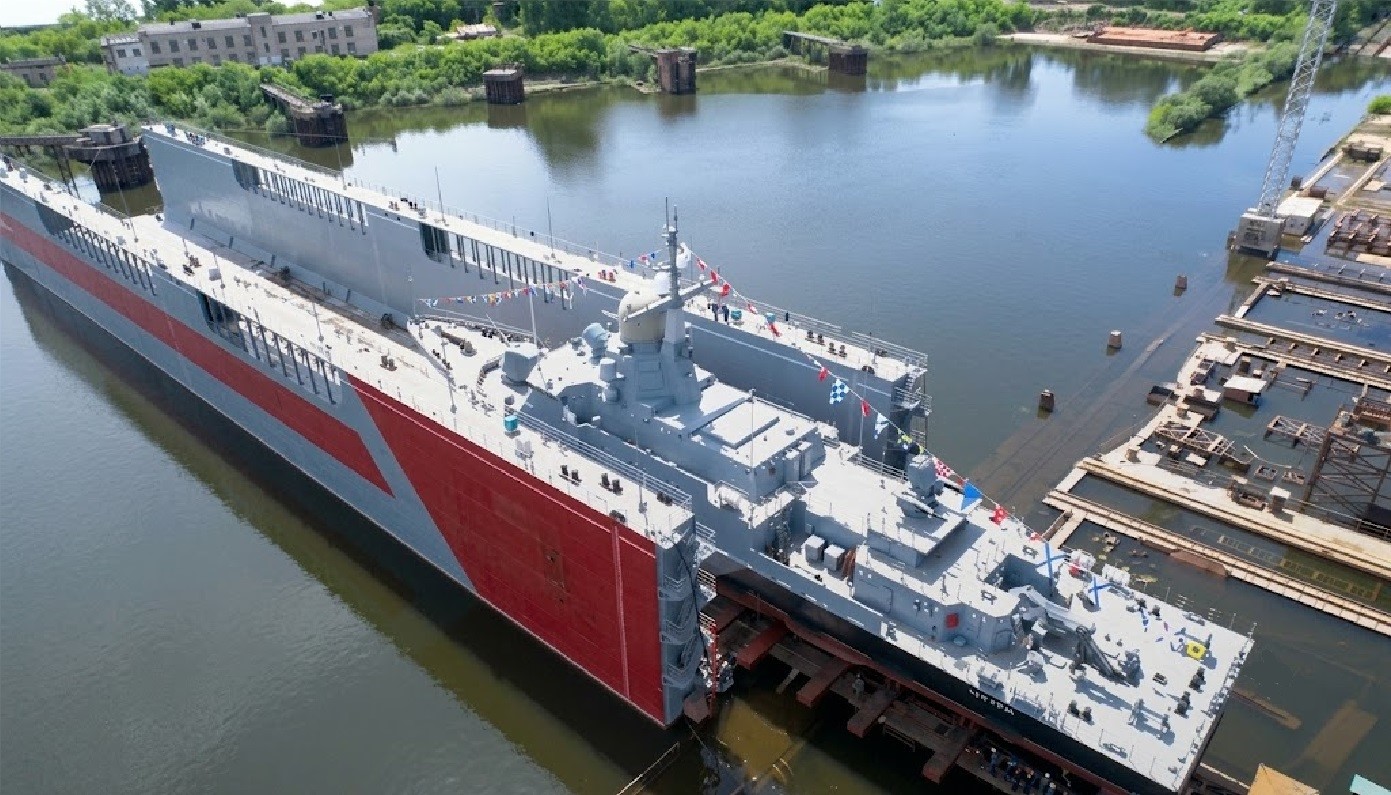
KOMSOMOLSK-ON-AMUR, Russia — Russia's state-owned United Shipbuilding Corporation (USC) has launched Shtorm (Storm), the third Project 22800 Karakurt-class small missile ship built at the Amur Shipbuilding Plant for the Russian Navy's Pacific Fleet.
The ship was moved from the shipyard slipway using the specialized floating pontoon dock "Amurets", completing the primary hull construction phase. Shtorm will now undergo equipment outfitting, installation of onboard systems, harbor acceptance tests, factory sea trials and state trials before entering operational service.
Shtorm is part of Russia's ongoing Project 22800 construction program, which is building compact missile-equipped surface combatants for coastal and regional naval operations.
The Project 22800 Karakurt-class was developed by the Almaz Central Marine Design Bureau in St. Petersburg. The class was created to provide the Russian Navy with a compact multi-role missile ship capable of operating in littoral and near-shore waters while offering improved seaworthiness compared with the Buyan-M class.
The vessel has a stealth-shaped superstructure with faceted surfaces intended to reduce radar reflections. It also features an integrated mast fitted with four phased-array radar panels to improve situational awareness while reducing the ship's radar cross-section.
Although the ship has a displacement of about 800 tons, it carries an eight-cell UKSK (3S-14) vertical launch system. The launcher can fire Kalibr-NK cruise missiles for land-attack and anti-submarine missions, with reported land-attack ranges of up to 2,500 kilometers, as well as P-800 Oniks supersonic anti-ship missiles.
For air defense, Shtorm is fitted with the Pantsir-M naval air defense system, combining 57E6 short-range surface-to-air missiles with twin 30 mm rotary cannons to engage aircraft, helicopters, unmanned aerial vehicles, anti-ship missiles and other aerial threats.
Its additional armament includes an AK-176MA 76.2 mm automatic dual-purpose naval gun capable of firing up to 150 rounds per minute. Close-range defense is provided by two 12.7 mm Kord heavy machine guns. The ship can also operate Orlan-10 unmanned aerial vehicles for reconnaissance, surveillance and target acquisition missions.
Shtorm has a standard displacement of about 800 tons, increasing to around 870 tons at full load. The ship measures 67 meters in length, has a beam of 11 meters and a draft of 3.3 meters.
Power is provided by a Combined Diesel and Diesel (CODAD) propulsion system using three M-507D-1 diesel engines and three diesel generators, each producing 8,000 horsepower. The propulsion system gives the ship a maximum speed of 30 knots.
The vessel has an operational range of about 2,500 nautical miles at an economical speed of 12 knots and an endurance of 15 days at sea. It is operated by a crew of around 50 personnel. The ship is built with domestically produced components for green-water operations.
Shtorm is the third Project 22800 Karakurt-class missile ship built at the Amur Shipbuilding Plant, one of several Russian shipyards producing the class for different fleets. Earlier Karakurt-class ships have already entered service with the Russian Navy carrying Kalibr and Oniks missile systems.
The modernization of production facilities at the Amur Shipbuilding Plant, including the introduction of the "Amurets" pontoon dock, is expected to improve shipbuilding efficiency and support continued serial production. After completing outfitting and sea trials, Shtorm will join the Russian Navy's Pacific Fleet.
——— End of Article ———