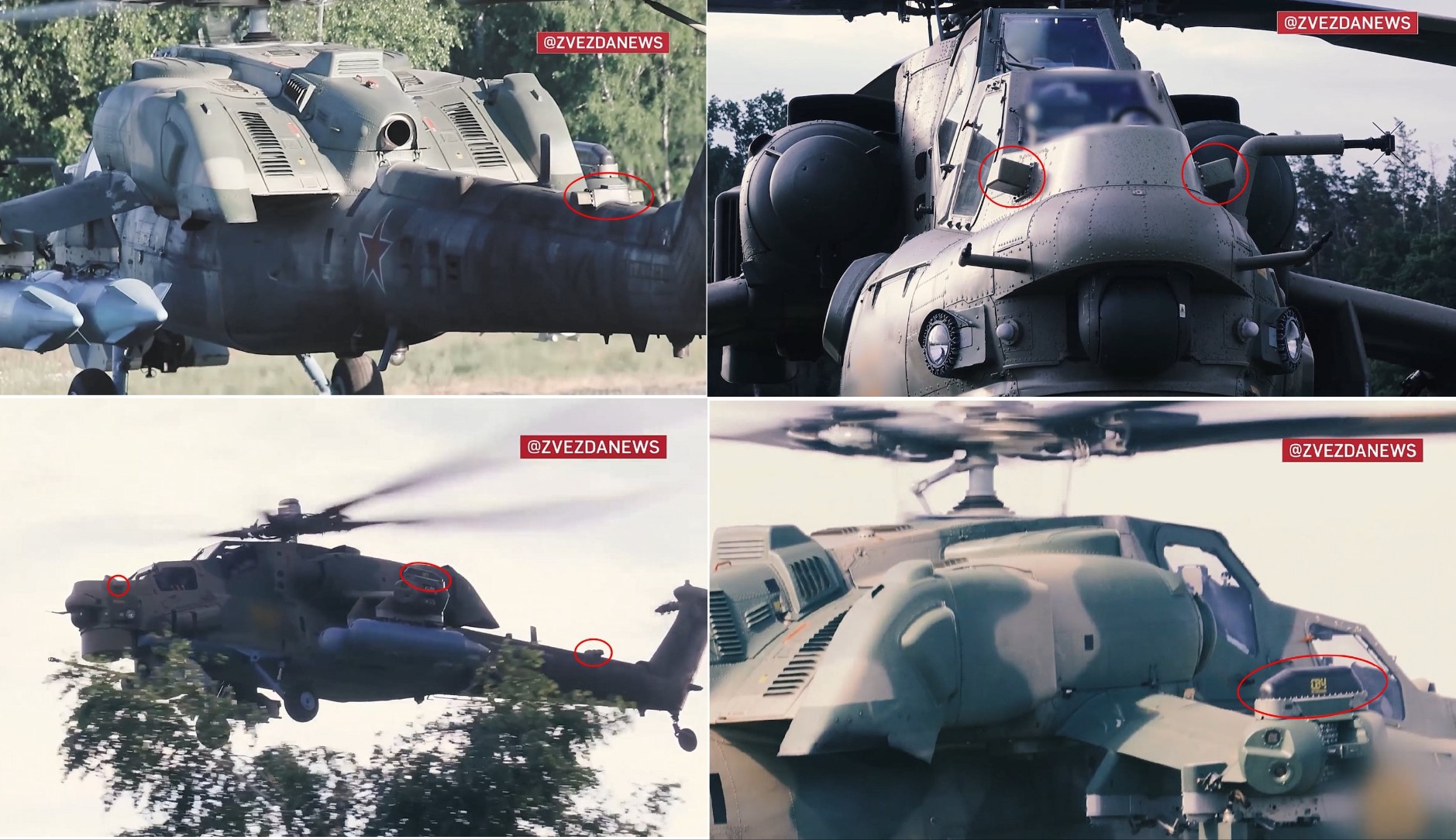
Moscow, — June 20, 2026 : Recent footage released by the Russian Ministry of Defense indicates that Russia has equipped its Mi-28NM attack helicopters with new electronic warfare (EW) systems designed to counter unmanned aerial systems (UAS) operating on the battlefield in Ukraine.
The upgrades were identified by Israeli defense analyst Guy Plopsky, who examined images from official Russian Ministry of Defense footage showing Mi-28NM operations over Ukraine. The footage reveals new antenna housings installed on the sides of the nose, the tops of the stub-wing weapon pods, and the tail boom—features not previously seen on standard production aircraft.
According to Plopsky, the installations are likely part of an electronic countermeasures (ECM) system intended for counter-drone operations. Their placement across multiple sections of the airframe suggests broad coverage around the helicopter, potentially allowing it to detect or jam threats approaching from different directions.
It remains unclear whether the housings contain only jamming equipment, drone-detection sensors, or a combination of both. Jamming systems disrupt radio-frequency control links or GPS signals used by drones, while detection systems provide early warning of approaching threats.
The Mi-28NM, NATO reporting name "Havoc," is the most advanced version of Russia’s Mi-28 attack helicopter. It features the N025 mast-mounted radar, third-generation thermal imaging systems, upgraded VK-2500P engines, and a range of weapons including a 30mm 2A42 cannon, rockets, air-to-air missiles, Ataka and Vikhr anti-tank missiles, and the LMUR guided missile.
Recent versions of the helicopter have also been integrated with Russian reconnaissance drones such as the Korsar and Forpost and can launch loitering munitions from airborne positions.
Russian forces have used the Mi-28NM extensively in Ukraine for close air support missions and stand-off strikes using guided weapons. However, attack helicopters remain vulnerable to FPV drones, loitering munitions, and modified commercial quadcopters due to their low-altitude operating profile near front-line areas.
The new modifications appear to be a response to these battlefield threats. Russia has introduced similar electronic warfare systems on tanks and armored vehicles during the conflict to counter drone attacks.
It is not yet known whether the Mi-28NM upgrades are part of a fleet-wide modernization program or field modifications applied to specific aircraft. The Russian Ministry of Defense has not released technical details regarding the system.
The Mi-28NM already operates with the L370V28 Vitebsk self-defense suite, which includes radar warning, laser warning, missile-approach warning, and directional infrared countermeasure systems. The newly observed equipment appears intended to strengthen protection against unmanned aerial threats as drone warfare continues to shape military operations in Ukraine.
——— End of Article ———