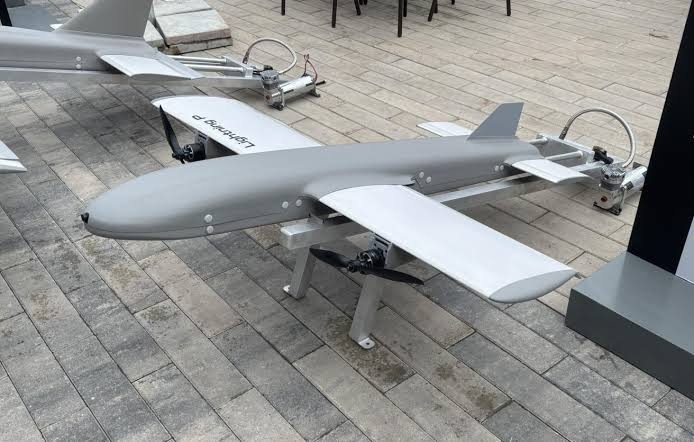
Moscow - June 21, 2026 : Russian state defense corporation Rostec has officially introduced the Molniya-13 heavy-class unmanned aerial vehicle (UAV), a new strike and reconnaissance drone designed to offer greater payload capacity, improved operational resilience, and enhanced battlefield performance. The platform was showcased during the National Security Belarus-2026 exhibition held on June 17, 2026.
Developed and manufactured by Atlant Aero, the Molniya-13—also promoted for export under the name "Lightning-13"—represents the latest evolution of the Molniya drone family. The new UAV builds on the experience gained from the operational use of the Molniya-2 platform and incorporates several structural and technical upgrades aimed at increasing combat effectiveness while maintaining a low radar signature.
One of the most significant improvements is the drone's expanded payload capacity. The Molniya-13 can carry up to 13 kilograms, substantially increasing its ability to transport equipment, munitions, and other mission-related payloads. To accommodate this increase, engineers redesigned the airframe with a larger fuselage that provides greater internal volume while preserving a relatively compact overall profile through the use of an aerodynamic fairing.
The propulsion system has also undergone a major redesign. Unlike earlier Molniya variants that utilized two electric motors, the Molniya-13 is equipped with four electric motors. This configuration improves the thrust-to-weight ratio and enhances operational reliability. The additional motors provide redundancy, allowing the aircraft to maintain controlled flight even if one motor becomes damaged or fails during a mission. The feature is considered particularly valuable in areas affected by electronic warfare and other battlefield disruptions.
The UAV is powered by higher-capacity batteries, enabling a flight range of up to 50 kilometers. It operates at a cruise speed of approximately 120 kilometers per hour and is designed to maintain stability during flight in strong headwinds. According to available information, the combination of an extended fuselage, upgraded propulsion system, and improved power supply contributes to better handling characteristics and increased mission endurance.
The Molniya-13 has been developed for a variety of military applications, including reconnaissance, target monitoring, transportation of supplies, and precision strike missions. Russian officials state that the drone has already undergone extensive field testing in operational environments and has been deployed by unmanned systems units operating within the Sever, Vostok, Zapad, Tsentr, and Dnepr force groups, as well as airborne and engineering formations.
During operational evaluations, the drone was reportedly used against fortified positions and light armored vehicles. Military engineers involved in the testing process noted that the platform achieved higher payload delivery capability and improved battlefield survivability without a significant increase in radar detectability.
The Molniya family has gained attention for its emphasis on affordability and mass production. The drones are commonly manufactured using lightweight and cost-effective materials, including foam, plywood, plastic, and composite structures. This approach allows rapid production while keeping acquisition costs relatively low compared to more complex UAV systems.
Earlier Molniya variants generally carried payloads ranging from approximately 3 to 5 kilograms in standard configurations and offered operational ranges between 30 and 60 kilometers depending on mission requirements. The Molniya-13's larger airframe, four-motor architecture, and increased battery capacity were introduced to address limitations in payload capacity, power generation, and reliability observed in previous models.
The UAV is typically launched using a catapult or rail-based launch system, allowing rapid deployment without requiring conventional runways. Russian sources indicate that the platform is intended for both domestic military use and potential export customers under the Lightning branding.
The introduction of the Molniya-13 reflects a broader trend in modern defense procurement toward low-cost, modular, and scalable unmanned systems capable of operating in contested environments. By combining increased payload capacity, improved redundancy, and simplified manufacturing methods, the new platform is intended to support reconnaissance, strike, and logistics missions while remaining suitable for large-scale deployment.
Rostec has not disclosed additional details regarding production volumes, future variants, or further technical enhancements beyond the specifications presented at the exhibition.
——— End of Article ———