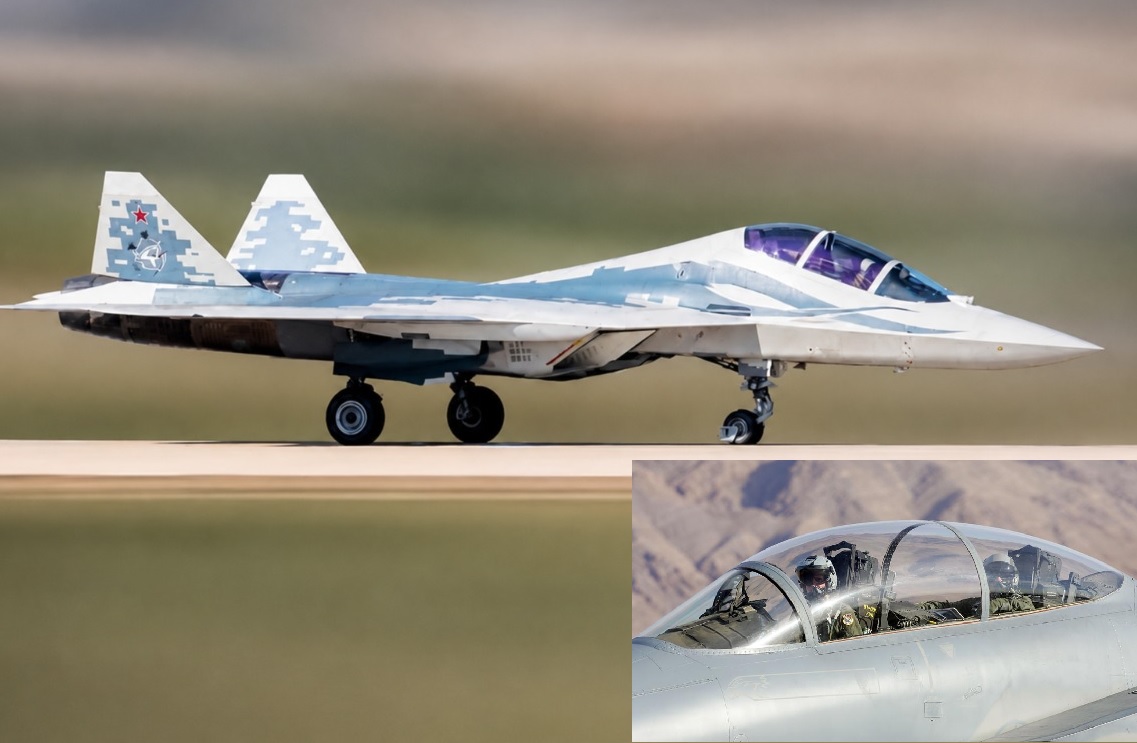
MOSCOW, — May 17, 2026 : Russia has begun preliminary ground taxi trials of a two-seat variant of the Su-57 fifth-generation stealth fighter, marking a new phase in the development of the country’s flagship combat aircraft as Moscow seeks to expand export sales and enhance operational flexibility.
The existence of the modified aircraft was confirmed on May 16 by Russian military aviation blogger Ilya Tumanov, who operates the Fighterbomber Telegram channel. Photographs published in Russian defense media showed an Su-57 airframe with an elongated forward fuselage section designed to accommodate a tandem second cockpit, a configuration commonly used in Russian combat trainer aircraft.
According to Tumanov, the aircraft’s final designation has not yet been determined, with possible names including Su-57D, Su-57UB, or Su-57ED. The aircraft is currently undergoing ground rolling and taxi tests to evaluate systems integration, braking performance, and handling characteristics ahead of flight trials expected later in 2026.
The redesign introduces additional engineering requirements to preserve the fighter’s low-observable characteristics. Russian defense sources also indicate that the modified configuration could provide improved range and mission endurance compared to the standard single-seat model.
Developed by Sukhoi and produced at the Komsomolsk-on-Amur aircraft plant, the Su-57 entered limited service with the Russian Aerospace Forces in 2020. The twin-engine multirole fighter features internal weapons bays, thrust-vectoring engines, and advanced avionics, and is positioned by Russia as its primary fifth-generation combat aircraft.
Russian military commentators stated that the two-seat version is intended primarily for export customers rather than domestic service. A dedicated trainer variant is considered important for foreign operators that lack Russia’s extensive pilot training infrastructure and simulator systems.
The development follows Russia’s renewed efforts to market the Su-57E export variant internationally. During the DSA-2026 defense exhibition in Kuala Lumpur in April, Russia’s state arms exporter Rosoboronexport announced new foreign contracts for the aircraft, although customer identities and order quantities were not disclosed.
Algeria has emerged as the first confirmed foreign operator of the Su-57. In recent months, photographs and videos have shown Su-57 fighters carrying Algerian Air Force markings, while Algerian pilots have reportedly conducted familiarization and conversion flights. Defense observers have linked Algeria to a long-discussed order for approximately 14 aircraft.
The export variant reportedly includes modifications such as English-language cockpit labeling, revised identification systems, and compatibility with selected non-Russian weapons.
Russian defense analysts have also suggested that the two-seat Su-57 could support additional missions, including acting as a control platform for unmanned combat aerial vehicles such as the S-70 Okhotnik drone.
At the same time, the Su-57 program continues to face operational security challenges. According to open-source tracking and Ukrainian military reporting, Russia has lost at least four Su-57 aircraft since the beginning of the full-scale war in Ukraine. All confirmed losses reportedly occurred on the ground during Ukrainian long-range drone strikes against Russian airbases rather than during aerial combat.
Recent attacks targeting airfields deep inside Russian territory have highlighted continuing vulnerabilities in the protection of high-value military aviation assets, even as Russia works to increase production and export activity for its most advanced fighter aircraft.
——— End of Article ———